




Keep the portable camp stove outside the RV and tent
A practical campsite decision guide separates outdoor portable stoves from installed RV appliances and plans a safe weather fallback.

Keep the portable camp stove outside the RV and tent
By Romana | October 20, 2026 | Cooking
A rain flap, an open RV window or a cracked screen door does not turn a portable camp stove into an indoor appliance. CDC says a portable camping stove should not be operated in a home, tent or camper. The same warning covers hibachis, charcoal grills and fuel lanterns.[1]
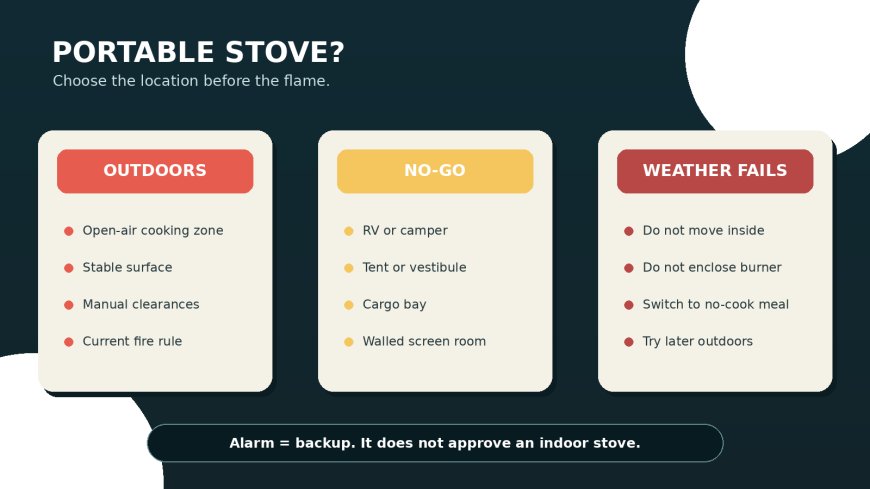
Quick answer: Set a portable fuel-burning stove in a genuinely open outdoor cooking area. Do not move it into the RV, tent, screen room, cargo bay or under a tightly enclosed canopy when weather turns. An RV's factory-installed range is a different appliance: use it only as its manufacturer directs, with its required ventilation and working alarms. A carbon-monoxide alarm is backup protection, not permission to bring outdoor equipment inside.[1][3]

Bad weather changes the meal, not the stove's label. Original RVCamping.info safety diagram.
This distinction matters because many camp stoves are compact enough to carry through the door. Portability says nothing about indoor approval. Fuel, combustion, enclosure and the exact instruction manual decide where an appliance belongs.
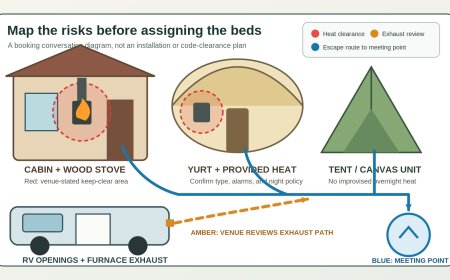
Treat "portable" and "installed" as separate lanes
A portable stove normally travels loose, connects to a small cylinder or fuel bottle, and is sold for outdoor cooking. The RV range is installed as part of the coach and has its own clearances, ventilation requirements and operating instructions. Do not borrow the RV range's location to justify using a camp stove on the dinette.
CPSC's consumer guidance says portable fuel-burning camping equipment does not belong in a vehicle or tent unless the product was specifically designed for an enclosed space and supplies instructions for that use.[3] CDC is more direct for portable camping stoves: keep them out of campers and tents.[1]
Use a label-and-manual test before lighting anything:
- Find the model label and instructions for the exact stove.
- Confirm the stated use location. "Outdoor use" is a boundary, not a suggestion.
- Check fuel type, cylinder position, clearances and lighting sequence.
- If the manual is missing or the stove's identity is uncertain, do not improvise an indoor setup.
An open window cannot rewrite an outdoor-use label. Neither can a powered roof fan.
Carbon monoxide gives no useful kitchen warning
Carbon monoxide has no color or odor that people can reliably notice. Early exposure can resemble flu without fever, including headache, tiredness, nausea and dizziness. Higher exposure can bring confusion, vomiting, loss of coordination, unconsciousness and death.[1][3]
That is why "it smells fine" is not a test. Flame color is not a room-air measurement, either. A person who is asleep or has consumed alcohol may not recognize symptoms before the exposure becomes fatal.[1]
If a CO alarm sounds, or anyone develops compatible symptoms while fuel-burning equipment is operating, move everyone into fresh air immediately and call emergency services from outside. Do not stay inside to diagnose the stove or silence the alarm. CPSC advises leaving for fresh air and contacting the fire department and a medical professional when CO poisoning is suspected.[3]
A detector is the last layer, not the first
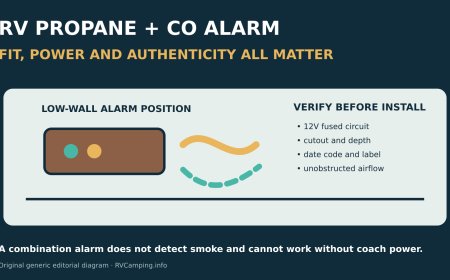
A working RV carbon-monoxide alarm belongs in the safety plan, but CPSC says an alarm does not replace correct installation, use and maintenance of fuel-burning appliances.[3] The alarm can warn of a failure or another nearby source. It is not a clearance certificate for a portable stove.
Before a trip:
- test each installed alarm by the maker's procedure;
- check its replacement date and power source;
- keep vents and alarm openings uncovered;
- review the exit path with everyone sleeping in the RV;
- replace an expired or damaged unit before using fuel-burning appliances.
The test button checks the alarm circuit, not the accuracy of the sensing element, according to CPSC. Follow the product's replacement schedule rather than assuming a successful beep means the sensor lasts forever.[3]
Build an outdoor cooking spot that is actually outdoors
NPS recommends learning a new camp stove before the trip and checking for damaged parts rather than discovering a problem at mealtime.[4] At the campsite, choose a stable outdoor location allowed by the current fire rules.
A practical RV setup has four boundaries:
- Open air: Keep the stove beyond the RV, tent and screen enclosure. Do not cook in a storage bay or beneath an awning with walls attached.
- Clear route: Place the stove where people do not have to step over a fuel hose, hot pot or open flame to reach the RV door.
- Combustible clearance: Follow the stove manual for distance from the RV wall, awning fabric, dry grass, picnic gear and other materials that can burn.
- Stable work surface: Use the surface and stand the manufacturer allows. Level the stove before adding a pot, and keep the fuel container in its specified orientation.
This is not a universal distance chart. Stove designs and campground rules differ. The exact manual and local fire order control.
Keep children and pets out of the hot zone. Have pot grips and the serving surface ready before ignition so a cook is not carrying a hot pan through the RV doorway while looking for space.
Rain, wind and wildfire restrictions can cancel the stove plan
Bad weather creates pressure to move cooking under cover. Make the alternate meal decision before that happens.
A canopy without sidewalls may provide rain cover only if the stove maker permits that configuration, required clearances remain intact and wind cannot drive heat toward fabric or the RV. A screened shelter, zipped awning room or tent vestibule is still an enclosure. If the only workable location is enclosed, do not light the portable stove.
Wind can destabilize cookware, extinguish a flame or push heat into nearby material. Do not build a homemade wind wall that surrounds the burner or traps exhaust. Use only the windscreen configuration permitted by the manual.
Campground fire restrictions may separately prohibit or limit stoves, charcoal and open flame. NPS tells campers to check local rules before choosing their cooking method.[4] A stove that is safe for outdoor use is not automatically legal during a restriction.
Pack one no-flame meal that needs no heating. It turns an unsafe weather improvisation into a simple menu change.
Do not use the RV oven as a space heater
Cold mornings produce a second shortcut: lighting the installed range or oven for warmth. CDC warns against heating living space with a gas range or oven.[1] Cooking appliances should do their assigned cooking job, under their operating instructions.
If the RV heating system fails, fix the heating problem or relocate. Do not repurpose a stove, grill or charcoal device. CPSC reports deaths associated with camping equipment used in enclosed areas and warns that altitude can increase the hazard.[2]
Use a two-minute pre-light check
Before every outdoor cook:
- PLACE: Is the portable stove fully outside every RV, tent, bay and walled shelter?
- LABEL: Does the exact manual permit this setup, fuel and surface?
- FIRE RULE: Are stoves allowed here today?
- CLEARANCE: Are fabric, dry vegetation, vehicles and traffic outside the required zone?
- FUEL: Is the connector undamaged and the cylinder or bottle positioned as directed?
- WEATHER: Can the stove and pot stay stable without enclosing the burner?
- EXIT: Can people enter and leave the RV without crossing the cooking area?
- BACKUP: If any answer fails, is the no-cook meal ready?
Keep the rule uncomplicated: outdoor portable stove, outdoor cooking area. The installed RV range follows its own manual. When weather removes the outdoor option, change dinner rather than changing where the stove is allowed to burn.
Evidence note: CDC and CPSC supply the enclosure, CO symptom, response and alarm guidance. NPS supplies the practice-before-travel and local-rule checks. The portable-versus-installed appliance split, campsite layout and pre-light card are original RVCamping.info planning tools.
Sources
- CDC: What to Do to Protect Yourself During a Power Outage — portable camp-stove and charcoal enclosure warnings, CO symptoms and emergency response (retrieved October 20, 2026).
- CPSC: Portable Heaters & Camping Equipment — camping-equipment CO hazard, enclosed sleeping areas, altitude and symptom guidance (retrieved October 20, 2026).
- CPSC: Carbon Monoxide Questions and Answers — equipment instructions, indoor-use boundary, alarms, symptoms and fresh-air response (retrieved October 20, 2026).
- National Park Service: Cooking in Camp — practice with a new stove, inspect equipment and verify local cooking rules (retrieved October 20, 2026).
What's Your Reaction?