



Badlands RV camping: Cedar Pass vs. Sage Creek
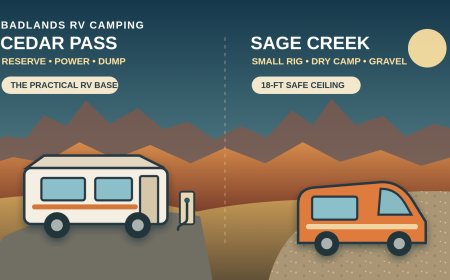
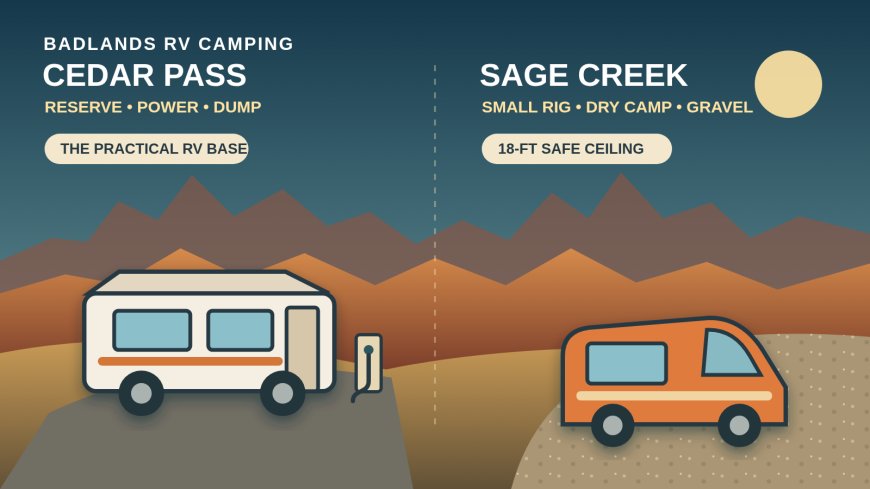
Cedar Pass is the practical reservable RV base; Sage Creek is a no-water, no-generator primitive option reached by a weather-sensitive gravel road.

Badlands RV camping: Cedar Pass vs. Sage Creek
By Romana | Updated September 25, 2026
Cedar Pass is the practical choice for most RV visits to Badlands National Park. It is reservable, reached by paved park roads, includes electric and nonelectric RV inventory, and has a dump station. Sage Creek is free and first-come, but it has no water, bans generators, and sits on a gravel road that can close after heavy rain or snow.[1][2][3][4]
Short answer: Choose Cedar Pass if you need a reservation, an electric-site option, tank service, or space for anything larger than a compact RV. Choose Sage Creek only if your entire camping vehicle fits the park's conservative 18-foot visitor-page limit, you can dry camp without a generator, and you have a fallback if the road closes or all 22 sites fill.[1][3][4]
Cedar Pass vs. Sage Creek at a glance
| Decision point | Cedar Pass Campground | Sage Creek Campground |
|---|---|---|
| Booking | Reservation required; use live Recreation.gov inventory. [1][2][4] | Free, first-come, first-served; no reservation. [1][4] |
| RV fit | RV electric and nonelectric sites are listed; match the exact site to the exact equipment. [2] | Plan to the stricter published limit: 18 feet or less. Two NPS pages conflict by one foot. [1][4] |
| Road | Paved Highway 240/Badlands Loop Road and Highway 377. [2][3] | Gravel Sage Creek Rim Road may close after heavy rain or snow. [1][3] |
| Power | Electric and nonelectric RV site types appear in booking inventory. [2] | No hookups; generators prohibited. [1][4] |
| Water and waste | Complimentary dump station in Group Loop; verify current water, shower, and restroom operation. | No water; pit/vault toilets and covered picnic tables. [1] |
| Best for | A planned stay, conventional RV, or travelers wanting electrical and dump options. | A genuinely small rig with enough battery and water for primitive camping. |
The table is a screening tool, not a fit guarantee. Measure the RV body, permanently mounted rear gear, and any connected tow vehicle. Recreation.gov says one RV, tow included, is allowed per Cedar Pass RV site, so a campsite match must account for the whole setup rather than a brochure length alone.[2]
Why Cedar Pass works for more RV trips
Cedar Pass has 96 sites and is near the Ben Reifel Visitor Center. The National Park Service identifies Cedar Pass Lodge as the campground manager and directs reservation questions to Recreation.gov.[1] The live reservation page currently describes the campground as seasonal, from late March through mid-October, and lists both electric and nonelectric RV sites.[2]
That seasonal wording matters. The broader NPS campground page calls Cedar Pass open year-round with limited winter availability, while Recreation.gov gives the narrower late-March-to-mid-October season.[1][2] Do not build a shoulder-season trip around either sentence alone. Search live inventory for the exact dates and call the staffed location if the two official pages still disagree.
Cedar Pass also solves a tank-management problem that Sage Creek does not: Recreation.gov lists a complimentary dump station in the Group Loop.[2] That is a dump station, not a promise of water or sewer at every campsite. Likewise, an “RV electric” label confirms an electric site type but should not be expanded into an unsupported amperage or full-hookup claim. Read the selected campsite record before paying.
There is no single Cedar Pass maximum length in the official campground overview. Site records are equipment-specific, and some inventory is electric while other inventory is nonelectric.[2] Enter the real equipment type and length, then inspect the exact result. If towing, verify that the parking geometry works for the connected combination and any second vehicle; the official notice allows one RV, tow included, per RV site.[2]
Cedar Pass generator hours are another operational advantage. The 2026 superintendent's compendium permits generator use there only from 8 a.m. to 8 p.m.; quiet hours are 10 p.m. to 6 a.m.[4] Electric-site campers may not need a generator, but nonelectric-site campers must plan charging inside that daytime window.
Sage Creek is not simply the cheaper Cedar Pass
Sage Creek has 22 sites, no fee, and no reservation system.[1] Its setting and rules are intentionally primitive. NPS lists no water, provides pit or vault toilets and covered picnic tables, and prohibits generator use.[1][4] If batteries cannot carry the refrigerator, furnace fan, medical equipment, lights, and device charging through the stay, Sage Creek is the wrong choice.
The road is a real constraint, not scenery copy. Sage Creek Rim Road is gravel. NPS says it may close temporarily after heavy rain or snow, while the campground page specifically warns about closures after winter storms and spring rains.[1][3] A status page that shows no warning when research is done is not a forecast for arrival day. Check park alerts before leaving pavement, and do not treat a first-come site as your only legal overnight plan.
The 18-foot versus 19-foot conflict
Current official NPS material disagrees. The visitor-facing campground page sets the cutoff at 18 feet: an RV over that length is prohibited.[1] The superintendent's compendium approved April 28, 2026 prohibits those longer than 19 feet.[4]
Until the park reconciles that language, 18 feet is the defensible planning ceiling. A 19-foot rig may appear to fit the compendium but fail the public campground instruction. Owners near either number should call Badlands National Park and ask how overall length is measured, including fixed racks or boxes. This guide does not turn the one-foot discrepancy into permission.
Sage Creek's 18-foot screening limit also changes which “small” RVs qualify. Many Class B vans, small travel trailers, and truck campers become longer once ladders, bike racks, spare tires, or tow hardware are counted. Measure the travel configuration, not the empty body specification.
Service and rule checks before committing
- Search the exact dates. Cedar Pass's Recreation.gov page is the booking authority; a general season does not prove availability. [2]
- Match equipment, not just length. Select the actual RV type and inspect the named site's restrictions. [2]
- Treat electric as electric. Do not assume water or sewer at the campsite; the documented facility-level service is the dump station. [2]
- For Sage Creek, use 18 feet as the ceiling. That is the conservative answer to the current conflict. [1][4]
- Carry Sage Creek water in. NPS says none is available. [1]
- Plan without a generator at Sage Creek. The 2026 compendium prohibits it. [4]
- Check the road on travel day. Sage Creek Rim Road may close after heavy rain or snow. [3]
- Keep a fallback. First-come camping can fill, and weather can remove road access. [1][3]
Which campground should you choose?
Choose Cedar Pass for the normal RV trip: a reservable base inside the park, a choice between electric and nonelectric RV inventory, and access to a dump station.[1][2] It is the lower-risk option for larger rigs, but only a confirmed campsite record establishes fit.
Choose Sage Creek for a compact, self-contained rig when primitive camping is the goal rather than a compromise. You must be comfortable with no water, no generator, first-come uncertainty, and a weather-sensitive gravel approach.[1][3][4] Use 18 feet as the practical maximum until NPS resolves its conflicting language.
Editorial note: Official campground, road, rule, reservation, and concession pages were checked September 25, 2026. No firsthand stay, campsite measurement, or road inspection is claimed. Conditions and live inventory can change; confirm the selected campsite and park alerts before travel.
Sources
- Campgrounds — Badlands National Park — NPS campground count, services, first-come status, 18-foot visitor guidance, and road caveat. Accessed September 25, 2026.
- Cedar Pass Campground — Recreation.gov — official reservation inventory, seasonal description, site types, tow rule, dump station, and facility notices. Accessed September 25, 2026.
- Directions — Badlands National Park — paved Highway 240 description and Sage Creek Rim Road gravel/closure warning. Accessed September 25, 2026.
- 2026 Superintendent's Compendium — Badlands National Park — reservation rule, generator hours and prohibition, and conflicting 19-foot Sage Creek language. Approved April 28, 2026; accessed September 25, 2026.
- Cedar Pass Lodge — official concession contact and operating context; the current page focuses on lodging, dining, and the gift shop rather than campground booking. Accessed September 25, 2026.
What's Your Reaction?