









Hughes Power Watchdog PWD30-EPO review: smart protection for a 30-amp RV?
Research-based review of the portable Hughes Power Watchdog PWD30-EPO: automatic shutoff, Bluetooth monitoring, tradeoffs, setup and who should buy it.

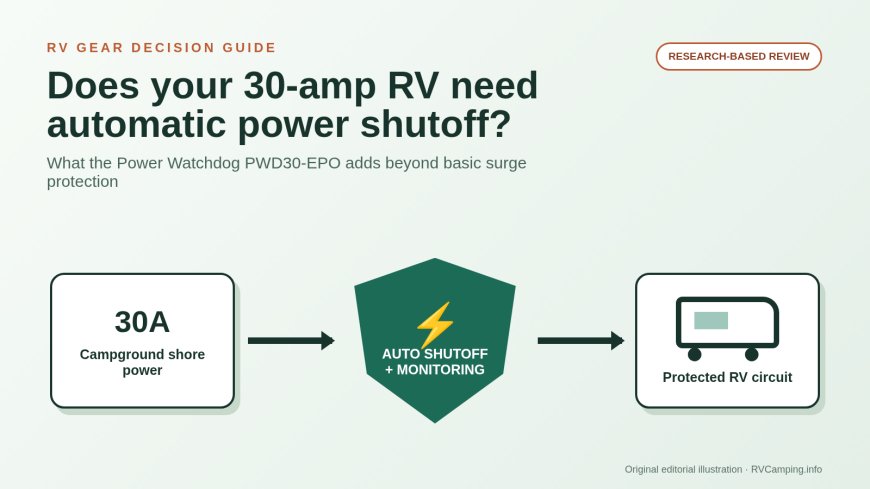
Summary: The portable Hughes Power Watchdog PWD30-EPO combines automatic power shutoff, campground-pedestal diagnostics, Bluetooth monitoring and a replaceable surge module. It is a strong fit for 30-amp RV owners who want more than a basic surge protector, but shoppers should understand its local-only Bluetooth connection, outdoor security needs and a specification discrepancy between current and older sources.
Affiliate disclosure: As an Amazon Associate, RVCamping.info earns from qualifying purchases. If you buy through an Amazon link in this article, we may earn a commission at no additional cost to you. This is a research-based editorial review; we did not physically test this unit.
Quick verdict
The portable Hughes Power Watchdog PWD30-EPO is worth considering if your RV has a 30-amp shore-power connection and you want a device that can disconnect the coach when incoming power becomes unsafe—not merely absorb a voltage spike.
Its most useful combination is automatic emergency power off, a 90-second restart delay after a fault clears, pedestal-wiring diagnostics and live voltage/amperage/wattage readings in a phone app. The replaceable surge module is also a meaningful ownership advantage: a spent module does not automatically turn the entire unit into electronic waste.[1]
It is less compelling for campers who only want inexpensive pedestal diagnostics, need 50-amp service, expect built-in internet monitoring or do not want a portable device hanging at the power pedestal.
Best for: 30-amp travel trailers and motorhomes whose owners want automatic power protection plus local power-use data.
Skip or compare alternatives if: your RV is 50 amp; you need native Wi-Fi; you prefer a permanently installed device; or you only need a basic wiring tester and surge suppressor.
Check the current PWD30-EPO listing on Amazon
What the PWD30-EPO actually does
A basic surge protector and an electrical management device are not the same purchase. The feature that matters here is the PWD30-EPO’s automatic disconnect.
Hughes says the portable 30-amp model disconnects the RV when voltage falls below 104 volts or rises above 132 volts. After conditions return to normal and remain stable for at least 90 seconds, it restores power automatically. The company also lists diagnostics and alerts for hazardous pedestal-power conditions.[1]
That makes this product more useful than a device that only indicates a wiring fault or clips a transient surge. A campsite can have low voltage during heavy demand without experiencing a dramatic one-time spike. Automatic cutoff is the feature intended to keep that unsafe supply from continuing into the RV.
The app displays voltage, amperage and wattage in real time. For a 30-amp rig, amperage monitoring can also help you learn which appliance combinations approach the service limit. Independent long-term users writing for RV.com described using the readings to understand appliance loads and reduce breaker-tripping guesswork.[2] That is an attributed owner experience, not a result of RVCamping.info testing.
Key specifications—and one number to verify
For the current Gen I portable product page, Hughes lists:
- 30-amp service
- Automatic shutoff below 104 volts or above 132 volts
- Automatic restart after at least 90 seconds of stable power following a fault
- 3,000 joules of surge protection
- IP65 water resistance
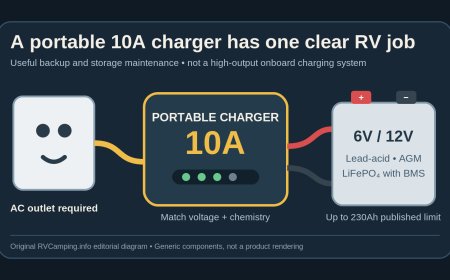
- Bluetooth monitoring through the free mobile app
- Replaceable surge/spike module
- Approximately 31 inches overall, including cables
- Body dimensions of about 11.5 × 5.5 × 3.75 inches
- Compatibility with dogbone adapters
- Limited lifetime warranty[1]
There is an important source discrepancy. Hughes’s current product page says 3,000 joules, while a detailed RV.com review published in 2022 reported 2,400 joules for the 30-amp EPO model.[1][2] Product generations and listings can change while model names remain similar. Before ordering, confirm the generation, model identifier and surge rating shown on the current Amazon listing, packaging and manufacturer documentation. The affiliate link in this article points to ASIN B07PRS5NPB, which Amazon identifies as a portable 30-amp Power Watchdog listing.[3]
This discrepancy is not a reason to reject the device, but it is a reason not to treat every PWD30-EPO page on the web as describing the same production version.
What we like
1. It can remove unsafe power automatically
The practical case for this unit is the EPO function. An alert is useful only if somebody sees it and can act. Automatic disconnection is designed to act even when you are asleep or away from the pedestal. The automatic restart also avoids a permanent outage after a temporary campground-power problem clears.[1]
2. The restart delay is air-conditioner-friendly
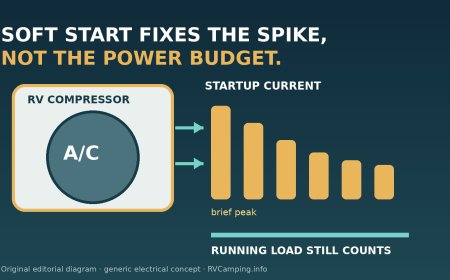
Hughes builds in a 90-second delay after a fault is resolved before it restores power. That pause is intended to protect appliances—particularly compressor equipment—from rapid power cycling.[1]
Do not confuse this with the initial connection check. Hughes advertises a roughly four-second analysis when first plugged into acceptable power. The longer delay follows a detected fault.[1]
3. The surge module is replaceable
Many surge devices are effectively disposable after their protective components are exhausted. Hughes sells a replacement module for this Gen I unit. The company says that even if the module is used up, EPO and Bluetooth can continue to operate—but surge protection will not return until the module is replaced.[1]
That warning matters: a unit that still passes power is not necessarily still providing surge protection. Check its status indication rather than assuming that “power on” means every protection function is intact.
4. The app turns power use into something visible
Watching voltage and current is not a substitute for correct wiring, breakers or electrical judgment. It can, however, make a 30-amp energy budget easier to understand. RV.com’s reviewers reported using the app to see the draw of different appliances and noted that the device reconnected when they returned to Bluetooth range.[2]
The tradeoffs
Bluetooth is not remote internet monitoring
The Gen I portable model uses Bluetooth. RV.com’s users characterized typical useful range as about 30 feet and noted that leaving Bluetooth range stopped phone alerts and live viewing, not the device’s underlying protection.[2]
Hughes points buyers to an optional RVWhisper add-on for Wi-Fi/cellular monitoring.[1] If “monitor my RV from anywhere” is a core requirement, include the cost and complexity of that add-on—or compare a current model with built-in Wi-Fi—rather than assuming the included app works across the internet.
A portable unit lives outside
The manufacturer gives the unit an IP65 water-resistance rating, but portable placement creates two practical issues: clearance and theft. Keep plug connections off standing water, follow the manufacturer’s orientation and connection instructions, and use the built-in security provision with a suitable cable lock if theft is a concern. “Water-resistant” does not mean submersible.
A hardwired model moves the equipment inside the RV and removes the pedestal-theft problem, but installation is more involved. Anyone uncomfortable working on an RV’s 120-volt electrical system should use a qualified RV technician or electrician.
It must match the RV’s service
This article covers the 30-amp portable model. A 50-amp RV needs the corresponding 50-amp protection strategy. A dogbone adapter changes plug compatibility; it does not create additional available amperage. When connected through a lower-amperage source, manage loads to the source and adapter limits.[1][2]
It does not make a bad pedestal safe to use
Automatic protection is a last line of defense, not permission to ignore heat, damage, loose receptacles or repeated faults. If the device reports a wiring or voltage problem, disconnect and involve campground staff. Do not repeatedly bypass or reset a hazardous source just to keep the RV powered.
Setup checklist for the first campsite
- Confirm that the unit and plug match your RV’s 30-amp, 120-volt shore-power service.
- With the pedestal breaker off, inspect the receptacle and both plugs for heat damage, looseness, discoloration or debris.
- Connect the Power Watchdog to the pedestal, then connect the RV shore cord to the unit.
- Secure the portable unit if theft is a concern, while keeping cords arranged to avoid strain and standing water.
- Turn on the pedestal breaker and let the device analyze the supply before loading the RV.
- Pair the app and verify that voltage and current readings appear.
- Learn the device’s status lights and fault indications before an alarm occurs.
- Run major appliances one at a time during your first monitoring session to understand their approximate current draw.
- If a fault appears, record the code and conditions; do not assume the campground pedestal is acceptable because it later reconnects.
- Periodically check whether surge protection remains active, especially after a storm or reported power event.
Who should buy it?
The PWD30-EPO makes the most sense for a camper who answers “yes” to all three questions:
- Is the RV’s shore-power service 30 amp?
- Do you want automatic disconnection for unsafe voltage or pedestal faults?
- Will you use live electrical data or value the replaceable surge module enough to justify paying more than a basic protector?
For that buyer, our research-based verdict is yes, shortlist it. Its automatic cutoff is the reason to buy; Bluetooth readings and the replaceable module are useful supporting features.
For occasional campers on a tight budget, a less expensive device may cover basic surge suppression and pedestal diagnostics, though it may not automatically disconnect for the same range of conditions. For full-timers who leave pets, batteries or temperature-sensitive equipment in the RV, native remote connectivity may be more important than this Gen I model’s local Bluetooth app.
Bottom line
The Hughes Power Watchdog PWD30-EPO is not just a phone-connected gadget. Its central value is automatic interruption of unsafe 30-amp shore power, followed by a delayed restart after conditions stabilize. Add a replaceable surge module and visible load data, and it becomes a well-rounded option for campers who want more protection and information than a basic pedestal tester provides.
The cautions are equally clear: verify the exact product generation and joule rating, budget for remote-monitoring hardware if you need off-site alerts, secure a portable unit outdoors and choose the model that matches your RV’s electrical service.
View the exact 30-amp portable listing on Amazon
Sources
- Hughes Autoformers / Power Watchdog — Gen I 30 Amp Surge Protector with Emergency Power Off, portable (accessed September 7, 2026).
- RV.com — “Hughes Autoformers Power Watchdog Bluetooth Portable Surge Protector Review” (published April 7, 2022; accessed September 7, 2026).
- Amazon — Power Watchdog portable 30-amp listing, ASIN B07PRS5NPB (accessed September 7, 2026). Product availability and listing details can change.
What's Your Reaction?