




Grand Canyon South Rim RV Camping: Developed Campground or Dispersed Site?
A rig-first guide to choosing Trailer Village, Mather, Tusayan-Montane or a legal Kaibab dispersed site, including current service cautions and route checks.

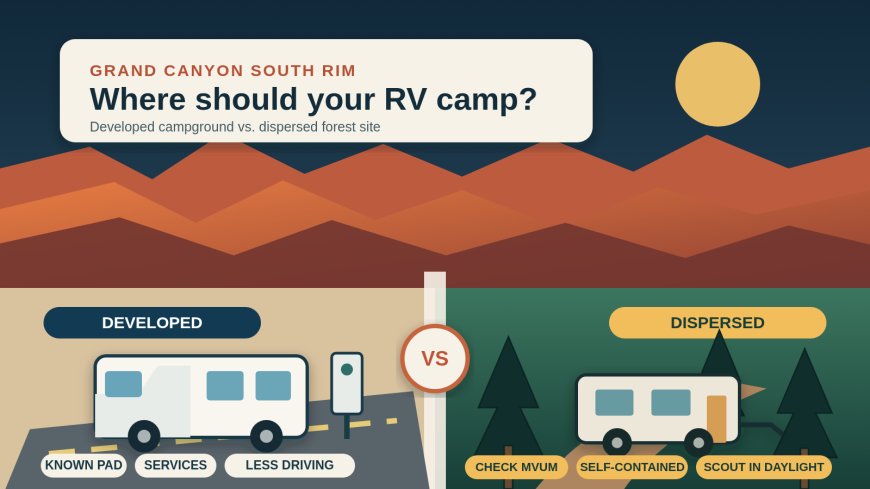
The best choice is not simply “paid versus free.” Choose a developed campground if your priority is predictable access, a known pad, waste handling and less daily driving. Choose dispersed camping in Kaibab National Forest if your RV is genuinely self-contained, you can evaluate an unpaved approach before committing, and you are willing to trade convenience for space and flexibility.
For many RV trips, the strongest answer is a split stay: use a developed site for arrival night or service day, then move to a verified legal forest site after filling water, emptying tanks and checking the latest road and fire notices.
Current-conditions note (September 8, 2026): The NPS fire page, last updated August 31, lists Stage 2 restrictions on the South Rim, Camper Services at Mather closed, Mather and Desert View campground spigots off, fires prohibited, and campground restrooms open.[9] The Kaibab National Forest alerts page displayed no forest fire restrictions when checked September 8, but that status can change independently of the park.[8] Recheck both agencies immediately before arrival.
The decision in one table
| Question | Developed campground | Kaibab dispersed camping |
|---|---|---|
| Site certainty | Reserved or assigned site with a defined parking area | First suitable legal site; no guarantee that a route, turn-around or level pad will fit |
| Utilities | Full hookups at Trailer Village under normal operations; Mather is the dry-camping option | No site utility pedestal, faucet, dump or trash pickup |
| Road exposure | Paved highway and campground circulation | Designated forest road, with surface and drainage conditions that can change |
| RV size | Published limits matter: Trailer Village describes paved pull-throughs for vehicles up to 50 feet[3] | The practical limit is the weakest turn, branch clearance, shoulder and turn-around—not an advertised maximum |
| Waste | Restrooms and managed trash; dump/fill access may be nearby when operational | Carry out garbage and store wastewater until a legal dump point is available |
| Campfire | Park or campground rules plus temporary restrictions | Forest rules, active orders and local restrictions all apply |
| Distance cost | Camp inside Grand Canyon Village or at a defined gateway campground | Every extra mile from pavement is repeated on sightseeing and service runs |
| Best for | Large rigs, first visits, short stays, medical power needs, late arrivals | Self-contained rigs, flexible schedules, daylight scouting and drivers comfortable reversing early |
What “developed” means around the South Rim
There are three useful developed-camping models, and they solve different RV problems.
Trailer Village: buy back utility margin
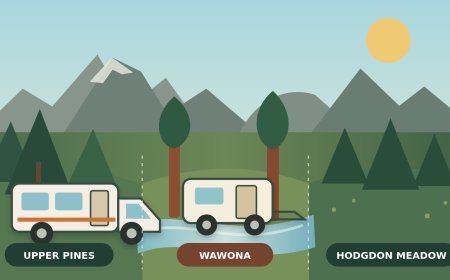
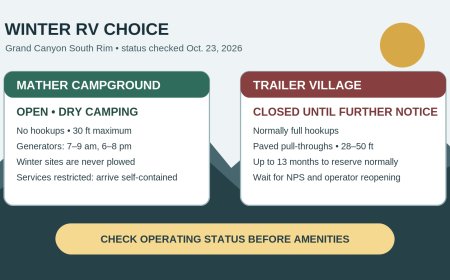
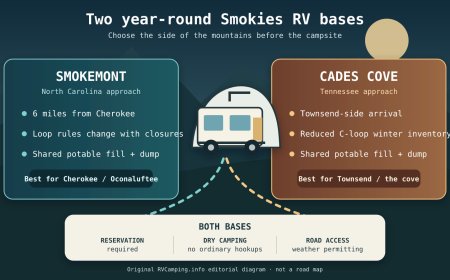
Trailer Village is the in-park choice for RVers who want an actual service pedestal. NPS describes it as the park’s only RV campground with sewer, water and electric hookups, including 30- and 50-amp service, with paved pull-through sites that can handle vehicles up to 50 feet.[3]
That is more than comfort. Hookups reduce generator dependence, conserve onboard water and remove the need to break camp for a dump run. A longer motorhome or fifth wheel also gets a known circulation pattern instead of testing a forest road with no safe place to turn around.
The tradeoff is cost and availability, and current utility emergencies can affect operations even at a developed property. Because the South Rim was under water-related restrictions at this article’s September 8 check, confirm Trailer Village’s operating status and the services included in the reservation before treating “full hookup” as a guaranteed arrival-day condition.[9]
Mather Campground: in-park location without hookups
Mather is in Grand Canyon Village and has 327 sites, flush toilets and drinking-water pumps as its normal campground design.[2] It is the middle choice: you get an organized site and park transportation access, but you still need to manage battery capacity and holding tanks.
Its location changes the trip. NPS says Market Plaza is 0.2 mile from Mather and 0.3 mile from Trailer Village, and the Village shuttle connects the campgrounds with the Visitor Center and village services.[4] That can let a motorhome stay parked while the shuttle handles sightseeing—a meaningful reduction in repeated engine starts, parking searches and fuel use.
Do not confuse permanent amenities with today’s availability. On September 8, the park’s current fire page still showed Mather’s campground spigots off and Camper Services closed, although restrooms remained open.[9] Arrive with enough potable water for the posted condition, leave reserve capacity in the gray tank, and identify a backup dump/fill location before entering the park.
Tusayan-Montane: a buffer between park and forest camping
Tusayan-Montane, formerly Ten-X, is a Forest Service developed campground south of Tusayan. The NPS South Rim camping page describes it as two miles south of town, with no hookups or showers but pit toilets and cold-water faucets under normal published operations.[1]
This option is useful when you want a defined site and toilet but do not need electricity or sewer. It also gives a cautious driver a base from which to scout dispersed roads with a tow vehicle rather than dragging the whole combination into an unknown spur.
Check seasonal dates, water availability and reservation inventory at the official listing before driving there. A developed forest campground does not make neighboring ground legal for overflow: a standing Kaibab order prohibits dispersed camping on National Forest System land within one mile of developed campgrounds and cabins on the Tusayan and Williams districts, in the mapped areas identified by that order.[7]
What dispersed camping actually asks of an RV
“Dispersed” does not mean “park anywhere.” It means camping outside a developed campground while remaining inside the rules for the land unit, motorized route and temporary orders.
The NPS overview says at-large camping is allowed in the national forest outside the park, must be at least 0.25 mile from Highway 64, and may be subject to other restrictions.[1] The Forest Service MVUM page says its Motor Vehicle Use Map shows where motorized travel is legally designated and that driving on undesignated roads, trails or areas is prohibited.[5] Those two rules are filters, not a campsite recommendation.
A pin from a camping app can be stale, misplaced or suitable only for a van. Treat it as a lead. Confirm land ownership, the current Tusayan Ranger District MVUM, active alerts and any posted signs yourself.[5][8]
Road risk is the price that does not appear on the campsite listing
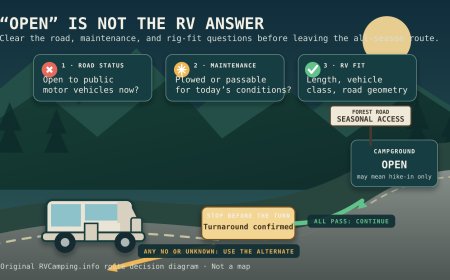
A forest road can be easy when dry and unusable for your rig after a storm. The important variables are not whether another reviewer called it “good,” but whether your exact combination can clear the route today.
Use a daylight entry plan:
- 1. Stop on pavement or at a proven staging area before airing down, unhitching or committing.
- 2. Walk the first questionable section and inspect ruts, crowns, soft shoulders, low branches and drainage crossings.
- 3. Identify a turn-around large enough for the entire combination before passing the last safe exit.
- 4. If towing, scout with the tow vehicle while the trailer remains somewhere legal and secure.
- 5. Turn back at the first condition that removes your recovery margin. Four-wheel drive does not improve trailer clearance or create a turning circle.
Rain matters even when the campsite itself looks firm. A shallow low point on the exit road can become the trip’s limiting feature, while clay or fine soil can lose traction quickly. Build enough food, water and holding-tank space to wait rather than drive out during a damaging or unsafe window.
Distance is a service multiplier
Compare camping options by repeated travel, not by the one-way distance shown on a map. If a dispersed site adds 12 miles each way to the Visitor Center and you enter the park on three days, that is 72 additional miles before any dump, water or grocery run. This example is planning arithmetic, not a claim about a particular forest road.
Developed camping inside the village may cost more per night but can replace those miles with shuttle trips. NPS warns that oversize parking is limited for RVs over 22 feet and vehicle-trailer combinations over 22 feet, and it advises arriving before 9:30 a.m. for the best chance at designated RV parking.[4] A dispersed camper who drives the motorhome into the park each morning has not escaped the large-vehicle parking problem; the campsite has merely moved it.
Motorhomes without a towed vehicle benefit most from an in-park campground. Travel trailers and truck campers can make dispersed camping work more easily because the camping unit can remain set while a smaller vehicle handles the park and service runs.
Permits and stay limits: use the rule for the correct jurisdiction
A Grand Canyon backcountry permit is not a pass to camp beside a forest road.[1] Park backcountry rules apply inside the national park; dispersed roadside camping south of the boundary is managed by Kaibab National Forest.[1][10]
For an ordinary personal camping trip, start with the MVUM and current forest orders rather than assuming a special-use authorization is needed. The Kaibab permit page calls out permits for activities such as outfitting and guiding, commercial filming, research, infrastructure, forest-product collection and organized groups of more than 75 people.[10] If your activity is commercial, organized, unusually large or more than simple personal camping, contact the Tusayan Ranger District before arrival.
Duration is explicit: the 2026 Kaibab order caps total occupancy at 14 days during a rolling 30-day window across the described National Forest System lands.[6] Moving a short distance does not reset that forest-wide 30-day clock.
Fire rules can differ across the boundary
Never carry a fire-status assumption from one jurisdiction to the other. At the September 8 check, Grand Canyon’s South Rim had Stage 2 restrictions tied to limited water for fire suppression, including no fires at Mather or Desert View.[9] The Kaibab alerts page simultaneously displayed no forest fire restrictions.[8]
That did not create an unconditional green light for dispersed campfires. The long-running developed-site buffer order separately prohibits camping and fire use in the mapped one-mile zones around developed sites on the Tusayan and Williams districts.[7] Posted restrictions, site-specific orders and basic fire safety still govern.
A propane stove with a shutoff is the lowest-impact cooking plan, but verify that the current restriction language allows it. Keep the stove on a stable, cleared surface and do not park a hot exhaust over dry grass. If a wood fire is legal, use an existing lawful location, keep water and a shovel ready, attend it continuously and leave only when it is cold to the touch.
Water, sewage and trash: dispersed camping moves the work into your RV
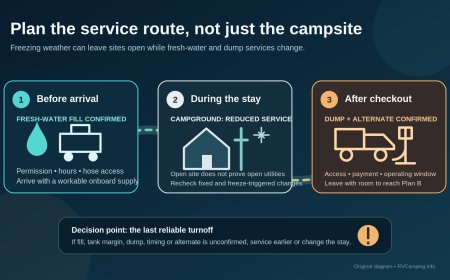
Developed campgrounds concentrate waste systems; dispersed camping makes you the system operator. Before leaving pavement, know:
- usable freshwater capacity after accounting for tank weight and daily consumption;
- black- and gray-tank capacity, not just their nominal labels;
- where the next legal dump and potable fill are operating;
- whether your route allows a dump run without surrendering the site or moving the whole rig;
- how every bag of trash will remain secured from wind and wildlife until removal.
Do not drain gray water merely because the site has no visible facility. Soap, food residue and pooled water create impacts and may violate local rules. Retain wastewater for an authorized dump unless the managing agency gives a specific, current instruction otherwise.
The present South Rim restriction makes contingency planning especially important. On September 8, NPS listed Mather’s normal Camper Services as closed and campground spigots off.[9] A dispersed camper should not arrive assuming a nearby park facility will provide the missing link in the water-and-waste plan.
A rig-first choice matrix
Choose Trailer Village first if you exceed Mather’s practical site envelope, require shore power, want sewer at the site, or cannot risk an unknown road. Confirm current utility status before departure.
Choose Mather first if your rig fits the reserved site, you can dry camp, and your main goal is reducing daily driving inside the park. Under current restrictions, prepare for the posted water and Camper Services limitations.
Choose Tusayan-Montane first if you want a defined Forest Service campsite and basic campground structure while remaining outside the park. Verify the current season and services.
Choose dispersed camping first if all of these are true: the MVUM and signs support your chosen access, the site lies outside restricted buffers, road and weather conditions fit your exact rig, you arrive in daylight, and you can leave with every gallon of wastewater and every piece of trash.
Use a split stay if you are uncertain. A first night in a developed site provides time to fill, dump, review maps and scout. The modest relocation can prevent the expensive version of “free”—body damage, recovery charges, a flooded road or a holding tank that fills before the trip ends.
Before turning off Highway 64
- Download the current Tusayan Ranger District MVUM for offline use.[5]
- Check the Kaibab alerts page and Grand Canyon fire/operations pages on the same day.[8][9]
- Confirm that the prospective area is at least 0.25 mile from Highway 64 and outside any mapped one-mile developed-site closure zone.[1][7]
- Verify your developed reservation’s actual pad length, hookup status and operating services.
- Fill potable water and empty both waste tanks at a confirmed operating facility.
- Save the ranger district phone number and an offline map.
- Share your road number and expected return time with someone not traveling with you.
- Scout in daylight and preserve an exit margin for rain.
The right South Rim base is the one that leaves enough capacity for the canyon itself. A service-rich site buys time and certainty. A legal dispersed site buys room and flexibility. Price both in miles, tank space, road exposure and recovery options—not only the nightly fee.
Source credit
This independent RVCamping.info guide was researched from current National Park Service and U.S. Forest Service campground, RV-access, map, permit, order and alert materials. The comparison, decision matrix, repeated-distance method and rig-planning recommendations are original editorial analysis.
Sources
[2] Mather Campground - South Rim
[3] Trailer Village RV Campground - South Rim
[4] Visiting the South Rim in an RV or Pulling a Trailer
[5] Kaibab National Forest Visitor Maps and Guides
[6] 14-Day Camping Limit in a Consecutive 30-Day Period
[7] Camping/Campfire Closure within Proximity to Developed Sites
[8] Kaibab National Forest Alerts
What's Your Reaction?