






The slow cooker is a holder, not a reheater: soup service in an RV
Reheat soup to 165°F before a preheated slow cooker, verify 140°F holding, branch correctly on lost power, and cool leftovers fast in an RV.

The slow cooker is a holder, not a reheater: soup service in an RV
By Romana | October 23, 2026 | Cooking
A cold tub of chowder and a slow cooker can look like an easy campsite dinner plan. It is the wrong handoff. USDA says to use a stove, microwave or conventional oven to bring leftovers to 165°F before transferring them into a preheated slow cooker. The cooker’s job after that is to hold the soup at 140°F or warmer.[1]
That distinction matters in an RV, where a low-voltage pedestal or tripped breaker can stop the holder without much warning. Treat the meal as three deliberate moves: reheat quickly, hold with a thermometer, then divide what remains while there is still room to cool it.

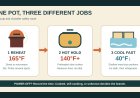
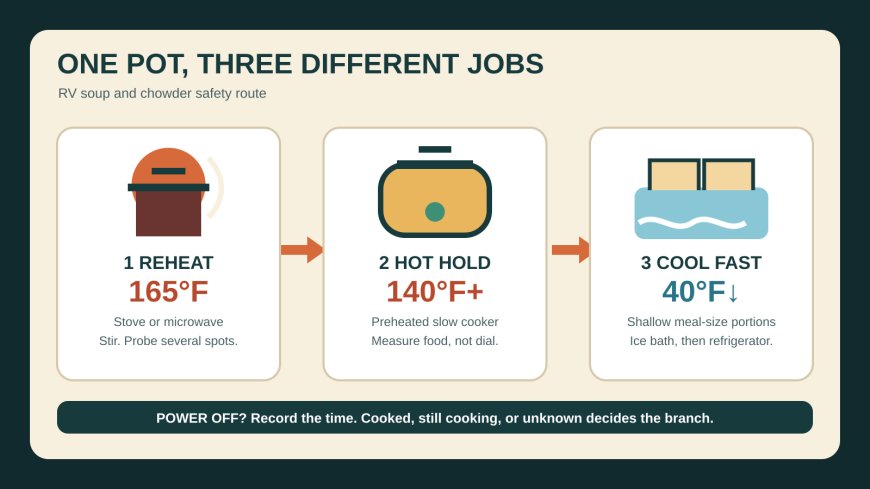
The slow cooker begins at the holding stage. Leftovers move out in shallow portions, not in the full crock. Original RVCamping.info diagram.
Reheat before the crock
Start with leftovers that have a known cold-storage history. Keep the soup in the refrigerator until the stove or microwave is ready, and heat only the amount that will be served. USDA’s slow-cooker guidance rejects reheating leftovers in the cooker and calls for 165°F before transfer to a preheated unit.[1] FDA also lists 165°F for leftovers and casseroles.[3]
For soup or chowder on an RV burner, use a pot with enough headroom to stir without sloshing. Scrape the bottom, fold the cooler center toward the sides and take readings in several locations with a cleaned food thermometer. Thick chowder can bubble around the edge while a potato-heavy center remains cooler. Reach 165°F throughout, then move the soup directly into the preheated slow cooker.[1][3]
Do not pour cold leftovers into a warm crock and wait for the dial to finish the job. A “low” or “warm” label reports a setting, not the food temperature. The safe sequence is easy to audit: cold storage → rapid reheat to 165°F → measured hot hold at 140°F or warmer.[1][4]
Hold the food, not the setting
Once the reheated soup is in the cooker, stir it and probe away from the crock wall. USDA says the holding temperature is at least 140°F, measured with a food thermometer. CDC likewise tells consumers to keep cooked food at 140°F or hotter, or at 40°F or colder.[1][4]
Leave the lid on between servings. Every opening lets heat escape, especially from a half-full cooker in cool outdoor air. A practical campsite log can be short:
- IN: time the 165°F soup entered the preheated crock;
- HOLD: food temperature at the first check and later checks;
- OFF: time heat stopped, whether by choice or by power loss;
- COOL: time the leftovers were divided and refrigerated.
The labels are an RVCamping.info handoff tool, not a federal form. Their purpose is to stop one person from assuming someone else checked the pot.
If the cooker cannot keep the soup at 140°F, stop treating it as a hot holder. Serve promptly within a documented time limit, move immediately into the cooling plan, or discard when the history is missing. Do not keep cycling the dial and hoping the next reading improves.
If the power drops, identify which event happened
A slow-cooker interruption has a narrower decision than an RV refrigerator outage. The October 22 refrigerator guide dealt with a closed cold appliance and a four-hour cabinet window. This decision concerns one cooker and depends first on whether the food had finished cooking.
USDA gives three branches:[1]
- Nobody was present through the cooking period. If the power went out, discard the food even if it looks done. There is no reliable cooking history to reconstruct.
- Someone was present and the ingredients were still cooking. Finish cooking immediately by another safe method, such as a working gas stove. Follow the RV appliance instructions and do not move an outdoor grill or camp stove inside.
- Someone was present and the food was completely cooked before power failed. USDA allows up to two hours after the outage for the cooked food left in the unpowered crock.[1]
That last branch is not a new two-hour allowance after several uncertain periods. Write the outage time at once. If you cannot prove that the soup was completely cooked before the failure, use the unfinished-cooking branch rather than the finished-food allowance. If nobody knows when power stopped, discard it.
A thermometer reading helps with the current state but does not recreate the missing timeline. Nor does bringing a questionable pot back to a boil. Reheating belongs to properly handled food; it is not a reset for an unknown outage.
Empty the crock into a cooling plan
The slow-cooker insert is deep and heavy. It is useful for holding, but it is a poor shape for removing heat from a large leftover volume. USDA directs consumers to use shallow covered containers and refrigerate leftovers within two hours after cooking finishes. Its general leftovers guidance starts that same clock when food leaves an appliance that was keeping it warm.[1][2]
CDC uses the same trigger: refrigerate within two hours of cooking or after removing food from an appliance that held it safely, with a one-hour limit when the food is exposed to temperatures hotter than 90°F.[4] FDA likewise calls for shallow containers. Its refrigeration deadline is two hours in ordinary conditions and only one hour when the outdoor temperature exceeds 90°F.[3]
Set up the cooling space before shutting off the cooker:
- Clear one refrigerator shelf and verify the appliance is at 40°F or below.
- Put several clean, shallow containers beside the crock. Use meal-size portions so the center of each container has a short path to a cold surface.
- Start the OFF clock when active hot holding ends. Ladle promptly; do not leave the crock on the table while everyone debates portions.
- If the compact refrigerator would be hit with too much heat, set the shallow containers in a clean ice-water bath. Keep bath water below the rims and stir the soup with a clean utensil.
- Refrigerate within the applicable one- or two-hour consumer limit. Leave space around the containers rather than stacking them hot.[1][3][4]
Hot food may go into the refrigerator in small portions; waiting for a deep pot to reach room temperature wastes the clock. FDA’s consumer guidance specifically calls for dividing large quantities among shallow containers so they cool faster.[3]
If the RV refrigerator cannot hold 40°F after the warm containers arrive, use a thermometer-equipped cooler with enough ice as controlled cold storage or keep fewer leftovers. A full crock should not dictate a storage plan that the RV cannot support.
The one-card version
Tape this beside the cooker:
- REHEAT elsewhere: 165°F throughout.[1][3][4]
- TRANSFER hot: preheated slow cooker.
- HOLD measured: 140°F or warmer.[1][4]
- POWER OFF: identify cooked, still cooking or unknown; start the clock.[1]
- COOL shallow: refrigerate before two hours elapse; use the one-hour deadline above 90°F.[1][3][4]
The card keeps the appliance roles separate. The stove or microwave reheats. The slow cooker holds. Shallow containers cool. In a small RV kitchen, asking one deep crock to do all three jobs is how the clock disappears.
Evidence note: USDA FSIS supplies the slow-cooker reheating, holding and power-interruption branches. USDA FSIS, FDA and CDC supply the consumer cooling, time and temperature limits. The four-entry log and one-card sequence are original RVCamping.info planning tools.
Sources
- Slow Cookers and Food Safety — USDA Food Safety and Inspection Service — reheating, 165°F transfer, 140°F holding and slow-cooker power-loss branches; archived USDA publication retained locally (reviewed October 23, 2026).
- Leftovers and Food Safety — USDA Food Safety and Inspection Service — shallow-container cooling and the clock after warm holding ends (reviewed October 23, 2026).
- Safe Food Handling — U.S. Food and Drug Administration — 165°F leftovers, shallow containers and prompt refrigeration (official page archived October 23, 2026).
- Preventing C. perfringens Food Poisoning — Centers for Disease Control and Prevention — 140°F hot holding, 40°F cold holding, 165°F reheating and prompt refrigeration (official page evidence reviewed October 23, 2026).
What's Your Reaction?