

















Can your RV safely handle a whole turkey? Run the cold-space test first
A four-gate RV turkey plan checks cold-space capacity, a complete thaw method, 165°F readings in three locations and room for shallow leftovers.

Can your RV safely handle a whole turkey? Run the cold-space test first
By Romana | October 18, 2026 | Cooking
A whole turkey can fit in an RV oven and still be the wrong campsite meal. The harder question is whether the refrigerator can hold the bird through a multi-day thaw, keep drips away from ready-to-eat food, and accept carved leftovers while they are still on the two-hour clock. Treat cold space as part of the recipe, not as cleanup after dinner.
Quick answer: Before buying the bird, reserve one cold zone for thawing and a second, later configuration for shallow containers of carved meat, stuffing and gravy. Thaw in a refrigerator at 40°F or below when the RV can hold that temperature and contain leaks. Cold-water and microwave thawing are safe alternatives only when their full procedure can be followed and cooking starts immediately. Cook whole poultry to 165°F, checking the innermost thigh and wing and the thickest breast. Carve promptly, portion leftovers into shallow containers and refrigerate them within two hours, or one hour above 90°F.[1][2][3]

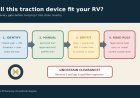
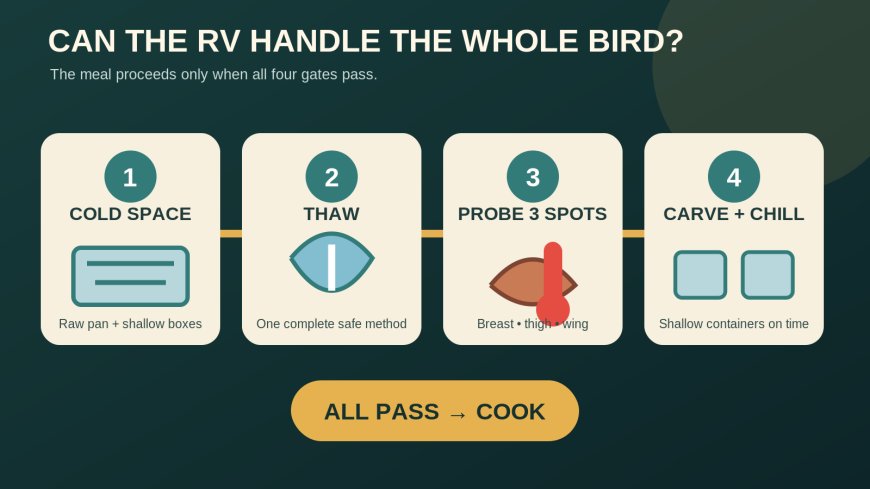
The meal goes ahead only when the RV can pass all four gates. Original RVCamping.info diagram.
Gate 1: reserve the refrigerator twice
A campsite turkey uses the same cold compartment in two very different shapes. Before cooking, it needs room for a bulky raw bird in a leak-catching pan. After dinner, it needs room for several shallow covered containers. A shelf that can hold the wrapped turkey may not have enough open area for quick-cooling leftovers.
Make both layouts before shopping:
- Measure the clear shelf width, depth and height with the door closed.
- Choose a rimmed pan or food-safe container that can hold the bird and any leaking juices.
- Keep that raw-turkey zone below produce, drinks and foods that will not be cooked.
- Set the empty leftover containers in the refrigerator as a second test. They should sit in a single shallow layer with room for cold air to move.
- Confirm the compartment with an appliance thermometer at 40°F or below.[1][3]
This is the decision point that makes the article different from a generic turkey timetable. If both layouts do not work, change the menu before the package is opened. A smaller turkey breast or poultry parts are easier to thaw, cook, measure and cool in a compact RV. A cooler can carry beverages and unopened shelf-stable items to free refrigerator space, but it should not become unmeasured overflow for a raw bird or leftovers.
Do not count on outdoor air as refrigeration. Sun, daytime warming and wildlife make a picnic table, truck bed or unmonitored storage compartment a poor cold room. USDA says frozen turkey should not be left where temperature cannot be constantly monitored.[1]
Gate 2: choose a thaw that the campsite can actually finish
USDA recognizes three safe thawing methods: refrigerator, cold water and microwave. Counter thawing is not one of them. The outside of a turkey can enter the 40°F-to-140°F danger zone while the center remains frozen.[1]
Refrigerator thawing needs days and dependable power
Allow about 24 hours for every 4 to 5 pounds in a refrigerator at 40°F or below. USDA's planning ranges are 1 to 3 days for 4 to 12 pounds, 3 to 4 days for 12 to 16 pounds, 4 to 5 days for 16 to 20 pounds, and 5 to 6 days for 20 to 24 pounds. Keep the bird in a container that catches juices. After refrigerator thawing, USDA allows another one or two days before cooking.[1]
For an RV, that schedule is a refrigeration commitment. Account for travel days, shore-power changes, propane supply or battery limitations according to the refrigerator manufacturer's instructions. Record the refrigerator temperature at least morning and evening and after a long door-opening session. If the appliance cannot reliably hold 40°F or below through the planned thaw, do not start a several-day refrigerator thaw in it.
Cold-water thawing needs attention, potable cold water and an immediate cook
USDA's cold-water method allows about 30 minutes per pound. The turkey stays in a leak-proof bag, submerged in cold tap water, and the water is changed every 30 minutes. Cooking must begin immediately after thawing.[1]
That can be a poor match for a dry campsite. A 16-pound bird may need 8 hours of repeated water changes, a clean basin large enough to keep it submerged, and a safe route for wastewater. Do not use warm water, cooler meltwater of uncertain cleanliness or a creek. If the campsite cannot support the complete method, it cannot support this thaw.
Microwave thawing is limited by appliance size
Follow the microwave manufacturer's instructions for bird size, power and time. USDA says to cook immediately because parts of the turkey may warm and begin cooking during defrosting.[1] Many RV microwaves cannot accept a whole bird with adequate clearance. Check the manual and physical fit while the turkey is still frozen; never force an oversized package onto a turntable.
Gate 3: match the bird, pan and cooking method
For oven roasting, USDA says to set the oven no lower than 325°F and to use a shallow roasting pan. Its published cooking times assume a fresh or completely thawed bird held at 40°F or below. Pan depth, oven accuracy, stuffing, a partly frozen center and a bird that blocks heat circulation can all change the time.[2]
An RV oven adds a fit problem. With the oven cold, place the empty pan and rack inside. Confirm that the door closes, the pan does not touch heating surfaces, and air can circulate as the appliance manual requires. A successful cold fit does not authorize a pan or cooking method that the oven manufacturer prohibits.
Cook stuffing in a separate casserole when possible. USDA calls that the optimum safety approach. If the bird is stuffed, mix and insert the stuffing immediately before cooking and verify 165°F in its center as well as in the turkey.[2]
Do not rinse raw poultry. Keep its wrapper, juices, tools and pan away from salad ingredients, bread and serving dishes. Wash hands and clean food-contact surfaces after handling the raw bird.
Gate 4: use the thermometer map, not the clock alone
Roasting tables help with meal timing; they do not decide doneness. USDA requires a minimum internal temperature of 165°F and directs cooks to check three places on a whole turkey:
- the thickest part of the breast;
- the innermost part of the thigh;
- the innermost part of the wing.[2]
Keep the probe away from bone. Check each location rather than stopping after the first 165°F reading. If any required point is below 165°F, continue cooking and recheck. A pop-up indicator does not replace these readings.[2]
Use a thermometer suited to the thickness of the food and follow its instructions for insertion depth and cleaning. If the RV oven has obvious hot and cool zones, rotate the pan only when the appliance instructions permit it and when doing so can be done without spilling hot fat.
USDA suggests a 20-minute stand before carving for quality. That rest is not a license to leave the meal on the table for the afternoon.[2] Start the leftover clock when food leaves active temperature control, not when the last person finishes eating.
Convert the refrigerator from raw zone to leftover zone
The safest leftover plan starts before dinner. Clear the reserved shelf. Put the shallow containers, lids and labels within reach. Decide which dishes will be saved and how much can fit without stacking warm containers tightly together.
USDA advises cutting cooked turkey into smaller pieces, slicing breast meat, and refrigerating legs and wings whole if desired. Stuffing should come out of the cavity. Turkey, gravy and side dishes should go into shallow containers for faster cooling. Perishable food must be refrigerated or frozen within two hours; use the one-hour limit when the temperature is above 90°F.[3]
Do not place the whole cooked bird in a small refrigerator and assume the center will cool in time. Do not fill one deep stockpot with meat and gravy. The leftover configuration you tested at Gate 1 is the landing zone.
If the refrigerator has space for only part of the meal, choose what to save before the clock runs out. Freezing is useful only if the freezer can freeze the portions and remain within its operating instructions. An ice chest is an alternative only when it has enough clean ice or frozen packs, an appliance thermometer, protected containers and a verified food zone at 40°F or below. Visible ice alone is not a temperature record.
Refrigerated cooked turkey, stuffing and gravy should be used within 3 to 4 days. Reheat leftovers to 165°F. USDA does not recommend reheating a whole turkey; smaller pieces heat more predictably.[3]
Stop conditions for the campsite cook
Change the meal rather than improvise if any of these is true:
- the raw bird and leak-catching pan will not fit below ready-to-eat food;
- the refrigerator cannot hold 40°F or below for the entire thaw;
- cold-water thawing cannot be attended with water changes every 30 minutes;
- the microwave or oven cannot safely fit the bird and cookware under its manual;
- there is no working food thermometer;
- the planned leftover containers do not fit before cooking begins;
- a temperature or time history is missing after a refrigeration problem.
A smaller cut is not a failed holiday. In an RV, it is often the version that gives the cook enough room to control thawing, measure doneness and cool leftovers on time.
The campsite turkey card
Write six lines on the meal plan:
- FIT RAW: bird in a leak-catching pan, low in a 40°F-or-below refrigerator.
- FIT COOK: pan and bird within the oven manufacturer's limits.
- THAW: complete one USDA method; no counter shortcut.
- PROBE: 165°F in breast, inner thigh and inner wing; stuffing also 165°F if used.
- CARVE: remove stuffing and divide meat into smaller portions.
- CHILL: shallow covered containers within two hours, or one hour above 90°F.
This framework treats refrigerator capacity as an ingredient. If the cold-space plan fails on paper, it will not improve when a hot turkey and six side dishes are waiting for a shelf.
Evidence note: USDA supplies the thawing methods and times, roasting and temperature guidance, and cooked-turkey handling limits. The two-layout cold-space test, four-gate structure and RV fit checks are original RVCamping.info planning tools.
Sources
- USDA FSIS: Turkey Basics — Safe Thawing — approved thawing methods, timing, temperature and leak-containment guidance (archived September 23, 2026; reviewed October 18, 2026).
- USDA FSIS: Turkey Basics — Safe Cooking — oven floor, thermometer locations, 165°F endpoint and stuffing guidance (archived September 23, 2026; reviewed October 18, 2026).
- USDA FSIS: Turkey Basics — Handling Cooked Dinners — carving, shallow-container, two-hour, storage and reheating guidance (archived September 23, 2026; reviewed October 18, 2026).
What's Your Reaction?