
















Vacuum-packed smoked fish in an RV cooler: use a label-state-discard card
Track vacuum-packed smoked seafood through frozen, thawing, opened and service states using its label, a thermometer and explicit discard triggers.

Vacuum-packed smoked fish in an RV cooler: use a label-state-discard card
By Romana | October 18, 2026 | Cooking
A flat packet of smoked salmon looks like ideal cooler food. The words on that packet may say otherwise. "Keep refrigerated," "keep frozen," a use-by date, thawing directions and instructions after opening describe different product states. In an RV, the safest system is to copy those directions onto the meal plan and tie each state to a measured temperature and a discard decision.
Quick answer: Read the package before it enters the cooler. Shelf-stable, refrigerated and frozen smoked seafood are not interchangeable. Follow the product's own storage, thawing and use-after-opening directions. Keep refrigerated smoked fish at 40°F or below unless its label sets a colder limit. For frozen reduced-oxygen seafood, FDA guidance supports keeping it frozen and thawing under refrigeration immediately before use when the package says so; Extension guidance for vacuum-packed fish may instead direct complete removal from the package before refrigerator thawing. Do not invent a universal pouch-opening rule: use the exact label. If the seal, temperature history, time-temperature indicator or instructions no longer support the product's state, discard it without tasting.[1][2][3]

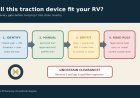
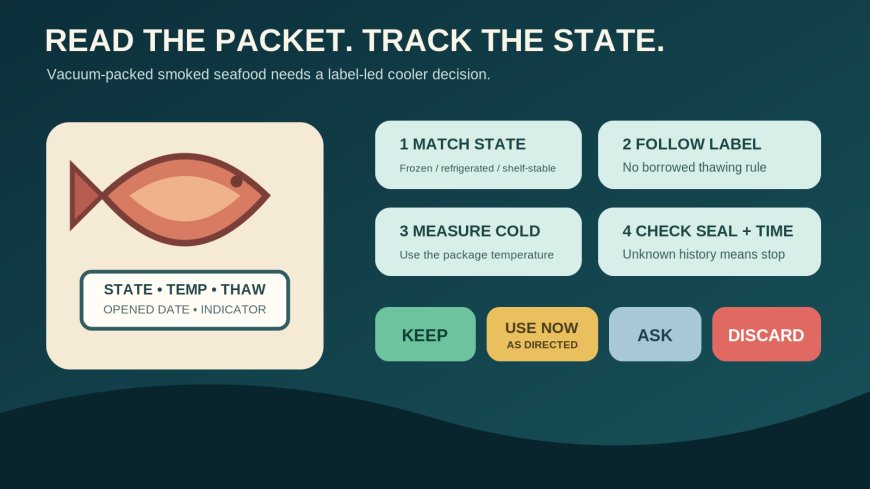
The package state chooses the lane; the thermometer and label decide whether it stays. Original RVCamping.info diagram.
Start with three states, not one category
"Smoked fish" can mean products with very different storage controls. Sort the package before packing it:
- Shelf-stable unopened: the label explicitly permits room-temperature storage. Keep it dry and follow the package after opening.
- Refrigerated: the label says to keep refrigerated. Give it measured cooler space at the stated temperature and honor the date and after-opening limits.
- Frozen: the label says to keep frozen. A cooler that merely keeps other foods below 40°F is not a freezer. Keep this product frozen until the directed thaw begins.
Do not infer shelf stability from smoke, salt, a tight vacuum or a foil pouch. FDA's consumer guidance distinguishes canned or shelf-stable smoked seafood from refrigerated smoked seafood.[2] The printed storage statement, not the package's appearance, establishes the lane.
Photograph the front, date code and handling panel before the package disappears under ice. Write the opening date and time directly on an outer bag or on the meal board. If an outer carton contains individually wrapped portions, retain the instructions until the last portion is used.
Why reduced oxygen changes the decision
Vacuum packaging is one form of reduced-oxygen packaging. FDA explains that suppressing aerobic spoilage organisms can allow Clostridium botulinum toxin to form before spoilage makes the food unacceptable. Certain non-proteolytic strains associated with fish can grow and form toxin at temperatures as low as 38°F, while smoked-fish controls depend on processing barriers plus strict refrigeration.[1]
That is why smell and appearance are not rescue tests. A package can look normal without proving that its process, seal and temperature controls remained intact. Cooking is not a general repair step either; FDA says not to rely on heating as the control for a potentially potent preformed toxin.[1]
FDA's processor guidance says refrigerated reduced-oxygen smoked and smoke-flavored fish should be held at or below 40°F. It also says frozen reduced-oxygen raw or unpasteurized cooked fishery products rely on freezing and should be labeled to stay frozen and to thaw under refrigeration immediately before use.[1] Those are broad safety principles. The consumer still follows the specific product label because formulation and processing differ.
Build a label-state card before departure
Copy five items from the package:
- State at purchase: shelf-stable, refrigerated or frozen.
- Storage ceiling: the exact temperature wording, including any limit colder than 40°F.
- Thaw instruction: in-package under refrigeration, remove before thawing, cook from frozen or another printed direction.
- Date rule: use-by, freeze-by and any period allowed after thawing or opening.
- Indicator rule: what the package says about a time-temperature indicator, if present.
Put the card in a zip bag on top of the cooler or save a photo where it works without cellular service. A generic note such as "salmon Friday" drops the facts needed for a discard decision.
If the package lacks directions you expected, do not borrow instructions from a different brand. Keep it in its purchased state and contact the manufacturer or retailer before using it. If the package cannot be identified or its required state was not maintained, discard it.
Give the packet a controlled cooler zone
FDA tells consumers to store seafood at 40°F or below and to use a refrigerator thermometer.[2] In a cooler, use an appliance thermometer in the food zone. Keep the smoked-fish packet in a clean watertight secondary container so meltwater, raw meat juices and abrasion cannot damage it.
Pack the container between cold sources rather than against the lid. Keep the cooler shaded, secured and closed. A separate drink cooler reduces door openings. Record the temperature at departure, arrival, before service and after heavy cooler use.
The 40°F ceiling is not permission to ignore a colder package limit. FDA notes that some reduced-oxygen raw fish products need controls below 38°F when refrigeration is the sole barrier.[1] A smoked product may have other validated barriers, but a camper cannot reverse-engineer those from taste or species. The label is the operational limit. Use the colder requirement whenever the package provides one.
A frozen package needs a genuinely frozen lane. Ice cubes and a 36°F thermometer reading show cold refrigeration, not proof that the fish remained frozen. If the label says "keep frozen," pack it in a freezer capable of that job or in a system designed and verified to maintain the product frozen. If it softens before the planned thaw and its history no longer matches the directions, stop.
Thaw by the packet's instruction
This is where two sound pieces of guidance can appear different because they address different products.
FDA's fishery guidance supports labeling frozen reduced-oxygen products to remain frozen and thaw under refrigeration immediately before use.[1] Penn State Extension tells consumers thawing fish in vacuum bags to remove fish before refrigerator thawing; for cold running water, it says to remove the fish from the bag immediately after thawing; for microwave thawing, remove it and cook immediately.[3]
The practical rule is narrow: do not apply one product's thawing method to every vacuum pouch.
- If the packet says to thaw under refrigeration immediately before use, keep it frozen until the planned thaw, use controlled refrigeration, and serve or prepare it within the label's time.
- If it says to remove the fish from the package before thawing, take it completely out, place it in a clean covered container and thaw it under refrigeration.
- If it says to open or vent before thawing, follow the exact method. A pinhole made at random is not a substitute for complete removal when complete removal is required.
- If it says to cook from frozen, do not stage a refrigerator thaw for convenience.
Never thaw a vacuum-packed smoked-fish packet on an RV counter, dashboard or picnic table. Do not submerge the retail vacuum pouch unless the label permits that method. General quick-thaw advice cannot overrule product-specific handling language.
Opening changes the clock
Once opened, a vacuum package is no longer in its original sealed state. Record the date and time, close or repackage the fish as the manufacturer directs, and use the label's after-opening limit. A use-by date on an unopened package may not describe storage after opening.
Prepare only the amount that will be served. Use clean utensils so hands and used crackers do not repeatedly contact the remaining fish. Return the retained portion to controlled cold storage promptly.
FDA says seafood and other perishable food should not remain unrefrigerated for more than two hours, shortened to one hour when the temperature is above 90°F. Cold seafood that will be out longer should be served over ice while remaining protected from contamination.[2] At a campsite, a small service plate replenished from the cooler gives better control than one large platter left on the table.
People who are pregnant, children, older adults and people with weakened immune systems have greater foodborne-illness risk. FDA advises these groups to avoid refrigerated smoked seafood unless it is in a cooked recipe; canned or shelf-stable smoked seafood is the lower-risk alternative named in the guidance.[2]
Use a four-column discard decision
When something goes wrong, write down four facts: package state, label instruction, measured temperature and elapsed time. Then decide.
Keep
Keep the product only when the package is intact, its state matches the label, the measured storage temperature meets the package limit, any indicator remains acceptable, and its date/opening window is current.
Use now under the label
This branch is for a planned transition the package permits, such as moving a frozen product into its directed refrigerator thaw immediately before use. Record the start time. "Use now" does not mean leave it on the counter or stretch the after-opening limit.
Ask before use
Contact the manufacturer or retailer while the product remains in its required state if the wording is unclear, an indicator is hard to interpret or outer and inner instructions conflict. Do not eat first and investigate later.
Discard
Discard without tasting when:
- a keep-frozen product thawed outside its directed process and the history is uncertain;
- the cooler exceeded the label limit and elapsed time cannot be established;
- a time-temperature indicator shows the discard condition;
- the seal is leaking, swollen, torn or otherwise compromised;
- the package is unidentified or its thaw/opening directions are missing;
- the use-by or allowed after-opening period has passed;
- the fish was thawed in a way that contradicts its package instruction.
Do not decide that an intact vacuum means safety. Reduced oxygen is the reason temperature and process controls matter.[1]
The cooler card
Tape this beside the thermometer:
- READ: storage state, temperature, thawing, date and opening instructions.
- PACK: watertight secondary container in a measured cold zone.
- MATCH: frozen stays frozen; refrigerated meets the label limit; shelf-stable means the label says so.
- THAW: only by the packet's method, timed immediately before use when directed.
- OPEN: mark date and time; follow the after-opening limit.
- DECIDE: if state, temperature, time or seal is unknown, discard without tasting.
This is not another generic cooler routine and not another raw-fillet thawing article. The unit of control is the commercial smoked-seafood package across its frozen, thawing, opened and service states. Each transition needs permission from the label and evidence from the thermometer.
Evidence note: FDA supplies the reduced-oxygen and botulism rationale, smoked-fish refrigeration control, frozen-product labeling model, consumer cold-storage limit, service window and higher-risk-group advice. Penn State Extension supplies consumer thawing cautions for fish in vacuum bags. The label-state card and four-column discard decision are original RVCamping.info field tools.
Sources
- FDA: Fish and Fishery Products Hazards and Controls Guidance, Chapter 13 — *Clostridium botulinum* Toxin Formation — reduced-oxygen hazard, smoked-fish refrigeration and frozen-product labeling controls (reviewed October 18, 2026).
- FDA: Selecting and Serving Fresh and Frozen Seafood Safely — consumer storage, cooler, service and higher-risk-group guidance (content current March 5, 2024; reviewed October 18, 2026).
- Penn State Extension: Proper Care and Handling of Fish from Stream to Table — consumer directions for thawing fish packaged in vacuum bags (2020 revision; reviewed October 18, 2026).
What's Your Reaction?