

























Inspect and clean a campsite grill without leaving wire bristles
A campsite-grill routine for inspecting cleaning tools and grates, choosing compatible bristle-free alternatives, separating the food zone, and knowing when to stop.

Inspect and clean a campsite grill without leaving wire bristles
By Romana
Category: Cooking
A campground grill can arrive with three unknowns: what the last cook left on it, what the grate is made from, and what cleaning tool has been hanging beside it all season. Do not put food on it until you have settled all three.
The small hazard is easy to miss. Wire grill-brush bristles can detach, remain on a grate and transfer into food. A CDC case series described six adults treated at one hospital system; injuries ranged from punctures in the neck to intestinal perforation that required emergency surgery.[1] That report did not establish how often the problem occurs nationwide. A later peer-reviewed analysis found 43 relevant cases in a national surveillance sample and extrapolated an estimated 1,698 emergency-department visits from 2002 through 2014, with a 95% confidence interval of 1,468 to 1,927.[2] That is a historical, model-based estimate of ED-treated injuries over 13 years, not a current annual count and not a reason to claim that every wire brush will shed.

Begin with the exact grill, not a universal cleaning trick
Look for a label, model number or campground instruction before choosing a tool. Grates may be stainless steel, bare cast iron, porcelain-enameled cast iron or another coated material. A method that is acceptable for one surface can scratch or chip another. If the grill belongs to the campground, do not remove parts, use a chemical cleaner or scrape aggressively without permission.
The model manual sets the boundary. One Weber Q guide, for example, calls for a stiff plastic scraper and a stainless-steel bristle brush for its cooking grates. It also describes removing a cool grate for washing with warm, soapy water and rinsing.[4] That is evidence for those listed models, not permission to use the same brush or washing method on every campsite grill.
If you cannot identify the grill or its approved cleaning method, use the least aggressive practical option and ask the campground host. A soft nonmetal pad with warm, soapy water on a fully cool, removable grate may be reasonable, but only if the owner permits it and the material manual does not prohibit it. Never improvise with a knife, tent stake, screwdriver or rock.
Inspect the brush before it touches the grate
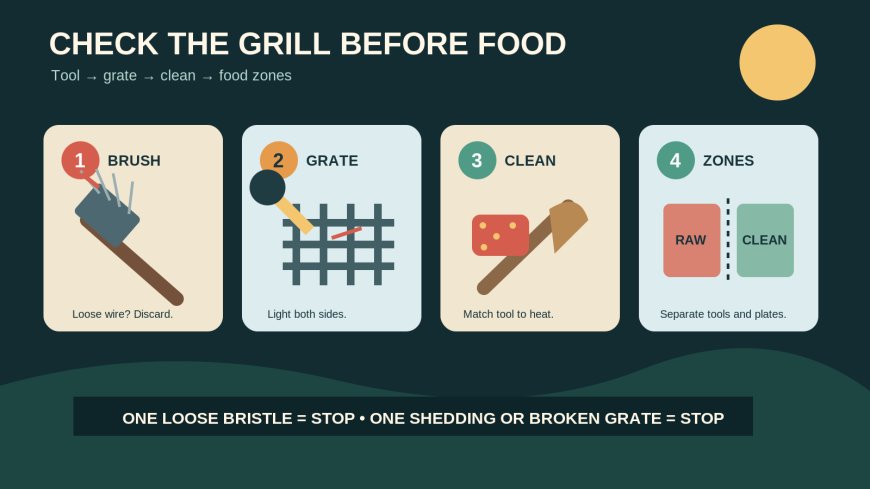
A wire brush needs a deliberate preflight. Hold it over a light background and check:
- the face and edges for loose, bent or broken wires;
- the anchor points for gaps where bundles or coils are pulling free;
- the head for cracks, heavy corrosion or separation from the handle; and
- the handle for a split or loose joint that could twist the head while you scrub.
Do not test a doubtful brush by dragging it across the cooking surface. Weber tells consumers to inspect before each use and discard the brush immediately if loose bristles are found. Its product warning also calls for replacement at least every season, and more often for frequent use.[5] The Weber Q manual separately says to replace the brush if loose bristles appear on the brush or cooking grate.[4]
At a shared campsite, you usually do not know the brush's age or storage history. If it is rusty, crushed, has uneven empty patches or leaves a wire in your hand, retire it. Put it in a rigid container or wrap the head before disposal so loose wires do not migrate into a picnic bin, gear bag or footpath.
A brush that looks intact still does not cancel the grate inspection. CDC could not determine which brands, brush designs or grate types were safer because those details were unavailable in its case series.[1]
Clean without creating a new foreign-object problem
CDC advises examining the grill surface and considering alternative cleaning products or methods.[1] There is no single bristle-free tool that fits every grate, but several categories are available:
- A shaped wood scraper has no separate wire bristles. Some designs are used on a hot grate and gradually form grooves around the bars.
- A grit-infused nylon brush is intended for a cool grate, not a hot one. Char-Broil's current cleaning-tool instructions pair nylon with cool grates and a wood scraper with hot grates.[6]
- A one-piece scraper or manufacturer-approved plastic scraper can lift deposits without a field of small wires. Check its heat rating and grate compatibility.
- A nonmetal scrub pad with warm, soapy water can work during a full cool-down wash when the grill manual allows removal and washing.
"Bristle-free" does not mean indestructible. Inspect a nylon head for melting, split tufts or missing material. Check a coil or mesh cleaner for broken strands and failed welds. Check a wood scraper for splinters, burned cracks and loose hardware. Retire any tool that is losing pieces.
Match heat to the tool. A nylon brush marketed for cool cleaning can soften or melt on a hot grate. A plastic scraper can do the same. Do not assume that a familiar kitchen scrubber tolerates grill temperatures. Follow the cleaning tool's temperature limit and the grill manual together.
Run a two-pass grate inspection
Inspect once before cleaning so you know what you are dealing with, then inspect again after the debris is gone.
First, turn off the fuel as the grill instructions require and let the unit reach the temperature specified for the chosen method. Use a flashlight at a shallow angle. Scan each bar from front to back, including the underside of crossbars, corners and the gap near the firebox wall. Thin wires are easier to see when side light creates a reflection or shadow.
After cleaning, repeat the scan. Look for:
- a straight or curved wire lying along a grate bar;
- a bristle standing upright in a groove;
- metal caught in burned residue at an edge;
- fragments from a scrub pad, scraper or coating; and
- cracks, broken bars or a grate that no longer sits securely.
FDA specifically tells outdoor cooks who use a bristle brush to check that detached bristles have not entered grilled food.[3] The practical campsite move is to finish the surface check before food comes out. Once patties or soft food have touched a suspect grate, a visual check of the top of the food cannot prove that no wire is embedded underneath.
If you find one loose wire, stop. Discard the brush, keep food off the grate, and clean the full cooking surface by a method approved for that grill. Remove the grate only if the manual and campground allow it. Wash, rinse, dry and inspect both sides under good light. If you cannot confidently clear the surface, use another grill or another cooking method. Food that contacted a grate while loose wire was present should be discarded rather than picked over.
Keep the cleaning zone out of the food zone
Do the dirty work before opening raw meat, buns or ready-to-eat food. Put used brushes, pads, oily towels and scraped debris on a tray or in a utility tub away from the prep table. Wash hands after handling the grate and cleaning tools.
Set a raw side and a clean side at the grill. Raw meat and its tongs stay on one side. A clean platter and clean serving utensil wait on the other. FDA warns against reusing platters or utensils that held raw meat, poultry or seafood unless they have been washed in hot, soapy water.[3] A tool used to scrape a grate does not belong on either food tray.
Keep a flashlight and inspection cloth in the utility kit, not beside the cooked-food platter. If the campground supplies one communal brush, do not return your clean serving tongs to the same hook or bin. The goal is simple: debris and raw juices move away from food, while clean utensils move toward finished food.
Know when the grate itself is the stop sign
Surface staining is not the same as structural failure. A manufacturer may allow light rust on bare cast iron to be removed and the grate re-seasoned. Porcelain enamel, stainless steel and cast iron need different treatment, so check the exact manual before sanding, oiling or using an abrasive.
Stop using the grate when a bar is cracked or broken, the grate rocks or can fall into the firebox, a sharp edge can catch food or hands, or a damaged surface continues to shed fragments after approved cleaning. Those conditions cannot be fixed by one more hard scrub. Mark the grill out of service if the campground has a process, tell the host, and move dinner to a sound cooking surface.
Do not paint a cooking grate or patch it with foil, wire or hardware-store coatings. Order the correct replacement part for a privately owned grill. For a campground grill, replacement is the owner's job.
A grate with stubborn carbon but no structural or coating damage may only need the manual's deep-cleaning procedure. A grate with loose fragments in the food-contact area is different. If you cannot tell whether the material is residue, corrosion or failed coating, stop and ask the manufacturer or owner rather than grinding it down beside dinner.
If a bristle may have been swallowed
Stop eating. Do not try to force the object down with more food. The CDC cases included severe pain on swallowing and severe abdominal pain, and diagnosis sometimes required radiographs or CT.[1] Seek urgent medical evaluation for suspected ingestion or new sharp throat, neck, chest or abdominal pain after grilled food, and tell the clinician that a grill-brush wire may be involved. Small bristles can be difficult to locate, so that history matters.[1]
The safest campsite routine is ordered, not complicated: identify the grill, inspect the cleaning tool, clean with a compatible method, inspect the full grate under good light, and only then establish the raw and cooked food zones. One loose bristle ends the brush's service life. A grate that sheds, cuts or will not sit securely ends the grill session.
Evidence note: CDC and FDA supply the public-health and outdoor food-safety basis. The Weber sources document one manufacturer's wire-brush inspection, replacement and model-specific cleaning instructions. Char-Broil documents current nylon-cool/wood-hot alternatives. RVCamping.info developed the two-pass inspection and campsite zone-control workflow; use the manuals for the exact grill and cleaning tool.
Sources
- Injuries from Ingestion of Wire Bristles from Grill-Cleaning Brushes — CDC MMWR — case series, limitations, inspection advice and clinical context.
- Epidemiology of Wire-Bristle Grill Brush Injury in the United States, 2002–2014 — PubMed — peer-reviewed national surveillance estimate and confidence interval.
- Handling Food Safely While Eating Outdoors — U.S. Food and Drug Administration — detached-bristle check and raw/cooked utensil separation.
- Weber Q 1000/1200/2000/2200 Grill Owner's Guide — Weber — model-specific grate cleaning and brush inspection instructions.
- Grill Brush #6494 product warning — Weber — before-use inspection and replacement interval.
- Cleaning Tools — Char-Broil — manufacturer directions for nylon brushes on cool grates and wood scrapers on hot grates.
What's Your Reaction?