






Raw chicken at camp: a two-container route from cooler to grill
Keep raw chicken cold and contained, separate raw and clean tools, verify 165°F, and control the serving clock at an RV campsite.

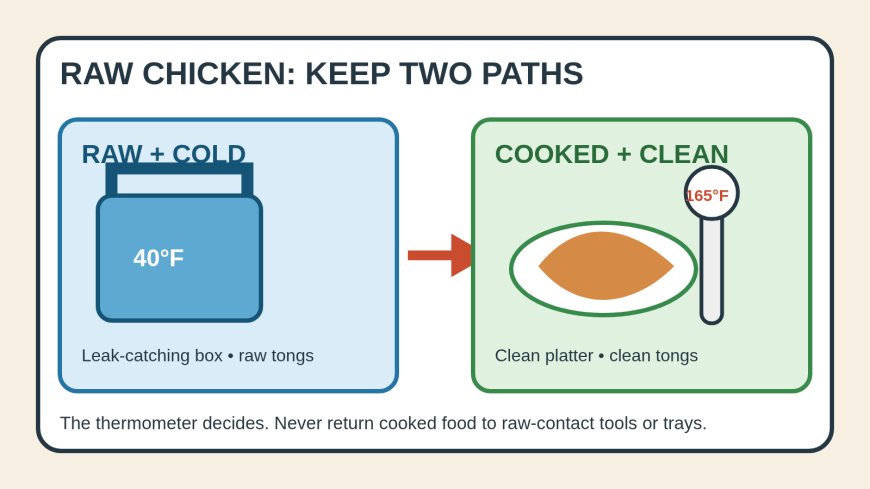

Raw chicken at camp: a two-container route from cooler to grill
By Romana
Category: Cooking
Raw chicken creates two separate jobs at an RV campsite. The first is keeping it cold and contained before cooking. The second is making sure the cooked food never returns to the tray, tongs or marinade that handled it raw. A small galley makes those paths easy to cross, so plan them before opening the package.
This is a workflow, not a recipe. It works for breasts, thighs, wings and cut-up chicken, but the exact cooking time will change with piece size, starting temperature, wind and grill performance. The food thermometer, not the clock or surface color, makes the final decision.
Pack a raw kit and a clean kit
Use two containers that are easy to tell apart:
- The raw kit holds the sealed chicken package, raw-only tongs or fork, marinade bag and a leak-catching pan or rigid box.
- The clean kit holds the serving platter, clean tongs, thermometer wipes or the supplies its instructions require, and any ready-to-eat garnishes.
Pack the raw kit low in the cooler so leakage cannot drip onto drinks, produce or food that will be eaten without further cooking. USDA camping guidance says to keep perishable food cold in an insulated cooler with enough ice or frozen gel packs and to separate raw meat and poultry from other food.[2]
A refrigerator thermometer or cooler thermometer gives you information that a hand on the lid cannot. USDA's grilling guidance sets 40°F as the cold-holding boundary and advises keeping meat and poultry refrigerated until use; when a cooler is used, it should stay out of direct sun and be opened as little as possible.[1]
If the campground water source is under an advisory, or if you cannot confirm that the water is potable, do not build the raw-prep plan around rinsing utensils at the site. Bring enough clean equipment to keep the raw and cooked paths separate until everything can be washed safely.
Set the station before the chicken comes out
Choose a stable work surface away from campground dust, pets and the sewer or waste-handling area. Set the clean platter and clean tongs on the side farthest from the raw kit. Put a trash bag or lidded waste container within reach so packaging does not travel through the RV after it is opened.
Prepare vegetables, buns and other ready-to-eat food first, then move them away. Open the raw kit last. USDA advises against partially grilling meat or poultry and finishing it later unless it moves immediately from partial cooking to the hot grill; a stop between those stages can let bacteria survive and multiply.[1]
Do not wash raw chicken. Splash can move contamination to the sink, faucet, counter and nearby food. At camp, the better move is to take the chicken from its container directly to the cooking surface, then close the raw container and clean contaminated surfaces before touching the clean kit.
Give every tool one side of the cook
The easiest rule is physical: once a tool touches raw chicken, it stays with the raw kit. It does not pick up a cooked piece "just once."
Use one of these setups:
- Two-tool setup: raw tongs place and turn the chicken while it is still raw; clean tongs handle pieces after the temperature check.
- Wash-and-reset setup: use one utensil, then wash it with hot soapy potable water and sanitize it before it touches cooked food. This only works when the campsite has the water, sink or wash basins, sanitizer and time to do the job correctly.
- Disposable raw contact: use a single-use barrier or utensil for the raw transfer, discard it, and continue with clean tools. Check local waste rules and do not leave contaminated items exposed to wildlife.
The same separation applies to plates. USDA warns not to put cooked meat or poultry on the same platter that held the raw product unless the platter has first been washed in hot, soapy water.[1]
Treat marinade as raw chicken contact
Marinade that held raw chicken belongs on the raw side. Do not brush it over cooked chicken or serve it as a sauce. USDA says that marinade used on raw meat or poultry should not be reused unless it is first brought to a boil.[1]
The cleaner campsite plan is to divide the marinade before adding chicken. One portion goes into the raw bag. The untouched portion stays sealed in the clean kit for basting late in cooking or serving. Label both. In a crowded cooler, two similar jars are an avoidable mistake.
If you intend to boil used marinade, do it in a separate vessel and keep splashes away from the clean platter. At a site with limited burner space or wash water, skipping that recovery step is usually simpler.
Check the thickest part with a thermometer
FoodSafety.gov lists 165°F for all poultry, including whole birds, breasts, thighs, wings, ground poultry and stuffing.[3] Measure in the thickest part without touching bone. Check more than one piece when sizes differ or when a small camp grill has obvious hot and cool zones.
A good field sequence is:
- Open the grill and choose the largest-looking piece in each heat zone.
- Insert the thermometer into the thickest edible section.
- If the reading is below 165°F, continue cooking and keep that piece on the raw side of the workflow.
- Clean the thermometer probe as its manufacturer directs before the next food contact.
- Move a verified piece to the clean platter with clean tongs.
Do not use browning, firm texture or clear juices as substitutes for the temperature reading. Those visual signs can help you decide when to check, but they do not establish the internal temperature.
Build a wind and fuel margin
Campground grills and portable stoves can lose heat in wind. Cold chicken, a crowded grate and repeated lid opening also lengthen the cook. Plan enough fuel to finish the batch, not merely to reach an estimated recipe time.
Never move a charcoal grill, propane appliance or other combustion source into the RV, a tent, a screen room or another enclosed or partly enclosed space to escape weather. If wind or restrictions make outdoor cooking unsafe or prohibited, use a legal indoor appliance designed and installed for the RV, choose a different meal, or postpone the cook.
Check current fire restrictions and the campground's appliance rules before lighting anything. A metal fire ring is not proof that every type of grill or stove is allowed that day.
Serve a small batch, then replenish
At a potluck, putting every cooked piece on one large platter starts one long exposure clock. Serve a smaller batch and hold the rest at a safe temperature. Use a clean utensil for each refill, and never pour a fresh batch onto a platter that has been handled by many people without replacing or cleaning it.
USDA's camping guidance says perishable food should not remain out of refrigeration more than two hours, or more than one hour when the air temperature is above 90°F.[2] That clock includes prep and serving time. Write the serve time on tape or a card rather than trying to reconstruct it later.
If cooked chicken will be saved, move it to shallow containers and refrigerate it promptly. A cooler is only a refrigerator substitute while it can keep food at 40°F or below. If you cannot verify cold holding, discard the leftovers rather than making a hopeful guess.
The five-stop check
Before serving, stop at five points:
- Cold: Was the chicken held at 40°F or below until cooking?
- Contained: Did raw liquid stay away from ready-to-eat food and drink ice?
- Separated: Are the clean platter and clean tongs still clean?
- Cooked: Did every sampled piece reach 165°F in the thickest part?
- Clocked: Is the serving time marked, with a one-hour limit above 90°F and a two-hour limit otherwise?
If any answer is unknown, correct it before serving or discard the affected food. A campsite meal does not need a complicated kitchen, but it does need a clean break between raw and ready-to-eat.
Sources
- [1] USDA FSIS: Grilling Food Safely (archived 2026-09-12; accessed September 18, 2026).
- [2] USDA FSIS: Food Safety While Hiking, Camping & Boating (archived 2026-09-12; accessed September 18, 2026).
- [3] FoodSafety.gov: Safe Minimum Internal Temperature Chart (archived 2026-09-04; accessed September 18, 2026).
What's Your Reaction?