






Campground burgers in a small RV kitchen: run a one-way safety line
Run campground burgers through one safe direction: verified cold transport, a contained raw zone, a 160°F thermometer release, clean service and clocked leftovers.

Campground burgers in a small RV kitchen: run a one-way safety line
By Romana Category: Cooking
A burger night gets awkward fast when the same two feet of counter must hold raw patties, buns, toppings and the clean dinner plate. The answer is not more counter space. It is a one-way route: cold storage, raw handling, heat, clean landing, then service. Nothing moves backward.
The short answer: Transport ground beef at 40°F or colder, sealed so raw juices cannot reach ready-to-eat food.[1][2] Wash hands after touching the beef and keep raw plates and utensils away from cooked burgers and toppings.[5] Cook every ground-beef patty to 160°F, checked in the center with a food thermometer inserted from the side.[1][3] Keep cooked burgers at 140°F or hotter if they will wait; otherwise refrigerate eligible leftovers within two hours, shortened to one hour when the air temperature is above 90°F. Reheat saved burgers to 165°F.[4][5]

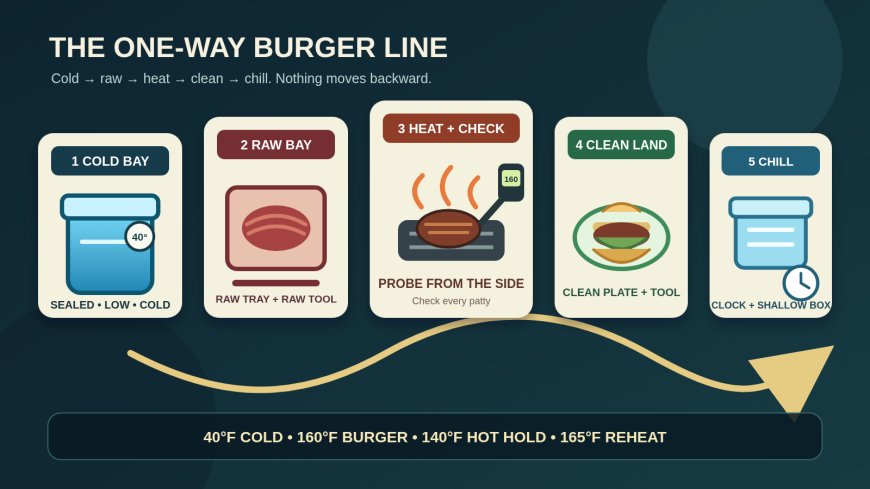
The burger moves forward; raw tools do not. Original illustration by RVCamping.info.
Give the burger five stops, not one crowded counter
Before opening the package, assign five stops:
- Cold bay: the cooler or RV refrigerator, with a thermometer.
- Raw bay: one rimmed tray or board for the package and uncooked patties.
- Heat: the grill or skillet.
- Clean landing: a plate that has never held raw beef, plus clean serving tools.
- Service and chill: the bun station, a written clock and shallow leftover containers.
This layout is an RVCamping.info workflow, not a government diagram. Its point is to make direction visible in a tiny space. The raw tray never becomes the cooked tray. The spatula does not migrate to the bun table. A clean landing plate does not sit under the raw package while you wait for the grill.
For an outdoor grill, put the raw bay on one side of the cook and the clean landing on the other. In a galley, where there may be only one usable surface, run the stops in time: prepare toppings and stage the clean plate first, move them away, then open the beef. A counter can change jobs only after the raw items are removed and the touched surface is cleaned.
Cold transport starts with a contained package
USDA camping guidance calls for a cold source and recommends placing raw meat below ready-to-eat food when one cooler must hold both. It also advises double wrapping raw meat or putting it in a plastic bag so leaking juices do not reach other food.[2]
Use that rule as a loading test:
- Ground beef begins refrigerator-cold or frozen.
- The original package goes inside a sealed bag or washable, lidded box.
- The box sits low, not above buns, lettuce, cheese, fruit or drinks.
- Frozen packs or ice surround the food, and an appliance thermometer verifies the temperature.
- Food needed later stays below the items needed first, so dinner does not require unloading the cooler onto the picnic table.
Ground beef should be held at 40°F or below. USDA notes that grinding can distribute surface bacteria through the meat, which is why the center must later reach the full ground-beef endpoint.[1] A frozen patty may help the cooler stay cold, but frozen is not a substitute for a cold source or a thermometer reading.
Put drinks in another cooler when possible. If one cooler must do both jobs, retrieve several drinks at once and shut the lid. At camp, move the cooler into shade. Do not treat a shaded cooler, a cold-looking gel pack or beef that still feels cool as a measurement.
If the thermometer shows warming, write down when the food likely left controlled cold storage. The later discard decision depends on elapsed time. When nobody can establish that history, cooking the beef does not repair the missing cold record; USDA warns that heat-resistant toxins produced after raw meat is mishandled may remain even after cooking.[1]
Close the raw bay before touching the clean side
Shape patties at home only if you can keep them cold and contained. At camp, opening a store tray and separating prepared patties creates fewer raw-hand contacts than portioning bulk beef across the whole counter. This is a workflow choice, not a recipe recommendation.
If patties must be formed in the RV, first place soap, potable water and a clean drying towel where they can be reached without opening a cabinet with raw hands. FoodSafety.gov calls for a full 20-second hand scrub with soap and water, along with different plates and utensils for raw and cooked food.[5]
Run a "last raw touch" check before the beef reaches the heat:
- wrapper and absorbent pad are in a lined trash container;
- raw tray and raw utensils remain together;
- seasoning touched by a raw hand is treated as part of the raw bay;
- refrigerator latch, faucet, stove knob and cooler handle are checked for accidental contact; and
- hands are washed before anyone handles buns, sliced toppings or the clean landing plate.
Hand sanitizer is useful when soap and water are unavailable, and USDA camping guidance recommends a product with at least 60% alcohol for that situation.[2] It does not clean a greasy tray, a contaminated counter or a spatula. Bring enough potable water and soap for the cleanup the meal will create.
Do not wash raw ground beef. Do not reuse marinade, if one was used, as a finishing sauce unless it is boiled according to appropriate guidance. The simplest burger line keeps liquids and shared seasoning containers out of the raw bay altogether.
Use 160°F as the release gate
USDA sets 160°F as the safe minimum internal temperature for hamburgers and other ground-beef dishes and says to verify it with a food thermometer.[1] Browning, grill marks, firmness and clear-looking juices are not release criteria. A patty can change color before its center reaches the endpoint.
A thin burger is easy to probe badly. USDA thermometer guidance says to enter a thin food from the side until the sensing area reaches its center.[3] Lift the burger onto a clean spatula or plate if that keeps fingers away from the hot grate. Aim through the side toward the middle, not down through the top into open air or against hot metal.
Check each patty. Thickness, grill position and flare-ups can make burgers finish at different times; USDA advises checking every piece rather than assuming one reading covers the batch.[3] If a burger is below 160°F, return it to the heat. Clean the probe after contact with an undercooked patty before inserting it into another burger or touching cooked food.
Do not partly cook burgers at home and finish them after the drive. USDA advises against partial cooking of ground beef for later completion because bacteria may survive and multiply during the interval.[1] Cook in one continuous session. If you fully cook patties in advance, cool and transport them as leftovers, then reheat them to 165°F at camp.[4]
The raw spatula needs an explicit retirement point. Once its last contact with undercooked beef is over, place it on the raw tray. Finish with a second clean spatula, or wash the first thoroughly with hot, soapy water before it touches food that has cleared 160°F. The burger moves to the clean landing plate only after the thermometer releases it.
Serve in batches and start one clock
A large platter invites early burgers to wait while the last batch cooks. Use a smaller landing plate and send finished burgers to the bun station in short batches. The reserve beef stays cold until there is grill space.
If cooked burgers will be held rather than served promptly, keep them at 140°F or above. A covered plate on an unlit stove, a foil pan near the grill and a closed microwave are not verified hot holding.[4][5] Without a heat source and a temperature check, start the service clock when the burger leaves heat.
Write the deadline on tape or a small whiteboard:
- FIRST BURGER OFF HEAT: ____
- AIR ABOVE 90°F? YES / NO
- CHILL OR DISCARD BY: ____
Perishable food has a two-hour limit outside temperature control; when outdoor air exceeds 90°F, the limit drops to one hour.[4] Time spent on the clean platter, in a bun, on the picnic table and during cleanup all belongs to the same clock. Moving a burger into a warm cooler does not restart it.
Keep the bun and topping station clean by assigning one person clean hands and clean tools. If the grill cook must assemble burgers too, the raw bay closes first, followed by handwashing. Guests should not reach across the raw tray for condiments.
Save only burgers with a complete history
A leftover qualifies for storage only when you know that it:
- stayed properly cold before cooking;
- reached 160°F;
- landed on a clean plate;
- avoided raw hands, juices and utensils after cooking; and
- entered refrigeration before the service deadline.
Transfer qualifying burgers into covered containers with a low, wide shape so heat can leave quickly. USDA permits refrigerated leftovers for three to four days.[4] In a small RV refrigerator, leave room for cold air to move and verify that the appliance holds 40°F or below. A cooler is acceptable cold storage only while it can maintain the required temperature; USDA's camping page gives the practical warning that leftovers are safe in a cooler only while ice remains.[2]
Mark each container with its contents and storage date. Reheat saved patties to 165°F, measured with a food thermometer.[4] Reheat only the amount you plan to eat. Discard a burger when its time, temperature or contamination history is unknown. Smell, taste and a second trip across the grill cannot fill in a missing record.
The one-way burger-line card
Tape this inside the galley cabinet:
- Verify 40°F or colder before opening the package.
- Stage toppings and the clean landing plate before raw work begins.
- Keep the raw tray, wrapper and raw utensil in one bay.
- Wash hands after the last raw touch.
- Probe each patty sideways to the center; release at 160°F.
- Move cooked burgers forward to clean tools and a clean plate.
- Hold at 140°F or hotter, or start the service clock.
- Chill eligible leftovers by the deadline; reheat them to 165°F.
The temperatures and time limits come from the cited federal guidance. The five-stop layout, last-raw-touch check, release gate and written burger clock are original planning tools for cramped RV and outdoor cooking spaces. This is U.S. consumer guidance, not a commercial food-service plan, and the article does not provide a burger recipe.
Sources
- Ground Beef and Food Safety | USDA FSIS (live page archived 2026-09-04)
- Food Safety While Hiking, Camping & Boating | USDA FSIS (live page archived 2026-09-12)
- Food Thermometers | USDA FSIS (live page archived 2026-09-12)
- Leftovers and Food Safety | USDA FSIS (live page archived 2026-09-12)
- 4 Steps to Food Safety | FoodSafety.gov (live page archived 2026-09-05)
What's Your Reaction?