







Theodore Roosevelt RV Camping: Cottonwood vs. Juniper
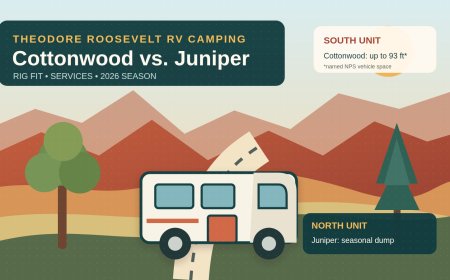
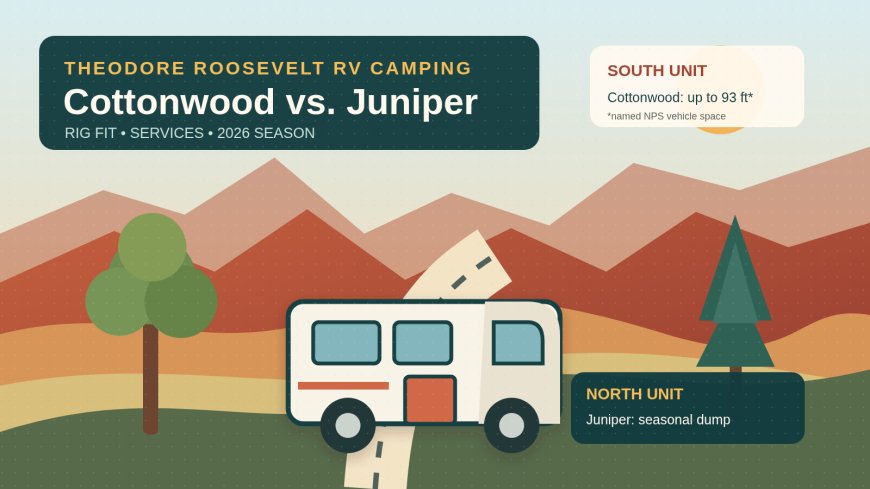
Cottonwood best serves South Unit trips and lists the longest named pads; Juniper serves the North Unit and adds a seasonal dump station.


Theodore Roosevelt RV camping: Cottonwood vs. Juniper in 2026
By Romana | Updated September 22, 2026
Cottonwood is the practical pick for a South Unit trip, Medora access and the park's largest published individual-vehicle pads. Juniper is the better choice for the quieter North Unit and, through October 1, the only one of the pair with an RV dump station. Neither campground has hookups. Both are open year-round, but their warm-season water systems do not run year-round and winter weather can close park roads.[2][3][4][5][6]
Short answer: Choose Cottonwood if the South Unit is the trip's focus or your measured setup needs one of its named 50- to 93-foot vehicle spaces. Choose Juniper for the North Unit, a seasonal dump station and a better chance of securing a pull-through site in the 50-foot range. Do not treat the two as interchangeable overflow lots: they serve separate park units, and a reservation at one does not put you near the other unit's scenic road.
Cottonwood vs. Juniper at a glance
| Question | Cottonwood Campground | Juniper Campground |
|---|---|---|
| Park unit | South Unit, about five miles from its entrance | North Unit, about five miles from its entrance |
| Best reason to choose it | South Unit itinerary; ten individual spaces in the NPS table are 50 feet or longer | North Unit itinerary; seasonal dump station; seven current Recreation.gov records show 50-57 feet for RVs |
| Published rig range | NPS lists 60 individual vehicle sites from 18 to 93 feet, plus 12 walk-to sites that exclude trailers and oversized vehicles | NPS says back-ins fit about 20 feet and many pull-throughs exceed 50 feet; current Recreation.gov data publishes positive RV limits of 20-57 feet across 36 records |
| Hookups | None | None |
| Water and waste | Drinking water and a fill station seasonally; no dump station | Drinking water, fill and dump station seasonally |
| Reservations in 2026 | All sites by reservation from May 1; same-day booking allowed | All sites by reservation from May 1; book before arrival because North Unit cell service is limited |
| Year-round reality | Campground open, but water may be unavailable after October 1 and winter road closures are possible | Campground open, but water and dump service are seasonal and winter road closures are possible |
The fit figures are screening numbers, not guarantees. Measure the RV body, hitch equipment, rear rack and tow vehicle, then read the current record for the exact site. A pad's listed length says nothing about slide clearance, tree limbs or whether a combined truck-and-trailer setup can stay entirely on the pad.
The biggest decision is the park unit
Cottonwood is the South Unit's campground. Recreation.gov places it five miles from that unit's entrance in Medora. Juniper is five miles inside the North Unit, whose entrance is on U.S. Highway 85 south of Watford City.[4][5] That geographic split matters more than a small difference in pad length or restroom service.
A South Unit day built around Medora and the Scenic Loop Road favors Cottonwood. A North Unit day centered on the Scenic Road, Little Mo Trail and Achenbach country favors Juniper. Moving an RV between units burns time and adds another full setup cycle. Pick the unit first, then solve site fit within that campground.
There is also a time-zone wrinkle. NPS says the North Unit uses Central time while the South Unit uses Mountain time.[6] Reservation confirmations and personal schedules deserve a second look when a trip includes both units.
Cottonwood: more exact length guidance, no dump station
Cottonwood's NPS page carries a site-by-site maximum-vehicle table updated May 17, 2026. Excluding the group site and walk-to inventory, it lists 60 vehicle sites ranging from 18 to 93 feet. Ten are at least 50 feet long: sites 9 (54 feet), 17 (77), 18 (68), 23 (50), 31 (78), 35 (93), 36 (58), 37 (75), 38 (85) and 43 (55).[2]
Those long entries are not all pull-throughs. Site 36 is back-in and site 43 is parallel. Most of the campground is much less generous: the same table includes 18- to 40-foot spaces, plus 12 walk-to sites where NPS bars trailers and oversized vehicles.[2] Filter by the measured setup rather than assuming "Cottonwood" means big-rig access.
There is a data conflict worth seeing before payment. The current Recreation.gov campsite records do not always match the NPS table. For example, Recreation.gov's equipment fields can differ from NPS's maximum-vehicle figure for the same numbered site. Those fields may measure different things, and neither explains connected truck-and-trailer length consistently. Save the booking page, compare it with the NPS table, and ask the park when a borderline rig depends on the larger number.[2][4]
Cottonwood has no electric, water or sewer hookups and no dump station. Recreation.gov lists toilets, drinking water and an RV fill station through October 1, subject to weather. Early-May startup and service beyond that October date are uncertain; vault toilets remain when the plumbing is shut down.[4]
A second fit limit is overhead clearance. Recreation.gov warns that campground trees and branches may not accommodate vehicles over 13 feet. Owners of tall fifth-wheels and motorhomes should treat that as a route-and-site warning, not merely a pad measurement.[4]
Juniper: seasonal dump service and useful long pull-throughs
Juniper's NPS fit guidance is broad rather than site-specific. The page says back-in spaces handle vehicles up to about 20 feet, many pull-throughs exceed 50 feet, and walk-to parking is for passenger vehicles only. That page's length note was last updated in 2022, so the current Recreation.gov records are useful for narrowing the search.[3]
The official campsite data retrieved September 22, 2026 exposed 37 active records that permit RV equipment. Thirty-six publish a positive RV maximum, from 20 to 57 feet. Seven reach at least 50 feet: sites 5 and 50 at 55 feet, sites 8, 30 and 40 at 50 feet, site 43 at 52 feet and site 49 at 57 feet.[5] These are equipment limits in the booking data, not a campground-wide maximum.
Juniper has no campsite hookups, showers or laundry. Its practical advantage is tank service: Recreation.gov lists a water fill and dump station from May through October 1. Weather can affect the water schedule, and vault toilets remain when the water system is unavailable.[5]
The North Unit has limited cellular service. NPS recommends making the reservation before arrival, and the Recreation.gov listing repeats that the park itself does not take reservations.[1][3][5] Save the confirmation and site details offline. A same-day reservation is allowed, but that does not mean a usable signal will be waiting at the campground.
What September 22 travelers should expect
September 22 falls inside the published seasonal-service window at both campgrounds. Cottonwood's fill station and Juniper's fill-and-dump station are listed through October 1, but Recreation.gov makes water availability weather-dependent.[4][5] A cold snap or maintenance issue can beat the calendar. Carry enough water to dry camp and arrive with waste capacity even when the listing says the system should be on.
Both individual campgrounds are listed as open year-round.[4][5] "Open year-round" does not mean full summer service. It also does not guarantee that every road remains drivable after snow or ice. The park's 2026 hours page says winter conditions can force closures on either unit's scenic road.[6]
The live NPS alerts feed retrieved for this review showed no current Cottonwood or Juniper campground closure. It did contain older, date-bounded 2026 notices, which is a good reminder to read an alert's dates rather than relying on its presence in the feed.[8] Conditions can change after this article's check. Reopen the campground page, alerts and Recreation.gov record on departure day.
Reservations changed in 2026
Beginning May 1, 2026, every campsite at Cottonwood and Juniper requires a Recreation.gov reservation. NPS says individual sites can be booked up to six months ahead and same-day reservations are available. Campground payments are cashless; reservations can be made on Recreation.gov, in its app or by phone.[7]
This replaces the old habit of arriving and self-registering during the busy season. Some Recreation.gov text still refers to a November-through-April self-registration season when explaining annual stay limits.[4][5] For a 2026 trip, follow the newer NPS announcement and the current booking interface rather than planning around legacy wording.
Regular sites allow up to six people and two vehicles, while walk-to sites allow one vehicle. Both listings set a 14-night limit during May 1 through October 31 and a 30-day total for the calendar year.[4][5]
Rig-fit checklist before booking
- Measure the RV from its foremost fixed point to the rear edge of every rack, spare tire or cargo tray.
- For a trailer, record trailer length, tow-vehicle length and total connected length separately.
- Confirm whether the booking field describes RV length, trailer length, maximum vehicle length or driveway length.
- Keep the whole setup on the paved or designated pad; both listings prohibit parking wheeled equipment off roadways and pads.[4][5]
- At Cottonwood, compare the current site record with NPS's 2026 length table. Ask before booking if the two numbers conflict.[2][4]
- At Juniper, favor a named long site rather than relying on the campground-level statement that "many" pull-throughs exceed 50 feet.[3][5]
- Check vertical clearance if the RV approaches or exceeds 13 feet.[4][5]
- Recheck water, dump availability, weather and park alerts on travel day.
Water, waste and power plan
Neither campground provides shore power. Generator hours run from 8 a.m. to 8 p.m. at both, and fire restrictions are common during hot, dry periods.[4][5] Solar and battery capacity matter for quiet overnight power, but shade and weather can reduce solar production.
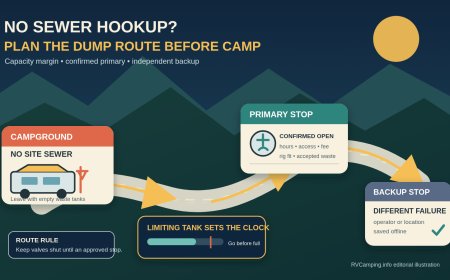
For Cottonwood, dump before entering the park or identify a legal commercial dump outside the campground. The on-site water fill is useful only while the seasonal system operates. For Juniper, use the dump and fill station before the October 1 cutoff, but keep a backup because the listing makes availability weather-dependent.[4][5]
There are no showers or laundry facilities in the park.[4][5] That matters on a multi-night stay and makes Medora services one more reason Cottonwood suits many first-time visits, while Juniper rewards travelers who arrive provisioned.
Bottom line
Cottonwood wins for a South Unit itinerary and for rigs that can secure one of its clearly listed long spaces. Its 2026 NPS table offers better planning detail than Juniper's older campground-level guidance. The tradeoff is simple: no dump station, no hookups and seasonal water.
Juniper wins for the North Unit and for self-contained rigs that benefit from an on-site dump through October 1. Its current Recreation.gov records include seven 50- to 57-foot RV entries, but the exact site still controls. Neither campground is a full-service RV park, and neither should be booked solely because it is labeled open year-round.
Editorial note: Campground specifications and status were checked against NPS and Recreation.gov on September 22, 2026. Site rankings, conflict analysis and planning advice are RVCamping.info editorial analysis. No firsthand stay, drive or campsite inspection is claimed.
Sources
- Camping at Theodore Roosevelt National Park — NPS overview of Cottonwood and Juniper, RV suitability and 2026 reservation notice. Accessed September 22, 2026.
- Cottonwood Campground — NPS site-by-site maximum-vehicle table and walk-to restrictions; table updated May 17, 2026. Accessed September 22, 2026.
- Juniper Campground — NPS fit guidance, reservation warning and North Unit context. Accessed September 22, 2026.
- Cottonwood Campground (ND) — official facility and campsite records for services, seasonal water, stay limits, height warning and site equipment fields. Accessed September 22, 2026.
- Juniper Campground (ND) — official facility and campsite records for dump service, seasonal water, restrictions and site-specific RV limits. Accessed September 22, 2026.
- Operating Hours & Seasons — year-round status, unit time zones and winter road-closure caveat; updated July 1, 2026. Accessed September 22, 2026.
- Theodore Roosevelt National Park moves to cashless fee collection — March 24, 2026 NPS release establishing reservation and payment rules. Accessed September 22, 2026.
- Theodore Roosevelt National Park alerts feed — live NPS alert data checked for campground and access closures. Accessed September 22, 2026.
What's Your Reaction?