




Dutch-oven camp cooking needs two safety plans, not one
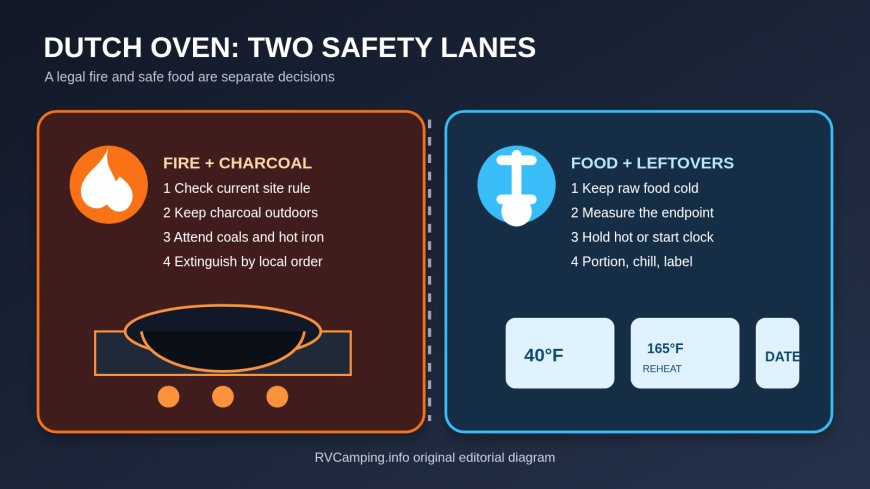
A two-track Dutch-oven campsite workflow that keeps charcoal and fire-rule decisions separate from food temperatures, service clocks and leftovers.

Dutch-oven camp cooking needs two safety plans, not one
By Romana Category: Cooking
A cast-iron Dutch oven can turn a campsite into a workable kitchen, but it also creates two problems that should never be treated as one. The first is whether you may light and manage charcoal or a fire at this place today. The second is whether the food reached a safe temperature and the leftovers stayed under control. A legal fire does not make undercooked chicken safe. A 165°F stew does not excuse prohibited charcoal.
The short answer: Run two separate checklists. The fire track begins with current land-manager and campground rules, continues with outdoor charcoal handling, and ends only when every coal is cold. The food track begins with cold storage and clean prep, uses a thermometer for the ingredient-specific endpoint, and ends with prompt shallow-container cooling or a discard decision.

The red lane governs flame and coals; the blue lane governs the food. Original RVCamping.info illustration.
Track one: permission comes before the menu
A built-in fire ring is hardware, not permission. BLM tells campers that fire restrictions can change during the year and directs visitors to check current regulations and posted guidance.[1] National Park Service restrictions can also change by stage, elevation, campground, and device. At Sequoia and Kings Canyon, for example, current restrictions distinguish wood and charcoal from several types of stoves and tell visitors to check again just before travel and on arrival.[2]
Check the exact managing agency, the named campground or dispersed area, and any host notice. Record the page and time checked. Ask device-specific questions:
- Is charcoal allowed today?
- Is it allowed in this exact campsite or only in agency-provided grills?
- May a Dutch oven sit on a ground pan, table, grill, or only inside the installed ring?
- Are ash disposal, water, shovel, spark-arrester, or permit rules in effect?
- Does a stricter county, state, concessioner, or campground order also apply?
If the current order is unclear, do not translate “gas stove allowed” into “charcoal allowed.” Change the meal plan to equipment the rule clearly permits, or choose a no-cook meal. The food was purchased already; that is not a safety exception.
Charcoal always stays outside in open air. The U.S. Consumer Product Safety Commission warns never to use charcoal in enclosed spaces including tents, campers, vehicles, garages, and mobile homes because carbon monoxide can kill.[6] An open RV door, roof vent, or range hood does not turn the galley into open air.
Build a coal station, not a loose pile
Once charcoal is confirmed legal, choose a stable, noncombustible location authorized by the site rules. Keep the oven out of dry grass, away from tent fabric, awnings, tablecloths, chairs, pets, and the RV wall. Wind can move sparks and heat; it can also make a lid lifter or hot lid harder to control.
Set out the extinguishing tools required by the local rule before ignition. Provide a clean, heat-safe landing place for the lid so nobody drops it into dirt or sets it on a combustible table. Treat the bail, lid, legs, chimney, windscreen, and ash pan as hot until checked otherwise. Use dry, heat-resistant tools suited to the oven rather than improvising with plastic utensils or damp fabric.
Do not use a memorized coal count as a safety standard. Oven size, coal type, wind, air temperature, pot loading, and lid fit all change the heat delivered. Coal placement is a cooking adjustment. It does not replace a food-thermometer reading.
One adult should own the coal lane. That person watches the fire boundary, manages additions, and keeps children and foot traffic out. A second person may own the food lane. Splitting the jobs prevents a common campsite failure: everyone assumes someone else checked the pot or the coals.
Track two: the thermometer answers a different question
The food plan starts before the first briquette is lit. Keep raw meat and other perishables at 40°F or below until prep. Use separate tools and a clean plate for cooked food. Place the thermometer, clean utensils, shallow leftover containers, labels, and cold-storage space where they can be used without crossing the hot-coal area.
Choose the endpoint from the food, not from “Dutch oven”:
- Whole cuts of beef, pork, veal, goat, and lamb require a three-minute rest after reaching 145°F.
- Use 160°F for ground meat and sausage.
- Poultry, including ground poultry, needs 165°F.
- Casseroles and leftovers need 165°F.[3]
A mixed dish follows the highest applicable endpoint. Chicken added to a beef stew makes 165°F the target. For a large roast or several pieces, check the thickest section and more than one location. For a stew or casserole, stir first so hotter edges and cooler centers trade places, then check multiple spots without resting the probe against cast iron.
The oven wall can be far hotter than the food center. Bubbling liquid around the edge, browned bread, or a hot lid proves only that those areas are hot. Time, aroma, and coal color are not food-temperature measurements.
Keep the raw utensil route separate from the serving route. If a spoon touched raw meat early in the cook, wash it before using it at the table. Clean the thermometer probe between checks. Put the finished food on a clean surface outside the coal-control zone so diners do not lean over hot iron.
Service has a clock even when the coals look alive
Serve the finished food promptly or maintain it at 140°F or above. FDA’s outdoor guidance places the ordinary limit at two hours outside temperature control. On days hotter than 90°F, only one hour is allowed.[5] That clock belongs to the food lane. A warm cast-iron pot is not verified hot holding.
Write down when active hot holding ended. Count all time on the table, during seconds, and during cleanup. If the food crosses the applicable limit, discard it. Do not “rescue” it by reheating or returning it to the oven.
For food still within the limit, divide leftovers into shallow containers for faster cooling. USDA advises prompt refrigeration, shallow portions, storage at 40°F or below, and using refrigerated leftovers within three to four days. Reheat leftovers to 165°F.[4] Before dinner, confirm the RV refrigerator or ice-filled cooler has room for those containers without warm stacking. If it does not, cook less.
Shutdown also has two separate finishes
The meal can be safely stored while the charcoal remains hazardous. Likewise, cold ashes do not prove the leftovers were handled safely.
Food finish: label shallow containers with the date, put them into verified cold storage, wash the thermometer and food-contact tools, and discard anything that exceeded its time limit. If the cooler lost its cold source or the RV refrigerator rose above safe temperature and the history is unknown, a sniff test cannot establish safety.
Fire finish: follow the site’s exact extinguishing and ash-disposal rule. Keep people away while the pot, lid, ash, and coals cool. Never put hot coals in a plastic trash bin, scatter them into vegetation, bury them, or load a hot oven into an RV storage bay. BLM’s general camping guidance says fires must be completely out before leaving.[1] If the local instruction requires water, stirring, repeat soaking, a designated ash can, or leaving ash in place, follow that instruction rather than a generic campsite habit.
A two-column departure card
Write this on one sheet and keep the columns separate:
| Fire and charcoal | Food and leftovers |
|---|---|
| Managing agency and exact site | Cold storage verified at 40°F or below |
| Rule URL and check time | Raw/cooked tools separated |
| Charcoal allowed for this device and location | Required endpoint selected |
| Extinguishing equipment ready | Thickest and coolest spots measured |
| Coals attended and boundary clear | Hot-held at 140°F or above, or clock started |
| Ash handled by the local rule | Shallow containers chilled within deadline |
| Oven and coals cold before storage | Leftovers dated; reheat to 165°F |
A blank in the left column means do not light. A blank in the right column means do not guess about the food. That division is the whole workflow.
Evidence note: This is an original planning workflow, not a recipe. Fire rules are time- and place-specific, so the local order controls. Federal food temperatures and time limits apply to the food lane and do not authorize any ignition device.
Sources
- Camping on Public Lands — Bureau of Land Management (current rules and complete extinguishment)
- Fire Restrictions — Sequoia & Kings Canyon National Parks (example of device-, stage-, and location-specific restrictions; checked October 3, 2026)
- Cook to a Safe Minimum Internal Temperature — FoodSafety.gov
- Leftovers and Food Safety — USDA FSIS
- Handling Food Safely While Eating Outdoors — U.S. FDA
- Charcoal — U.S. Consumer Product Safety Commission
What's Your Reaction?