







Guadalupe Mountains RV Camping: Pine Springs vs. Dog Canyon
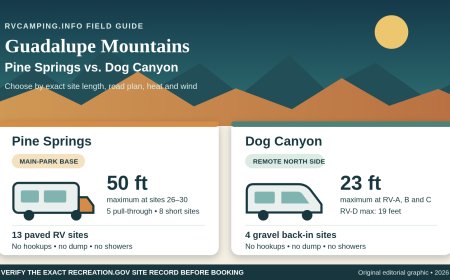
Pine Springs is the practical main-park base with five 50-foot pull-through sites; remote Dog Canyon is limited to four compact-RV spaces of 23 feet or less.

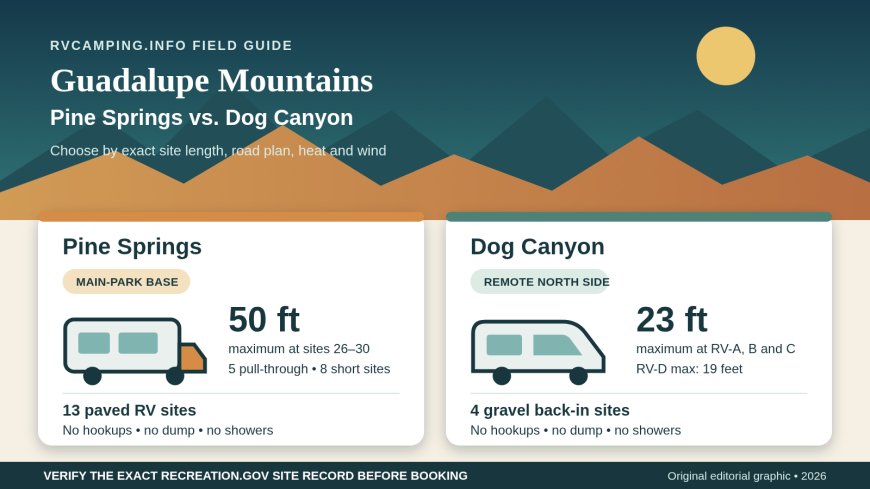
Guadalupe Mountains RV camping: Pine Springs vs. Dog Canyon
By Romana for RVCamping.info | September 27, 2026
Why this is not another Big Bend comparison: RVCamping.info published a Big Bend campground comparison on September 18, 2026. Repeating it nine days later would violate the site's 90-day duplication rule. This replacement covers Guadalupe Mountains National Park, a comparable West Texas desert-and-mountain destination that had not been reviewed in the publication manifest.
Pine Springs and Dog Canyon are both dry campgrounds, but they solve different trip problems. Pine Springs is the practical base for the park's main visitor center and trail system, with four pull-through RV spaces that list a 50-foot equipment limit. Dog Canyon is a remote north-side campground where every RV space is 23 feet or shorter. It is cooler at night and quieter, but it is not a shortcut to Pine Springs.
The best default for most RV travelers is Pine Springs. Pick Dog Canyon only if your complete camping unit fits its exact reserved site, you want the north district, and you arrive with enough fuel, food and water margin for an isolated stay.
The short comparison
| Question | Pine Springs | Dog Canyon |
|---|---|---|
| Best for | Main park access, Guadalupe Peak area, larger RVs | Small vans, truck campers and compact trailers; north-district trails |
| RV inventory | 13 paved RV spaces in a marked parking area | 4 gravel back-in RV spaces |
| Published reservable fit | 20–22 feet at nine sites; 50 feet at sites 26–30 | 23 feet at RV-A, RV-B and RV-C; 19 feet at RV-D |
| Hookups | None | None |
| Dump station | None | None |
| Fresh-water tank fill | No hose connection; potable water is for bottles and hydration packs | Drinking water is listed, but no site hookup; arrive self-contained |
| Restrooms and showers | Flush toilets and utility sink; no showers | Flush toilets and sinks; no showers |
| Reservations | Recreation.gov; all sites reservable up to six months ahead | Recreation.gov; all sites reservable up to six months ahead |
| Road approach | Just off paved U.S. 62/180 | End of NM 137; 70 miles from Carlsbad and about two hours by the published route from Pine Springs |
| Heat and exposure | Desert setting at about 5,730 feet; limited shade and common high wind | About 6,300 feet; cooler nights, some morning shade, but similar daytime highs |
| Generator rule | Allowed outside 8 p.m.–8 a.m. quiet hours | Allowed outside 8 p.m.–8 a.m. quiet hours |
NPS describes both campgrounds as open year-round and says every Pine Springs and Dog Canyon site can be reserved as much as six months ahead.[1] Recreation.gov identifies March through May and September through November as the busiest periods at both campgrounds.[2][4]
Pine Springs: the useful parking lot
Pine Springs is easy to understand once you drop the image of a conventional wooded campground. Its RV area is a paved parking lot next to a busy trailhead. Painted lines define the spaces. Day hikers and overflow foot traffic can make the area feel active rather than secluded.[1][2]
That trade is often worthwhile. The campground sits just off U.S. 62/180, near the visitor center, and puts campers at the trail system serving Guadalupe Peak, Devil's Hall and the Bowl. It is also the only in-park option in this comparison with published 50-foot pull-through inventory.
The park's broad rule says RVs and trailers 55 feet or longer are prohibited at Pine Springs. Do not read that as a promise that a 54-foot rig fits. The current individual records top out at 50 feet, and only sites 26, 27, 28, 29 and 30 are in that larger group. The remaining eight reservable RV spaces list a 20-, 21- or 22-foot maximum.[1][3]
Pine Springs site-by-site fit
| Site | Published equipment maximum | Published site size | Entry |
|---|---|---|---|
| 21 | 22 ft | 25 × 25 ft | Back-in |
| 22 | 22 ft | 25 × 25 ft | Back-in |
| 23 | 22 ft | 25 × 25 ft | Back-in |
| 24 | 22 ft | 24 × 25 ft | Back-in |
| 25 | 20 ft | 24 × 25 ft | Back-in |
| 26 | 50 ft | 53 × 24 ft | Pull-through |
| 27 | 50 ft | 53 × 24 ft | Pull-through |
| 28 | 50 ft | 53 × 24 ft | Pull-through |
| 29 | 50 ft | 53 × 24 ft | Pull-through |
| 30 | 50 ft | 53 × 20 ft | Pull-through |
| 31 | 21 ft | 23 × 12 ft | Entry listed as N/A |
| 32 | 21 ft | 23 × 12 ft | Entry not stated |
| 33 | 20 ft | 22 × 12 ft | Entry not stated |
Those numbers come from the individual Recreation.gov records retrieved on September 27, 2026, not from an estimate made from a campground map.[3] Three listings, sites 23, 24 and 25, also display an 8-foot overhead-clearance field even though the RV area is described and pictured as an open paved lot. Treat that field as a booking-data conflict: ask the park to explain it before assigning any RV taller than eight feet to those sites. Do not simply ignore a restrictive field because the photo looks open.
A 50-foot maximum still does not answer every towable question. Check whether the listing measures the trailer, the motorhome, the towing combination or the vehicle allowed within the painted space. Recreation.gov permits up to two vehicles in these individual records, but that does not establish where an unhitched tow vehicle may park when the trailer fills most of the site. Save the exact site record and call the park if your total combination is close to the published dimensions.
Dog Canyon: compact rigs and a long way around
Dog Canyon is a separate destination in the park's isolated northern district. Recreation.gov places it at the end of NM 137, 70 miles from Carlsbad and 110 miles from Pine Springs. The published route between campgrounds takes about two hours. It crosses open rangeland where cattle may be on the road.[4]
The RV area has four gravel back-in spaces. RV-A, RV-B and RV-C each list a 23-foot equipment maximum and a 23-by-13-foot site. RV-D is smaller at a 19-foot maximum and a 19-by-13-foot site.[5] That makes Dog Canyon a realistic match for a camper van, truck camper, compact motorhome or short trailer, not a fallback for a larger coach that could not get Pine Springs.
| Dog Canyon site | Published equipment maximum | Published site size | Entry |
|---|---|---|---|
| RV-A | 23 ft | 23 × 13 ft | Back-in |
| RV-B | 23 ft | 23 × 13 ft | Back-in |
| RV-C | 23 ft | 23 × 13 ft | Back-in |
| RV-D | 19 ft | 19 × 13 ft | Back-in |
Dog Canyon's higher, protected setting brings some morning shade and cooler nighttime air. Recreation.gov cautions that daytime highs can still resemble Pine Springs. The campground has no cellular service; limited Wi-Fi may be available at the intermittently staffed ranger station.[4]
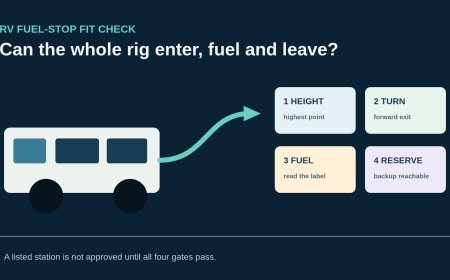
Route this as a fuel-and-supplies problem, not only a mileage problem. The park tells travelers to fuel and shop before entering. Travelers approaching from New Mexico should use Whites City as the final stop for gas, diesel, food and ice; no fuel is sold in the park.[6] Download the reservation and maps before leaving reliable service.
Hookups, water, waste and power planning
Neither campground has electric, water or sewer hookups. Neither has a dump station or showers.[1][2][4] Pine Springs specifically prohibits connecting a hose to fill an RV fresh-water tank; its potable water is intended for bottles and hydration packs.[1]
Arrive with the tank level your measured payload and axle limits can safely carry. Conserve capacity for drinking and cooking, and do not plan to drain gray water on the ground. NPS directs campers to use campground utility sinks for dishwater and identifies the closest free dump station as being in Carlsbad.[1] That is much more convenient after Dog Canyon than after Pine Springs, but a traveler should verify that outside facility before depending on it.
Generators may run only outside the 8 p.m. to 8 a.m. quiet period. The rule does not make either campground an all-day air-conditioning solution: you still need enough battery, fuel and thermal margin for quiet hours, and strong wind may make awning use impractical.[1][2][4]
Open wood and charcoal fires are prohibited. Recreation.gov also includes portable propane fire rings in the open-fire ban. Cooking stoves and lanterns must use containerized fuel.[2][4]
Season, heat and wind change the choice
Both campgrounds operate year-round, but "open" is not the same as comfortable. Pine Springs averages its hottest conditions from June through August. NPS places the wetter period between May and September and warns that intense local storms can trigger flash floods. Summer visitors should avoid midday activity and carry one gallon of water per person per day for hiking.[6][7]
Dog Canyon's 6,300-foot location is higher than Pine Springs and can deliver cooler nights, but the official listing warns that daytime highs may be similar.[4] If the trip depends on air conditioning, neither dry campground is a robust summer choice without a carefully tested off-grid power plan.
Wind is the other seasonal constraint. NPS identifies November through March as the windy season, when winds above 30 mph are common and gusts may reach 50–80 mph. Pine Springs' Recreation.gov page separately warns that gusts over 50 mph are common, especially in winter and spring.[2][6] Check the forecast before committing to the exposed parking area, close the awning before conditions deteriorate, and be prepared to change hiking and driving plans.
Reservations: inspect the exact record before paying
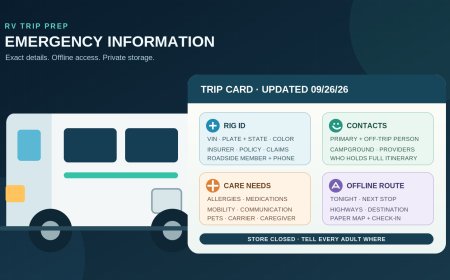
Every Pine Springs and Dog Canyon campsite is reservable through Recreation.gov up to six months in advance.[1] That includes same-day inventory when available; it does not mean you can arrive and rely on a self-pay vacancy. Cell coverage is limited at Pine Springs and absent at Dog Canyon, so book and save the confirmation before the final approach.[2][4]
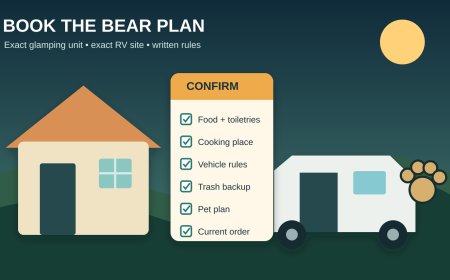
Use this order:
- Measure the RV body and the complete travel combination.
- Open the exact campsite record, not just the campground overview.
- Confirm the listed equipment type, maximum length, site dimensions, surface and entry.
- Resolve restrictive or contradictory fields with the park before booking.
- Save screenshots or a PDF of the record and reservation.
- Recheck NPS alerts, Recreation.gov notices and the weather before departure.
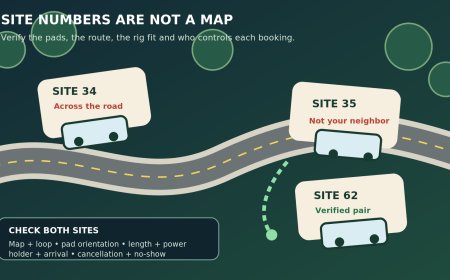
Recreation.gov warns that booking an incompatible site may lead to refusal without a refund.[2][4] The warning matters here because Pine Springs mixes 20-foot spaces with 50-foot pull-throughs, and Dog Canyon's smallest site is four feet shorter than the other three.
Roads and arrival plan
Pine Springs is the simpler RV approach. It is just off U.S. 62/180 near milepost 130. The published approaches are 55 miles west from Carlsbad, 110 miles east from El Paso, or north from Van Horn on Texas 54 to U.S. 62/180.[2]
Dog Canyon requires a deliberate north-side route. From Carlsbad, Recreation.gov directs drivers north on U.S. 285 and south on NM 137. From Pine Springs, the published route runs east on U.S. 62/180, then through Dark Canyon Road to NM 137. Cattle frequently occupy this open-range roadway.[4] Do not accept an unverified navigation shortcut onto a primitive road simply because it reduces the map's mileage.
Arrive in daylight. Dog Canyon's remote setting, lack of cell service and intermittent staffing leave less room for a wrong turn, tire problem or site-fit surprise. Pine Springs has the easier approach, but its trailhead congestion makes a midday arrival less appealing during busy spring and fall weekends.[2]
Current-conditions caveat for a 2026 trip
This package checked the NPS live alert feed on September 27, 2026. The feed contained two active notices, one about Devil's Hall trail difficulty and one about cashless park-store payments; it did not list a Pine Springs, Dog Canyon or campground-approach closure.[8] That is a dated snapshot, not a promise about your arrival day.
Conditions can change after this article is prepared. Reopen the NPS alerts and conditions page, both Recreation.gov campground records, and the weather forecast before leaving the last full-service town. Call the park when a live alert, road report or exact-site field affects whether your RV can enter or occupy the reserved space.
Bottom line
Choose Pine Springs for the main park, the easiest road approach and the only published 50-foot inventory. Accept that the RV area is a dry, exposed parking lot with trailhead traffic.
Choose Dog Canyon for a compact rig and a north-district stay, not as overflow for Pine Springs. Its cooler nights and smaller campground come with a two-hour separation from the park's main campground, no cell service and a hard 19- or 23-foot site limit.
Whichever one you reserve, the campground name is not the final fit test. The exact site record is.
Sources
- [1] National Park Service, Camping - Guadalupe Mountains National Park. Retrieved September 27, 2026.
- [2] Recreation.gov, Pine Springs Campground. Retrieved September 27, 2026.
- [3] Recreation.gov, Pine Springs individual RV-site records (sites 21–33). Thirteen linked site records retrieved September 27, 2026; exact dimensions preserved in the evidence package.
- [4] Recreation.gov, Dog Canyon Campground. Retrieved September 27, 2026.
- [5] Recreation.gov, Dog Canyon individual RV-site records (RV-A–RV-D). Four linked site records retrieved September 27, 2026; exact dimensions preserved in the evidence package.
- [6] National Park Service, Safety - Guadalupe Mountains National Park. Retrieved September 27, 2026.
- [7] National Park Service, Weather - Guadalupe Mountains National Park. Retrieved September 27, 2026.
- [8] National Park Service, Guadalupe Mountains live park-alert feed. Snapshot retrieved September 27, 2026.
What's Your Reaction?