



Booking a glamping stay with mobility needs: verify the route, bed, bathroom, and emergency plan
A four-gate booking check for glamping guests with mobility needs: verify the exact route, bed setup, bathroom and emergency plan before paying.

Booking a glamping stay with mobility needs: verify the route, bed, bathroom, and emergency plan
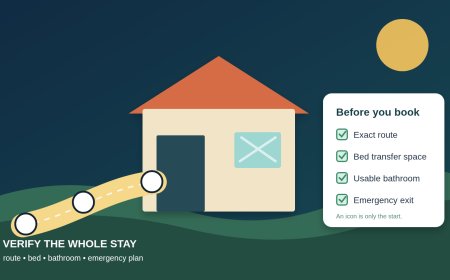
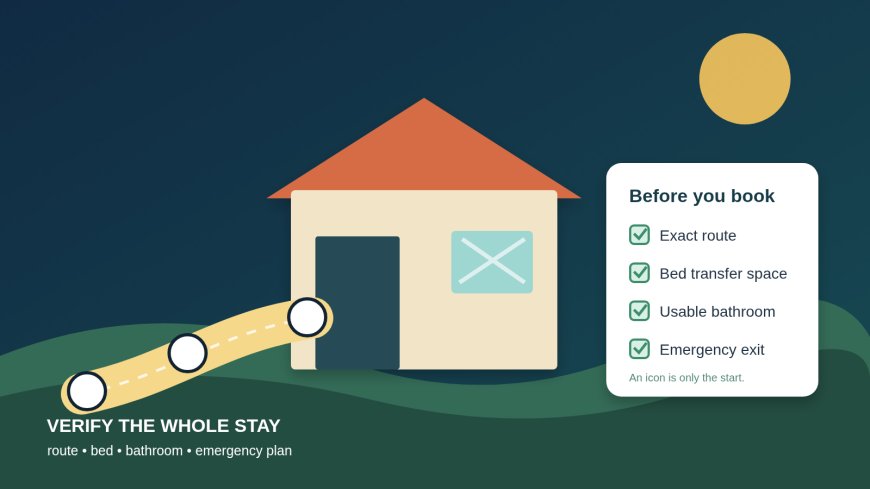
An "accessible" badge is a reason to ask better questions, not a reason to stop asking. Before booking a glamping tent, yurt or cabin, verify four connected pieces for the exact unit: the route from parking, the bed and transfer space, the bathroom, and the emergency plan. If any one of them fails, the stay may fail.
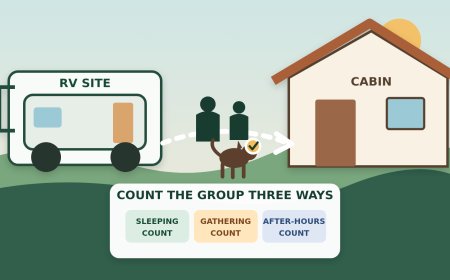
This is a narrower test than a general accessible-campground checklist. It follows one guest from the vehicle into the glamping unit, through a nighttime bathroom trip, and back out during an emergency. For mixed RV and glamping groups, run the same check from the RV site too, then confirm that the two accommodations are connected by a route everyone can use.
This article offers booking questions, not legal advice or a finding that a property complies with disability law. The guest decides whether the measured setup fits their body, mobility device and transfer method.
Use four gates, in order
Do not average strengths and weaknesses. A good ramp does not fix a bed that cannot be approached. A suitable bed does not fix a shower across 300 yards of sloped road. Treat each item as a pass-or-stop gate:
- Route: Can the guest get from the arrival point to the door, bathroom and group spaces in expected weather?
- Bed: Can the guest reach the sleeping surface, position a mobility device and transfer using their normal method?
- Bathroom: Is the usable toilet and bathing setup private or shared, reachable at night and open when needed?
- Emergency: Can the guest receive an alert, leave the unit and reach a safe place if power, weather, smoke or fire changes the normal route?
A property may use "accessible" accurately and still lack a feature one traveler needs. The U.S. Department of Justice reservation rule for covered places of lodging requires the reservation service to give a traveler enough detail about accessibility to judge whether the property and room will work.[1] That principle is useful at a glampsite: ask for facts that support your own decision.
Gate 1: verify the continuous route
Start with the exact parking or drop-off point, not the property entrance. Ask staff to trace the permitted route to the assigned unit number. Record the distance, surface, narrowest point, steepest section, cross slope, steps, curbs, drainage channels, gates, thresholds and road crossings. Ask what becomes loose, muddy, icy or flooded after ordinary weather.
Then continue the line. Measure from the glamping door to the toilet the guest would use at 2 a.m., to the shower, and to the RV site or common table where the group expects to gather. "Nearby" and "short walk" are not measurements.
California State Parks provides a sharp real-world example at Sue-meg State Park. Its page says all four Agate Campground cabins are wheelchair accessible, while the restroom directly across the road does not provide wheelchair access. Another restroom building that does is about 200 to 300 yards away by campground road; an accessible portable toilet is nearer the cabins.[4] The cabin label alone cannot tell a guest which nighttime toilet option works.
Ask for a current, continuous video from parking to the unit and bathroom, filmed along the route guests must use. Close-up photos of a ramp can hide the gravel approach, a tight turn at the top or a raised door track. If staff cannot make a video, request photos at every change of surface and a site map marked with the assigned unit, bathroom and safe drop-off.
Gate 2: verify the bed as a transfer setup
"Sleeps four" describes capacity, not usability. Get the bed type, mattress size and floor-to-top-of-mattress height with the bed made. Ask for clear floor dimensions on both sides and at the foot, plus the narrowest aisle from the door. Confirm whether a bunk, futon or platform is the only low sleeping option.
The Access Board's ADA standards for transient lodging illustrate why layout matters: an accessible sleeping area generally provides clear floor space on both sides of a bed, with an exception for certain two-bed arrangements where one clear space lies between the beds.[2] The standard does not answer a traveler's next questions. It does not state the mattress height in the assigned cabin, whether a platform blocks the legs of a portable lift, or whether a nightstand has been moved into the approach space.
Ask staff to photograph the bed from the doorway and each side. Put a tape measure in the frame for height and aisle width. If the guest uses a transfer board or portable lift, confirm the needed approach and under-bed clearance with the equipment provider. Do not ask a reservation agent to judge whether a transfer will be safe.
Park listings also differ in useful detail. Mount Tamalpais State Park identifies Steep Ravine Cabin 1 as accessible and says its beds, turning space, table and counter are accessibly designed, with accessible parking and restrooms nearby.[5] That is more helpful than an icon, but "nearby" still leaves distance, surface, bed height and bathroom fixtures to confirm for one guest.
Gate 3: verify the actual bathroom, not the amenity list
First ask whether the assigned unit has a private bathroom. If not, identify the exact shared building and backup toilet. Get its hours, cleaning closures and seasonal status. Confirm that the route and entrance remain usable after dark, and whether a locked gate or code changes after the office closes.
For the toilet, ask about seat height, clear floor space, transfer side, grab-bar positions, flush control and door swing. For a shower, identify it as a roll-in shower, transfer shower, tub or curbed stall. Ask for the curb height, seat type and height, handheld shower, controls, grab bars and room for the guest's mobility device. A generic photo of the bathhouse exterior proves none of this.
Oregon State Parks says its ADA yurts and cabins have entrance ramps and accessible restrooms. The same statewide page notes that deluxe cabins and Umpqua Lighthouse deluxe yurts have private bathrooms with showers.[6] Those are different arrangements. A booking needs the exact unit type and unit number, because "accessible restroom" might mean a bathroom inside the rental or a separate facility reached outdoors.
If the guest needs a shower chair or other property equipment, request its model, dimensions, weight limit, arm style and reservation status. "Available on request" is weak unless the property can attach the item to the booking and name a backup if it is missing or broken.
Gate 4: build an emergency plan around the guest
Normal access and emergency egress are different questions. Ask how the property warns sleeping guests about fire, severe weather, wildfire, flooding or evacuation. A siren may not wake a guest with limited hearing. A text alert may fail where cell service is poor. A verbal knock may not reach a remote yurt.
The Access Board's egress guide says evacuation plans should address all occupants, including people with disabilities.[3] For a glamping stay, turn that broad principle into a short, property-specific plan:
- Who contacts the unit after hours, and by what methods?
- Where is the nearest usable exit from the unit, and can it be opened without moving furniture?
- What outdoor route leads to the assembly area? Does it include stairs, soft ground, locked gates or vehicle traffic?
- Who can provide an accessible vehicle evacuation if the guest's own vehicle or driver is unavailable?
- What is the alternative if the normal bathroom or exit route is blocked?
- Where will a mobility device, shoes, light, medication, keys and phone stay overnight so they can be reached quickly?
Agree within the group who checks the glamping unit and who handles the RV. Do not make an informal promise to carry a person or mobility device unless the traveler has chosen that method and the people involved know it can be done safely. Ask the operator what trained help and evacuation equipment actually exist; do not fill gaps with assumptions.
Send one message before the cancellation deadline
We are considering glamping unit [number/type] for [dates] and need details for a guest with mobility needs. Please answer for that exact unit.
1) From the parking or drop-off point, what are the distance, surface, narrowest width, steepest section, steps, thresholds and weather-sensitive areas on the route to the door? Please give the same details for the route to the usable toilet, shower and our RV site [number], if applicable.
2) What bed will this guest use? Please provide the mattress size, floor-to-top height, clear floor space on each side and at the foot, aisle width, and under-bed clearance if any. Can furniture remain in the confirmed layout?
3) Is the usable bathroom private or shared? For the toilet, please provide seat height, transfer side, clear space and grab-bar positions. For the shower, please identify the type, curb, seat, controls and handheld shower. What are the overnight hours and backup if this facility closes?
4) How will this unit receive emergency alerts after hours? What route reaches the assembly area, and what accessible transportation or staff assistance is actually available during an evacuation?
Please send current photos with a tape measure and a continuous route video if possible. Attach the answers and unit number to the reservation, and tell us what could change before arrival.
Save the reply, images, map and cancellation terms together. If the operator changes the unit, repeat all four gates. "Equivalent" is not a measurement.
Recheck on arrival before unloading
One person should walk or roll the complete route while another checks the unit. Compare the bed, bathroom and door setup with the written answers. Test the night route before dark, locate the assembly area, and save the after-hours number in every adult's phone.
If a material feature is different, document it and speak with staff while another unit or refund may still be possible. The booking is ready only when the exact route, bed, bathroom and emergency plan work as one chain.
Sources
- Americans with Disabilities Act Title III Regulations, U.S. Department of Justice, reservation requirements at 28 CFR § 36.302(e) (accessed September 25, 2026).
- Chapter 8: Special Rooms, Spaces, and Elements, U.S. Access Board, transient lodging sleeping areas and bathrooms (accessed September 25, 2026).
- Chapter 4: Accessible Means of Egress, U.S. Access Board, evacuation planning guidance (accessed September 25, 2026).
- Accessible Features at Sue-meg State Park, California State Parks, cabin and restroom example (accessed September 25, 2026).
- Accessible Features at Mount Tamalpais State Park, California State Parks, Steep Ravine Cabin 1 example (accessed September 25, 2026).
- Cabins and Yurts, Oregon State Parks, unit types and accessibility information (accessed September 25, 2026).
What's Your Reaction?