
















Dicor 501LSW-1 review: right for some RV roofs, wrong for others
Dicor 501LSW-1 suits approved horizontal RV roof seams, but not every membrane or joint. Check compatibility, setup, and the key tradeoffs.

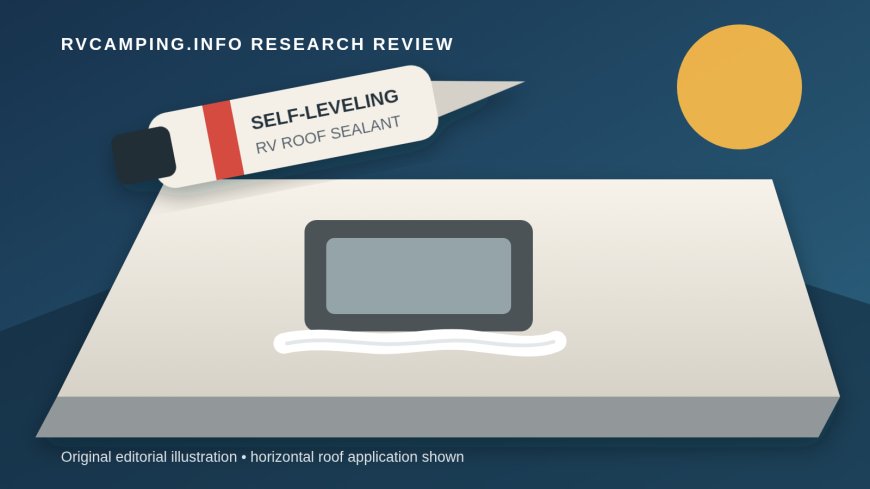
Dicor 501LSW-1 is a sensible maintenance sealant for horizontal seams and roof penetrations when the RV maker or roof-membrane supplier allows it. Skip it for vertical joints, structural repairs, or any roof whose documentation specifies another sealant system. The catch matters: Dicor lists broad material compatibility, but an Alpha Systems roof, for example, calls for Alpha-brand sealants only.[1][4]
Research note: This is a research-based review. RVCamping.info did not buy, apply, or physically test this tube.
Quick verdict
- Best for: Touching up compatible horizontal roof seams around vents, pipes, fasteners, and roof edges.
- Skip it if: Your RV's sealant chart calls for another product, the joint is vertical, the membrane is unknown, or the repair involves loose hardware, rotten decking, a torn membrane, or an active leak whose path has not been found.
- Compatibility boundary: “Compatible with EPDM, TPO and PVC” is not the same as “approved for every EPDM, TPO or PVC roof assembly.” Dicor states the first claim; the roof maker's instructions still decide the second.[1][4]
- Main tradeoff: The self-leveling flow makes a broad horizontal cap easier to form, but it is the wrong behavior on a wall, steep transition, or joint where the bead must stay put.
The exact product and Amazon listing
The product reviewed is the white, 10.3-ounce Dicor HAPS Free Self-Leveling Lap Sealant, part number 501LSW-1. Dicor's current product page shows 501LSW as the white 10.3-ounce horizontal-surface version, and its 2025 aftermarket catalog uses the retail SKU 501LSW-1.[1][2]
As an Amazon Associate, RVCamping.info earns from qualifying purchases. If you buy through an Amazon link in this article, we may earn a commission at no additional cost to you.
Check Dicor 501LSW-1 on Amazon (ASIN B000BRF7QE).[3]
Amazon has more than one listing that uses similar Dicor model wording. This review and link are limited to ASIN B000BRF7QE, the single white 10.3-ounce tube identified as model 501LSW-1 in the listing retrieved for this article.[3]
Why roof identity comes before the caulk gun
Dicor describes this sealant as compatible with EPDM, TPO, and PVC membranes and lists adhesion to a range of rigid substrates, including metal, wood, vinyl, fiberglass, and masonry. It also calls lap sealant a “secondary seal.”[1] That is a useful product boundary. A bead can cover a compatible joint, but it does not replace the primary gasket, butyl tape, fastener, flange, or sound roof structure underneath.
The broad compatibility statement is not blanket approval. Alpha Systems tells owners to use only Alpha-brand sealants in contact with an Alpha roof membrane. Its repair procedure specifies self-leveling sealant for horizontal surfaces and non-sag sealant for vertical ones.[4] RV Repair Club gives the same practical advice at the vehicle level: find the sealant chart for the model year and use the product specified for that location instead of reaching for a generic tube.[7]
Before buying, identify:
- the roof membrane maker and material;
- the RV model year and the manufacturer's sealant chart;
- whether the joint is horizontal, sloped, or vertical;
- what old sealant or coating is already present; and
- whether the problem is a surface crack, a loose component, or damaged membrane or decking.
If any of those answers is unclear, ask the RV manufacturer, membrane supplier, or a qualified service shop. A cheap tube is not cheap if an incompatible solvent or sealant damages the roof.
501LSW-1 versus non-sag sealant
Dicor's current catalog separates the 501 self-leveling family from the 551 non-sag family. The 501LSW-1 is listed under “Self-Leveling (for horizontal surfaces),” while 551LSW-1 is the white non-sag option.[2]
Use that distinction literally. A level roof flange around a vent is the intended kind of job for 501LSW-1. A sidewall seam, window perimeter, or steep front-cap transition needs a product that will not slump. Even on a roof, a crowned or sharply curved section deserves a closer look before using a flowing sealant.
This is also not an adhesive for holding a loose fixture down. Repair the mechanical attachment or primary seal first. Use lap sealant only where the approved repair instructions call for a secondary weather seal.
What the independent evidence adds
One comparative video test from All About RVs reported that Dicor retained strong adhesion and cleaned up well on the test panel, while several competing products showed lifting or trapped dirt. The reviewer also warned that the test substrate was new roofing and that results on an older RV roof differed, so the comparison is useful evidence, not a universal durability promise.[8]
That caveat matches the bigger lesson here. Surface age, contamination, old sealant, membrane chemistry, bead thickness, weather, and movement all affect the result. Owner anecdotes can show possible failure modes, but they cannot prove that every tube will crack, yellow, or last a set number of years.
A safer setup and application plan
1. Inspect before covering anything
Look for gaps, lifted edges, voids, shrinkage, surface cracks, loose fasteners, soft decking, tears, and staining inside the RV. Keystone recommends a full exterior-seal inspection at least twice a year and a roof inspection every three months.[5] Your own manual may set a different interval, so follow the stricter requirement.
Do not assume the visible crack is the leak source. Water can travel under a membrane or along framing before it appears indoors. Soft roof material, recurring leakage, a loose vent, or widespread seal failure calls for diagnosis rather than another layer of sealant.
2. Confirm safe roof access
Check whether the roof is walkable and where weight may be placed. Work only on a dry, stable surface with suitable fall protection and a safely placed ladder. Keystone advises using an authorized service center when roof conditions are unsafe or the owner is not comfortable with the inspection.[5]
3. Follow the roof maker's cleaning instructions
Do not improvise with a strong solvent. Alpha's repair sheet, for example, says to use regular soap and water, let the area dry, and avoid solvents because they can damage existing caulk and weaken plastic roof parts.[4] Another roof system may specify a different cleaner or primer.
Remove only material that the applicable repair procedure tells you to remove. Alpha advises pulling away loose caulk by hand and leaving firmly adhered material in place; it warns against tools that could puncture the membrane.[4] That is good evidence for Alpha roofs, not a universal instruction for every assembly.
4. Make a controlled bead
Use an in-date, undamaged tube and a caulk gun you can control. Apply enough approved sealant to bridge onto clean, sound material on both sides of the joint. Do not treat “self-leveling” as “flows like paint.” It should relax into a wider cap, but it still needs to be placed over the area that requires sealing.
Keep the product off sidewalls, awnings, clothing, and ladder rungs. Stop if it runs toward an edge or if the joint geometry makes it impossible to maintain coverage. That is a sign to reassess the product choice.
5. Protect the repair and recheck it
Follow the current label and technical instructions for temperature, skin time, cure, and weather exposure. We did not find one current, product-page cure schedule clear enough to turn into a universal rain deadline, so this article does not invent one. Check the actual tube and contact Dicor if the directions are incomplete.
Inspect the bead after it settles and again after travel or severe weather. Look for skipped sections, bubbles, lifting, contamination, or a path that can hold water. Continue the roof-inspection schedule rather than treating one application as permanent maintenance.
Who should buy it
Buy Dicor 501LSW-1 if all of these are true:
- the repair is on a horizontal or nearly horizontal roof detail;
- the RV or roof maker approves Dicor 501 self-leveling sealant for that location;
- the existing roof and primary attachment are sound;
- you can clean, dry, apply, and protect the repair as instructed; and
- you are prepared to inspect the seal later.
It is a practical choice for a small approved touch-up around a vent flange, pipe penetration, screw head, or roof edge. The single tube also avoids buying a contractor case when the job is limited.
Who should skip it
Skip this specific tube when the roof documentation calls for another system, including Alpha-only applications. Also skip it for vertical joints, windows, sidewall trim, structural bonding, loose accessories, large tears, rotten decking, or a leak that has not been traced.
Owners who cannot safely access the roof should pay for inspection and repair. The same applies when the membrane type is unknown, several incompatible products are layered together, or prior silicone makes adhesion uncertain.
Bottom line
Dicor 501LSW-1 solves a narrow problem well: it forms a flexible secondary seal over approved horizontal RV-roof details.[1][2] Its familiar name does not override the roof maker's sealant chart. Confirm the membrane, the joint orientation, and the specified repair system first. If all three point to 501LSW-1, it is an easy product to justify. If one does not, choose the approved alternative instead.
Sources
What's Your Reaction?