
















Campfire baked potatoes: the safe foil-to-leftovers plan
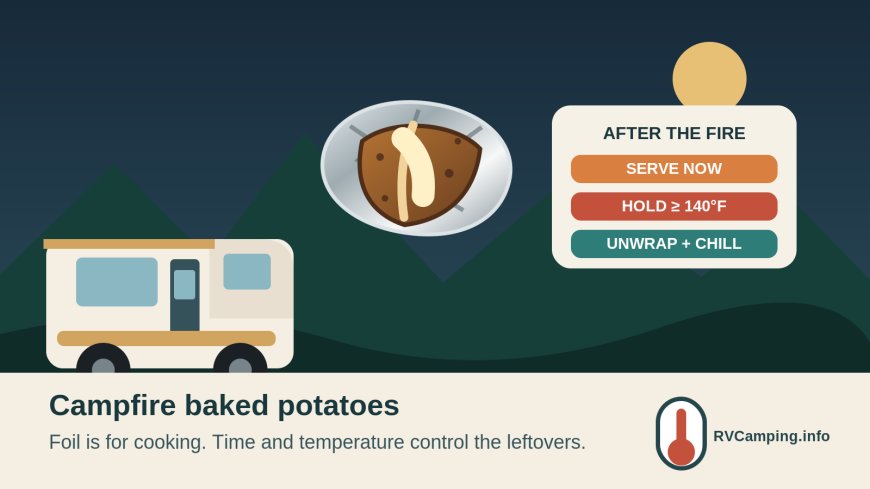
Use foil for cooking, then serve baked potatoes hot, hold them at 140°F or above, or unwrap and cool them quickly for safe campsite leftovers.

Campfire baked potatoes: the safe foil-to-leftovers plan

By Romana | September 23, 2026 | Cooking
Quick answer: Foil is fine for cooking a potato. Trouble starts when a cooked potato stays sealed in foil while it cools slowly or sits around camp. Serve foil-baked potatoes as soon as they are done, or keep them at 140°F or hotter. If you want leftovers, take off the foil, split or cut the potatoes, put them in a shallow container, and get them into a refrigerator at 40°F or colder within two hours. On a day above 90°F, that limit drops to one hour.[1][2]
Use a food thermometer for holding, cooling, refrigerator temperature, and reheating. A tender potato is a cooking result; it does not tell you what happened during the hour it sat beside the fire.
The campsite decision in 30 seconds
| Situation | Do this |
|---|---|
| Eating now | Open carefully and serve. Watch for steam burns. |
| Waiting for the rest of dinner | Hold at 140°F or above and check the center with a clean thermometer.[1] |
| Saving leftovers | Remove foil, split or cut, move to a shallow container, and refrigerate promptly.[1][3] |
| Potato has been below hot-holding temperature for over two hours | Discard it. Use a one-hour limit if the outdoor temperature is above 90°F.[1] |
| You do not know how long it sat out | Discard it. Smell and appearance cannot reconstruct time and temperature. |
| RV refrigerator is above 40°F or too crowded to cool food | Do not plan on leftovers. Serve a smaller batch and discard the excess. |
That is the whole system: eat hot, hold hot, or cool fast. Do not create a fourth category called "still warm, probably fine."
Why foil changes the handling plan
A baked potato is a heat-treated plant food.[3] The FDA Food Code places this kind of food under time-and-temperature control when it can support pathogen growth or toxin formation.[3] That classification matters after baking, not because the potato needs a special endpoint before it becomes fluffy.
Foil makes a good cooking packet. It traps moisture, keeps ash off the skin, and is easy to move with tongs. Once the potato leaves the heat, however, the same close wrapper limits exposure to air. The combination worth avoiding is a cooked potato, still sealed, held for too long at a temperature that allows bacterial growth.[2][4]
USDA lists baked potatoes sealed in aluminum foil among foods that have been linked with botulism illness.[2] That statement needs context. It does not mean every foil-baked potato carries botulinum toxin, and it does not make foil dangerous on contact.
A CDC review of U.S. foodborne botulism from 1990 through 2000 describes a Texas restaurant outbreak in 1993 that affected 17 people. The implicated potato dip was made from potatoes baked in foil and then left wrapped at room temperature for several days.[4] CDC also explains that the organism rarely causes illness because toxin production requires several conditions to line up, including low acidity, enough moisture, suitable temperature, and an oxygen-poor setting.[4]
The useful lesson is narrow and practical: never treat foil as storage. Take it off before cooling leftovers, then control time and temperature. Freshly cooked potatoes served hot are not the scenario described in that outbreak.
Before you light the fire
Check the cold side of the plan first. An RV refrigerator should be at 40°F or below for this consumer workflow.[1] Put an appliance thermometer inside and verify the reading before dinner. A refrigerator that feels cool but reads 46°F is not a dependable leftover system.[1]
Pack these items where you can reach them:
- a clean, calibrated food thermometer with a thin probe;
- tongs or heat-resistant gloves;
- a shallow food-storage container;
- a clean knife and cutting board;
- a timer and a label or marker.
Leave enough refrigerator space for air to move around the container.[3] If the fridge is packed wall to wall, cooling a load of hot, dense potatoes will be slow. Cook only what the group is likely to eat, especially when boondocking with limited battery capacity or using a cooler instead of a powered refrigerator.
Foil is optional. You can bake potatoes directly on a grill grate, in a covered pan, or in foil according to the cooking setup and desired skin. This guide is not a recipe, and there is no food-safety bonus for wrapping them. The post-cook decision is what matters.
Serve now or hot-hold with a thermometer
If dinner is ready, open the packets and serve. Point the opening away from faces and hands because trapped steam can burn.
If service is delayed, keep the potatoes genuinely hot. USDA's consumer guidance says cooked food held hot should stay at 140°F or above.[1] For retail operations, the FDA Food Code sets a 135°F minimum for hot-held TCS food.[3] At camp, 140°F is the simpler household target and gives a small buffer for lid opening, wind, and thermometer variation.
Do not count a turned-off oven, extinguished grill, insulated tote, or closed Dutch oven as hot holding unless a thermometer confirms the food remains at or above the target.[1][3] "It still felt warm" is not a measurement.
Start a timer when the potatoes come off controlled heat if you are not actively hot-holding them. The discard limit is two hours, or one hour when the air temperature is above 90°F.[1][2] That clock includes serving time, conversation, cleanup, and the walk back to the RV.
Cool leftovers fast in a small RV refrigerator
Do not wait for potatoes to reach room temperature. USDA says hot leftovers can go directly into refrigeration and recommends shallow containers so food cools quickly.[1]
Use this sequence:
- Remove every foil wrapper. Foil used for cooking has finished its job.[2][4]
- Split each potato lengthwise or cut large potatoes into smaller portions. FDA lists smaller or thinner portions as a rapid-cooling method.[3]
- Arrange the pieces in one layer in a shallow container. Do not pile six intact potatoes into a deep bowl.[1][3]
- During active cooling, leave the container loosely covered if it is protected from drips and other contamination. FDA's retail guidance allows loose covering or no covering during cooling to improve heat transfer.[3]
- Refrigerate immediately, with space around the container. Seal it once cold.[1][3]
- Label the container with the date.
For a measurable cooling check, the FDA Food Code says to lower cooked TCS food from 135°F to 70°F during the first two hours, then reach 41°F or colder no later than six hours after cooling began.[3] This is a standard for retail operations, but it is a useful way to test whether an RV refrigerator and container arrangement are doing the job. Probe the thickest piece without repeatedly opening the refrigerator.
If cooling is not on pace, divide the potato into smaller pieces, move the container to a colder open spot in the refrigerator, or use a clean ice-water bath around the container before returning it to refrigeration. FDA names shallow pans, thinner portions, rapid-cooling equipment, and ice-water baths among acceptable cooling methods.[3]
A cooler deserves the same temperature test. Plenty of ice is not proof that the food itself reaches and stays at 40°F or below.[1] Keep the potato container above meltwater, limit lid opening, and check the cooler with a thermometer. If you cannot maintain cold control, do not keep the potatoes for tomorrow.
Toppings have their own clock
Butter is easy to portion at service. Sour cream, cheese sauce, cooked bacon, chili, and other perishable toppings need their own hot or cold control. Keep cold toppings at 40°F or below and return them to refrigeration promptly.[1]
Do not stir a tray of toppings into leftover potatoes and assume the potato timer resets. It does not. The safe window follows the ingredient with the least certain time-temperature history.[1] If sour cream sat on the picnic table for three hours, folding it into a freshly opened potato does not rescue it.[1]
Use small serving cups rather than putting the entire container on the table. Refill from the refrigerator as needed. This reduces waste and makes the decision about what to save much easier.
Store, reheat, or discard
Refrigerated leftovers keep for three to four days under USDA guidance.[1] Freeze them sooner if they will not be eaten in that window. In an RV, use the shorter end whenever refrigerator temperature has been unstable during driving, hookups have failed, or the door has been opened often.
Reheat only the portion you plan to eat. Bring the center to 165°F and verify it with a thermometer.[1] A skillet, oven, air fryer, or microwave can all work if the cold center reaches the target.[1] Rotate or turn microwave-heated portions and check more than one spot.
Discard potatoes when:
- they exceeded the two-hour limit, or the one-hour limit above 90°F;
- the holding or cooling time is unknown;
- refrigeration stayed above 40°F long enough that safe control cannot be established;
- the container leaked, sat in cooler meltwater, or was contaminated;
- the leftovers are past four refrigerated days.[1]
Do not taste a questionable potato to decide. Reheating is not a time machine, and a normal smell is not a temperature log.
When botulism symptoms require emergency care
Botulism is rare, but it is serious. CDC lists difficulty swallowing, muscle weakness, double or blurred vision, drooping eyelids, slurred speech, and difficulty breathing among common symptoms.[5] Foodborne cases can also involve nausea, vomiting, abdominal pain, or diarrhea.[5]
If anyone develops possible botulism symptoms after eating, seek emergency medical care immediately. CDC calls botulism a medical emergency and says not to wait.[5] Keep the food isolated from people and pets, and follow instructions from medical or public-health professionals rather than transporting or tasting it.
The no-drama camp rule
Foil belongs to the cooking step, not the storage plan. After the potatoes come off the heat, choose one lane: serve them, verify hot holding at 140°F or above, or remove the foil and cool them quickly. If the timer or temperature record is missing, throw them away. A few dollars of food is not worth inventing a safe history after the fact.
Sources
- Leftovers and Food Safety — USDA FSIS guidance for hot holding, the two-hour/one-hour rule, rapid cooling, refrigerator storage, and reheating.
- Clostridium botulinum & Botulism — USDA FSIS consumer guidance identifying unrefrigerated foil-sealed baked potatoes as a reported botulism association and advising prompt refrigeration.
- FDA Food Code 2022 — FDA retail model code definitions and sections 3-501.14 through 3-501.16 on cooling methods, cooling targets, and holding temperatures.
- Foodborne Botulism in the United States, 1990–2000 — CDC outbreak review describing the 1993 Texas potato-dip outbreak and the combination of conditions needed for toxin production.
- Symptoms of Botulism — CDC symptom list and emergency-care advice, reviewed April 1, 2024.
What's Your Reaction?