







Lodgepole vs. Azalea vs. Sunset: which Sequoia and Kings Canyon campground fits your RV?
Compare Lodgepole, Azalea and Sunset by exact RV fit, approach-road restrictions, dry-camping services, generator hours, booking and park geography.

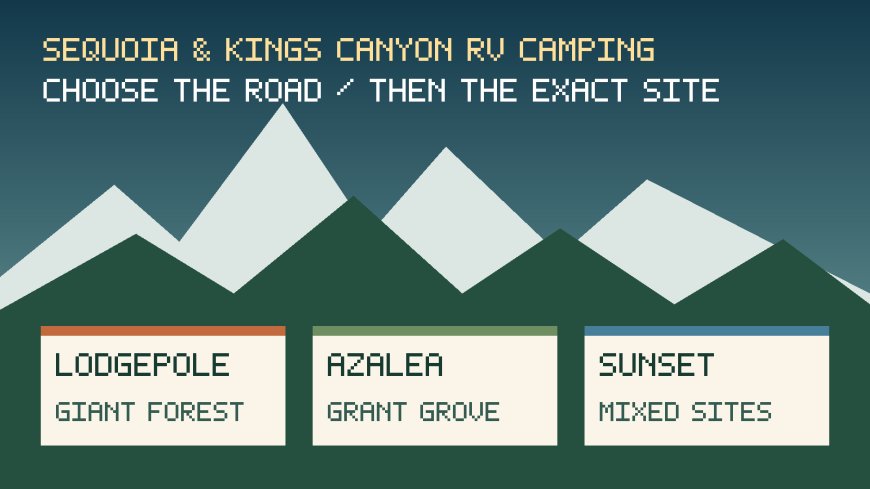

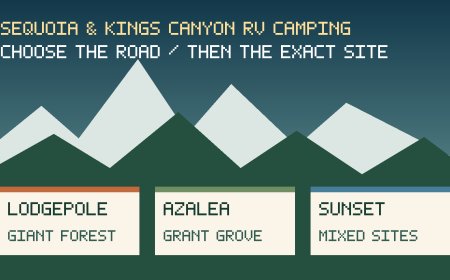
Bottom line: Pick Lodgepole when Giant Forest and the General Sherman Tree are the center of the trip, but route a rig longer than 22 feet through the Big Stump entrance on Highway 180 rather than up the tight Highway 198 switchbacks.[1][3] Pick Azalea for the broadest practical RV fit near Grant Grove; one current listing accepts a 39-foot RV or trailer, though its driveway grade is marked severe.[5][8] Pick Sunset for the same Grant Grove geography with a more mixed inventory, where many sites are tent-only and an individual "standard nonelectric" label still may not permit an RV.[6][9]
These are National Park Service campgrounds with shared campground facilities, not concession RV resorts. The current Recreation.gov inventory is nonelectric, and the facility pages describe shared potable or drinking water rather than campsite water connections.[4][5][6] Plan a dry-camping stay, then verify every equipment field on the exact site before paying.
At a glance
| Decision point | Lodgepole | Azalea | Sunset |
|---|---|---|---|
| Best geographic use | Giant Forest, General Sherman, Tokopah Falls | Grant Grove and a balanced base between the two parks | Grant Grove and walkable General Grant Tree access |
| Elevation | About 6,700 feet | About 6,500 feet | About 6,500 feet |
| Electric hookup | No; current RV-capable inventory is nonelectric | No; current RV-capable inventory is nonelectric | No; current inventory is nonelectric |
| Shared water and toilets | Drinking water and flush toilets | Potable water and flush toilets | Potable water and flush toilets |
| Generator rule | 8–11 a.m. and 5–8 p.m. | 9 a.m.–9 p.m. | 9 a.m.–9 p.m. |
| Route warning | Use Highway 180 for rigs over 22 feet | Direct Highway 180 approach from Fresno | Direct Highway 180 approach from Fresno |
| Exact-site lesson | Site 162: 26-foot RV, 18-foot trailer | Site 74: 39-foot RV or trailer, severe grade | Site 090: 23-foot driveway, no RV or trailer listed |
The last row is not a campground-wide maximum. It shows why the booking decision belongs at the site level. Within one campground, adjacent listings can differ in equipment type, driveway length, slope, number of vehicles and whether an RV is permitted at all.[7][8][9]
Start with the road, not the campsite
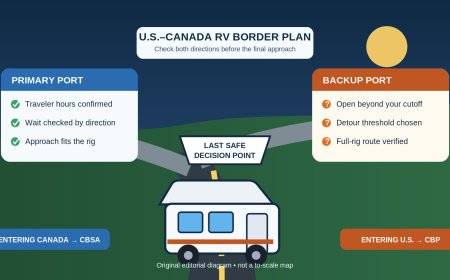
Lodgepole looks close to the southern Ash Mountain entrance on a map. That does not make Highway 198 the right RV approach. The National Park Service says the Generals Highway climbs about 5,000 feet through narrow, winding terrain.[3] Vehicles longer than 24 feet are not advised from Foothills Visitor Center to Potwisha, and vehicles longer than 22 feet are not advised from Potwisha to Giant Forest Museum.[3] A single vehicle longer than 40 feet is prohibited on the latter stretch.[3]
For a longer motorhome or a truck-and-trailer combination, enter through Kings Canyon’s Big Stump entrance on Highway 180. NPS identifies that as the preferred route for oversized vehicles, and its campground page says Lodgepole is about 45 minutes from the Highway 180 entrance.[1][3] This is a route choice, not a promise that a campsite will fit. You still need a site whose equipment allowance and paved parking area match the rig.
Azalea and Sunset sit in the Grant Grove area, roughly three miles beyond the Big Stump entrance, so they avoid the tight southern climb entirely.[5][6] That makes both easier first-night or last-night choices for a long rig. It also changes the sightseeing plan. Driving the RV from Grant Grove to Giant Forest still puts it on the park road network, and side roads have separate restrictions.[3] Vehicles longer than 22 feet and vehicles towing units are prohibited on Moro Rock/Crescent Meadow Road; vehicles longer than 22 feet are also prohibited on Crystal Cave Road.[3]
A campsite reservation never waives a road rule. If the tow vehicle is your sightseeing vehicle, leave the trailer at camp and verify parking at the destination. If the motorhome is your only vehicle, build shuttle use and RV parking into the day instead of assuming every attraction lot can take it.
Rig fit: compare the exact site, not the campground name
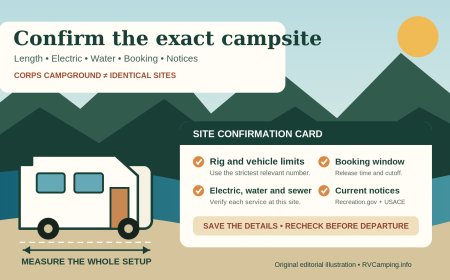
Recreation.gov’s site records make the differences concrete. Lodgepole site 162 is drive-in and back-in. It permits an RV, pickup camper or camper van up to 26 feet, but a trailer, pop-up or fifth wheel only up to 18 feet. The driveway is 26 feet long, paved and marked with a slight grade.[7] A 25-foot motorhome may fit that listing. A 25-foot travel trailer does not.
Azalea site 74 is much larger on paper.[8] It lists RVs and trailers up to 39 feet, a 39-foot paved back-in driveway and two vehicles.[8] The catch is the grade: Recreation.gov labels it severe.[8] Length alone does not answer whether leveling range, rear overhang or hitch clearance works for a particular unit. Treat the grade field as a reason to inspect the site photos and carry a backup, not as a detail to ignore after the length filter turns green.
Sunset site 090 shows another trap.[9] It is labeled "standard nonelectric," has a 23-foot paved back-in driveway and allows a pickup camper or camper van.[9] The permitted-equipment list does not include an RV or trailer.[9] A generic "standard" filter would make it look plausible. The equipment list rules it out for a travel trailer.
Use a four-part fit check for any of the three campgrounds:
- Match the listing’s permitted equipment to the unit: RV, trailer, fifth wheel, pickup camper or camper van.
- Compare the equipment maximum with the measured body length and any booking definition shown on the site.
- Compare the driveway length, entry style, surface and grade with the tow vehicle, slides, stabilizers and leveling system.
- Read the vehicle count and parking note. The campground requires all four wheels to remain on pavement, and overflow parking does not create room for an RV that the site does not permit.[4][5][6]
Save the exact listing with the reservation. Recreation.gov inventory can change, and a campground-level overview cannot preserve the details of the pad you bought.
Hookups, water and waste planning
All three choices should be treated as dry camping. Recreation.gov labels the sampled RV-capable sites "standard nonelectric."[7][8] The campground pages describe shared drinking or potable water and flush toilets.[4][5][6] A spigot in the campground is not a water hookup at the site.
Lodgepole has the strongest nearby service set. Its Recreation.gov page places the village about a quarter-mile away and lists a market, showers and laundry.[4] That convenience is useful, but it does not turn the campsite into a full-hookup pad. Arrive with a charged battery bank, enough fresh-water capacity for the interval between fills and a plan for gray and black water.
NPS rules prohibit dumping gray water on the ground or at a water spigot.[2] Used water must go to a restroom, dish sink or RV dump station.[2] Verify dump-station operating status before arrival instead of building the tank plan around an icon on an old map. Seasonal campgrounds can have open loops while a particular utility is unavailable.
Azalea and Sunset place campers near Grant Grove Village services, but their current source pages do not advertise campsite hookups.[5][6] If continuous shore power is a requirement for medical equipment, climate control or battery limits, these three are the wrong product. Search for a separately operated RV park outside the national parks and confirm its utility specification directly.
Generator hours are not the same at all three
Quiet hours are generally 10 p.m.–6 a.m., but generator access differs.[2] Lodgepole restricts operation to 8–11 a.m. and 5–8 p.m.[2] Azalea and Sunset use the broader 9 a.m.–9 p.m. window.[2]
That difference matters more than it first appears. At Lodgepole, there is a six-hour afternoon gap when a generator cannot run. An absorption refrigerator may not care, but a battery-dependent compressor fridge, inverter load or high-draw medical device might. Work out the battery budget before selecting Lodgepole because the campground’s location will not fix an undersized power system.
The 9-to-9 rule at Azalea and Sunset is permission within a time range, not permission to make unlimited noise. Recreation.gov requires campers to keep conversations, music and generator sound within their own site, and the ban on unreasonable noise applies all day.[5][6] Fire restrictions are also separate from generator rules. NPS says a temporary order can regulate several ignition sources, including campfires, charcoal, fueled stoves and cigarettes, so recheck the live fire notice near departure.[1]
Booking and arrival
The NPS campground page says nearly all park campgrounds require advance reservations and that sites fill quickly.[1] Lodgepole, Azalea and Sunset each have a Recreation.gov campground record with individual site inventory.[4][5][6] Use the park page to establish current operating status, then complete the rig check on Recreation.gov.
Azalea has a seasonal twist.[5] Its listing says late spring, summer and early fall use reservations; outside that period, available sites shift to first come, first served with Recreation.gov Scan and Pay.[5] Do not carry that arrangement over to Lodgepole or Sunset without checking their live pages. Booking systems, open loops and season dates can change independently.
All three source pages set check-in and check-out at noon. They also warn that a site left vacant for 24 hours after the arrival date may be canceled and returned to inventory.[4][5][6] If a delay will push arrival beyond that threshold, use the facility contact instructions on the reservation rather than assuming payment holds an empty pad indefinitely.
Cell service can be unreliable. Keep an offline screenshot or printout of the confirmation, campsite number, equipment limits and arrival instructions. If Scan and Pay applies, install the app and sign in before climbing into the parks.
Geographic tradeoffs
Lodgepole is the focused Sequoia choice. General Sherman and Giant Forest are close, and Tokopah Falls begins in the Lodgepole area.[4] The trade is access: longer rigs should come from Highway 180, and returning to Grant Grove or Kings Canyon adds mountain-road time.
Azalea is the practical Grant Grove RV base. It has 110 sites, shared potable water and nearby village services.[5] The sampled 39-foot site shows that meaningful big-rig inventory exists, but the severe grade also proves that “long enough” is not the same as “easy to level.”[8]
Sunset occupies similar geography and puts the General Grant Tree within walking distance.[6] Its inventory mixes standard and tent-only sites, while group sites A and B explicitly prohibit RVs and trailers.[6] It works best for campers willing to screen each listing carefully rather than treating the whole campground as RV inventory.
For a trip covering both parks, splitting the stay can beat daily backtracking: use Lodgepole for Giant Forest days and Azalea or Sunset for Grant Grove and the Highway 180 corridor. For a single base with a longer rig, start with Azalea’s exact-site inventory. For a camper van or short truck camper, Sunset may offer viable pads that a trailer search should reject.
A booking order that prevents expensive mistakes
- Measure the complete travel setup and record motorhome or trailer length, tow vehicle length, height and deployed width.
- Choose the entrance. Use Highway 180 when the vehicle or combination is over 22 feet and Lodgepole is the destination.[1][3]
- Eliminate prohibited side roads from the sightseeing plan before booking.[3]
- Open the exact Recreation.gov site, not just the campground page. Match permitted equipment, maximum length, driveway length, grade and vehicle count.[7][8][9]
- Assume no campsite hookups. Verify shared water and any dump facility separately for the travel dates.[4][5][6]
- Test the power plan against Lodgepole’s split generator windows or the 9 a.m.–9 p.m. rule at Azalea and Sunset.[2]
- Save the confirmation offline and recheck operating status, road conditions and fire restrictions before departure.[1]
Lodgepole wins on proximity to Giant Forest. Azalea has the clearest evidence of room for a longer RV, site by site. Sunset can work for small self-contained equipment, but its mixed inventory punishes loose filters. The campground name gets you into the right part of the parks; the road rule and exact site record decide whether the trip works.
Sources
- Camping — Sequoia & Kings Canyon National Parks (accessed October 7, 2026)
- Campground Regulations — Sequoia & Kings Canyon National Parks (accessed October 7, 2026)
- Visiting With an Oversized Vehicle — Sequoia & Kings Canyon National Parks (accessed October 7, 2026)
- Lodgepole Campground — Recreation.gov (accessed October 7, 2026)
- Azalea Campground — Recreation.gov (accessed October 7, 2026)
- Sunset Campground — Recreation.gov (accessed October 7, 2026)
- Lodgepole Site 162 — Recreation.gov (accessed October 7, 2026)
- Azalea Site 74 — Recreation.gov (accessed October 7, 2026)
- Sunset Site 090 — Recreation.gov (accessed October 7, 2026)
What's Your Reaction?