









Cougar Rock vs. Ohanapecosh vs. White River: Mount Rainier RV campground comparison
Cougar Rock is the practical southwest base, Ohanapecosh is closed in 2026, and White River is a first-come small-rig choice with separate seasonal road constraints.

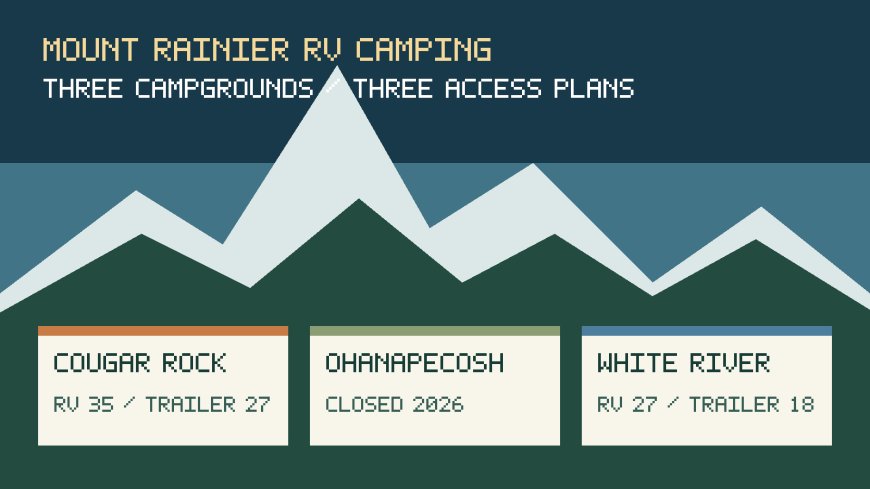

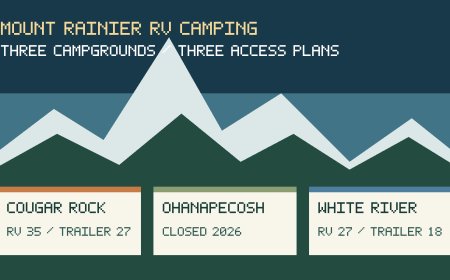
Bottom line: Choose Cougar Rock for the southwest approach and the easiest access to Longmire and Paradise.[1] Choose Ohanapecosh for the lower, forested southeast side when it reopens, not for a 2026 trip: the entire campground is closed for construction this year.[1] Choose White River for the high northeast side, a small rig and a first-come plan.[1] None has campsite hookups or a working dump station.[1] The park-wide ceiling is not the site you are promised: Cougar Rock allows motorhomes up to 35 feet and trailers up to 27 feet, Ohanapecosh lists 32 and 27 feet, and White River drops to 27 and 18 feet.[1]
Mount Rainier's three vehicle campgrounds share the same dry-camping basics, but they are not interchangeable stops on a loop. Each sits on a different approach road, operates on a different booking model, and has its own length ceiling. Seasonal roads can cut the obvious route between them. Start with access, then check the campground limit, and only then decide whether a particular site works.
At a glance
| Decision point | Cougar Rock | Ohanapecosh | White River |
|---|---|---|---|
| Best use | Southwest entry, Longmire and Paradise | Southeast forest base after reopening | Northeast trail access with a smaller rig |
| Normal season | Typically late May to early October | Typically late May to early October; closed all of 2026 | Typically late June to September |
| Booking | Reservable sites plus first-come inventory | Closed in 2026; Recreation.gov anticipates 2027 reopening | First-come only; Scan and Pay or cashless kiosk |
| Campground RV / trailer maximum | 35 ft / 27 ft | 32 ft / 27 ft | 27 ft / 18 ft |
| Hookups | None | None | None |
| Potable water | Yes, but the RV fill station is closed | Normally yes; campground closed in 2026 | Yes during the operating season |
| Dump station | No working station | No | No |
| Main access catch | Southwest entrance queues; road is winding | SR 123 and Stevens Canyon are seasonal; tunnel clearances matter | White River Road is seasonal; Sunrise Road is a separate branch |
These are planning limits, not permission to arrive at any open pad.[1] NPS requires every RV, tow vehicle and trailer to stay on the paved or gravel parking area.[1] A site that is long enough on paper can still fail because the trailer type is excluded, the driveway is too short for the tow vehicle, or the loop turn is too tight.[1]
The 2026 reality comes before the usual comparison
On October 5, NPS listed Cougar Rock as open, White River Loops B and D as open through October 11 with a midday October 12 seasonal closure, and Ohanapecosh closed for all of 2026.[1][3] Ohanapecosh's campground, visitor center, restrooms, picnic area and river access are inside the construction closure.[1][3] A map pin or an old reservation calendar does not override that closure.[1][3]
The 2026 Ohanapecosh rehabilitation is substantial: Recreation.gov says the work covers 185 campsites, nine bathrooms, wastewater, electrical and water systems, with reopening anticipated for the 2027 camping season.[10] Treat 2027 as an expectation, not a confirmed operating date.[10] Check the NPS campground page and live Recreation.gov calendar before building a trip around it.[10]
White River has a different temporary complication.[3] The campground and White River Road reopened September 5 after wildfire closures, but Sunrise Road remains closed to private vehicles for the rest of the 2026 season.[3] White River Campground is below that junction and remains accessible while its own road and loops are open.[3] Do not read “Sunrise Road closed” as “White River Campground closed,” and do not assume a White River campsite grants vehicle access to Sunrise.[3]
Road access: three approaches, not one campground circuit
Cougar Rock is the least complicated choice for a west-side trip.[5] Year-round park access is through the Nisqually Entrance on SR 706, although severe weather can still interrupt travel.[5] NPS describes park roads as winding, with narrow shoulders and a 35 mph maximum in most places.[5] Weekend queues at the southwest entrance can be long.[5] Cougar Rock sits uphill from Longmire on the road toward Paradise, so it avoids the seasonal east-side passes when the trip's focus is Longmire and Paradise.[5]
Ohanapecosh is reached from the southeast on SR 123, often via US 12 and Packwood.[2][5] NPS says the Ohanapecosh area is generally reachable from late May into early November, but connections to the rest of the park can close earlier.[2][5] The SR 123 tunnel is posted at 13 feet 1 inch.[2][5] The more direct summer route from Paradise uses Stevens Canyon Road, whose tunnel is posted at 12 feet 6 inches.[2][5] A rig that clears the campground's length limit can still be too tall for the intended route.[2][5]
White River is approached from SR 410 and the White River Entrance, then White River Road.[2] This road is seasonal and can be metered when parking fills.[2] As of the September 28 road report, White River Road was open and scheduled to close October 26, subject to change, while the campground's own 2026 season ended earlier.[2] Road availability and campground availability are separate checks.[2]
Current construction adds one more White River planning item.[4] Through October 31, crews are working at Fryingpan Creek Bridge; waits can reach 30 minutes where White River Road narrows to one lane.[4] The same project is scheduled to continue during the 2027-2029 seasons, so future campers should check the construction page rather than carrying the 2026 traffic pattern forward.[4]
Beyond the campground intersection, Sunrise Road is steep, narrow and winding.[1][2] NPS recommends that RVs and vehicle-trailer combinations longer than 25 feet not continue toward Sunrise, though the notice exempts unmodified standard-length motor coaches.[1][2] That recommendation concerns travel beyond the White River Campground junction; White River's own 27-foot RV and 18-foot trailer campsite limits remain the controlling numbers at camp.[1][2]
Exact rig fit: use three gates
The first gate is the campground entrance limit.[1] At Cougar Rock, entry is off-limits to a motorhome longer than 35 feet or a trailer longer than 27 feet.[1] Ohanapecosh's corresponding limits are 32 and 27 feet.[1] White River's are 27 and 18 feet.[1] Measure the equipment the same way the listing describes it.[1] “Trailer” is not automatically the truck-and-trailer combined length, and a motorhome's towed car still needs legal parking space.[1]
The second gate is the exact Recreation.gov site record.[8][9] Cougar Rock site A001 shows why a campground maximum is not enough: the listing permits an RV up to 25 feet, says the site is unsuitable for trailers, and notes a 10-by-8-foot tent pad reached by stairs.[8] Site C036 is a different product inside the same campground.[8][9] It is a 76-foot pull-through reserved for motorhomes between 32 and 35 feet or trailers between 24 and 27 feet; its notes say RV only, with no tents.[9]
Those two Cougar Rock records differ in equipment type, length, driveway shape and camping mode. Filtering for “standard nonelectric” would miss the distinction. Before checkout, read allowable equipment, maximum length, driveway length, driveway entry, grade, surface, vehicle count and every warning on the site page. Save that page with the confirmation in case the listing changes.
Ohanapecosh used the same site-specific system before construction.[11] Its site A001 record permits an RV up to 25 feet but says trailers are unsuitable; the parking pad is listed as 12 by 33 feet.[11] That old record is useful evidence of how much sites can vary, but it is not proof that A001 will reopen unchanged after rehabilitation.[11] When inventory returns, use the new live site record.[11]
White River is the hardest campground for exact pre-arrival matching because it is first-come only and NPS does not provide a public Recreation.gov site-detail inventory comparable to Cougar Rock's reservable pages.[1] The honest pre-trip conclusion is limited: 27-foot motorhome, 18-foot trailer, and no guarantee of a particular pad.[1] Arrive with a fallback outside the park, inspect the chosen parking spur before committing, and never use the campground maximum as evidence that a specific empty site fits.[1]
Hookups, water and waste tanks
All three campgrounds are dry camping.[1] NPS states that there are no electric, water or gray-water hookups in any park campground, and its regulations say no utility connections of any kind are available.[1] A potable spigot in a loop is shared water, not a threaded campsite connection.[1]
Cougar Rock normally has campground drinking water, but the dedicated RV water-fill station is closed.[1][7] For 2026, Recreation.gov marks the combined sewage-disposal and tank-filling service unavailable.[1][7] The NPS campground table lists no dump station at Cougar Rock, Ohanapecosh or White River.[1][7] Arrive with fresh water already on board if filling from containers is not practical, and identify an off-site dump before entering the park.[1][7]
Ohanapecosh normally lists potable water, but every facility is unavailable during the 2026 construction closure.[1][3] White River lists potable water during its operating season.[1][3] Late-season campers should still verify the current notice because water systems can shut before a road closes.[1][3] None of the three is a reliable place to service a full waste tank on departure.[1][3]
Generator, fire and pet rules
NPS limits generator use to 8-10 a.m., noon-2 p.m. and 5-7 p.m.[1] Cougar Rock Loop E and Ohanapecosh Loop E are generator-free at all times.[1] Quiet hours are 9 p.m.-7 a.m.[1] White River follows the same generator windows, but the campground page does not identify a generator-free White River loop.[1] If loop-specific quiet matters, confirm it with the ranger rather than assuming the Cougar Rock rule transfers.[1]
The baseline fire rule allows a small fire only in the provided closed grate.[1][6] Campers may not leave it unattended, burn trash, or collect wood, branches, twigs or cones.[1] Temporary restrictions supersede that baseline.[1][6] NPS reported on September 21 that the 2026 parkwide fire ban had been lifted, while explaining that a future ban would prohibit campfires and ignition of wood or briquettes in campground fire features.[6] Check the fire page again on arrival day.[1][6]
Pets must be caged, restrained or leashed on a lead no longer than six feet.[1] Do not leave a pet alone at camp or secure it to a tree; pets also stay off trails, out of buildings and amphitheaters, and away from vegetated areas.[1] In practical terms, a campground stay does not make most Mount Rainier hikes pet-accessible.[1]
Reservations and arrival strategy
Cougar Rock mixes reservable and first-come sites.[7][1] Current Recreation.gov availability shows that some loops shift to first-come status late in the season, so use the live calendar rather than repeating a fixed reservation window from an older guide.[7] Group sites are tent-only; booking one is not a workaround for an oversized RV.[1]
White River is first-come only.[1] NPS directs campers to choose an unoccupied site, then use Recreation.gov's Scan and Pay QR code at the kiosk.[1] There is no cellular service, so download the app before entering the park; cashless debit or credit payment is also accepted at the campground kiosk.[1] “First-come” does not mean “drive in after dark and sort it out tomorrow.” The fit inspection, payment and campground limit all still apply.[1]
For Ohanapecosh, no reservation strategy fixes the 2026 closure.[1][10] Watch for confirmed season dates and fresh site records for 2027.[1][10] Do not use a cached availability page or the anticipated reopening language as authorization to camp.[1][10]
A decision framework that starts with disqualifiers
- Apply the date test. Eliminate any campground whose live status is closed. For 2026, that removes Ohanapecosh. Compare the campsite season with the road season instead of assuming one closing date covers both.[1][2]
- Apply the route test. Cougar Rock favors SR 706 and the southwest. Ohanapecosh depends on SR 123 or seasonal Stevens Canyon Road. White River depends on SR 410 and White River Road. Check tunnel height, road alerts and construction against the rig before considering scenery.[2][4][5]
- Apply the campground-size test. Stop if the motorhome or trailer exceeds the posted campground maximum.[1] White River is the strictest: 27-foot RV and 18-foot trailer.[1]
- Apply the exact-site test. At Cougar Rock, and at Ohanapecosh once bookings return, match the listing's equipment type, length, driveway and vehicle fields. At White River, inspect an unoccupied pad and keep a backup plan.[8][9][11]
- Apply the tank-and-power test. All three lack hookups and dumps.[1] Check fresh water status, arrive with waste capacity, and make sure the battery plan works inside the three generator windows.[1]
- Apply the trip-purpose test. Cougar Rock is the practical Paradise and Longmire base. Ohanapecosh is the low-elevation southeast forest choice when open. White River trades reservation certainty and rig size for the northeast side and nearby trail access.
For a first Mount Rainier RV stay, Cougar Rock is the broadest fit as long as the exact site clears the rig. Ohanapecosh belongs on a future-season shortlist, not a 2026 itinerary. White River is a deliberate choice for smaller equipment and travelers comfortable arriving without a site reservation. The safest pick is the one whose road, operating status, campground ceiling and actual parking spur all agree.
Sources
- Campgrounds — Mount Rainier National Park (accessed October 6, 2026)
- Road Status — Mount Rainier National Park (accessed October 6, 2026)
- Alerts & Conditions — Mount Rainier National Park (accessed October 6, 2026)
- Park Construction — Mount Rainier National Park (accessed October 6, 2026)
- Directions — Mount Rainier National Park (accessed October 6, 2026)
- Wildland Fire Information — Mount Rainier National Park (accessed October 6, 2026)
- Cougar Rock Campground — Recreation.gov (accessed October 6, 2026)
- Cougar Rock Site A001 — Recreation.gov (accessed October 6, 2026)
- Cougar Rock Site C036 — Recreation.gov (accessed October 6, 2026)
- Ohanapecosh Campground — Recreation.gov (accessed October 6, 2026)
- Ohanapecosh Site A001 — Recreation.gov (accessed October 6, 2026)
What's Your Reaction?