








Where should RV warning triangles go after a breakdown? Use a safety-first placement plan
Choose and place RV warning triangles, flares or visibility devices without treating one distance pattern as universal or walking into live traffic.

Tips and Trends
Where should RV warning triangles go after a breakdown? Use a safety-first placement plan
Choose and place RV warning triangles, flares or visibility devices without treating one distance pattern as universal or walking into live traffic.
By Romana 
This guide begins after the RV is stopped. It covers triangles, fusees or road flares, electric warning lights and similar visibility devices. It does not repeat the broader breakdown sequence of choosing a stopping place, calling for help or arranging an RV-capable tow. The job here is narrower: decide whether anyone should leave the RV, identify the rule that applies to this rig and road, and place only the devices that can be reached without creating a worse hazard.
Make the exit decision before opening a storage bay
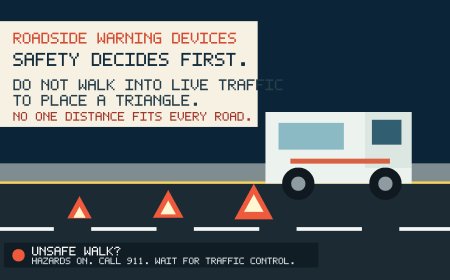
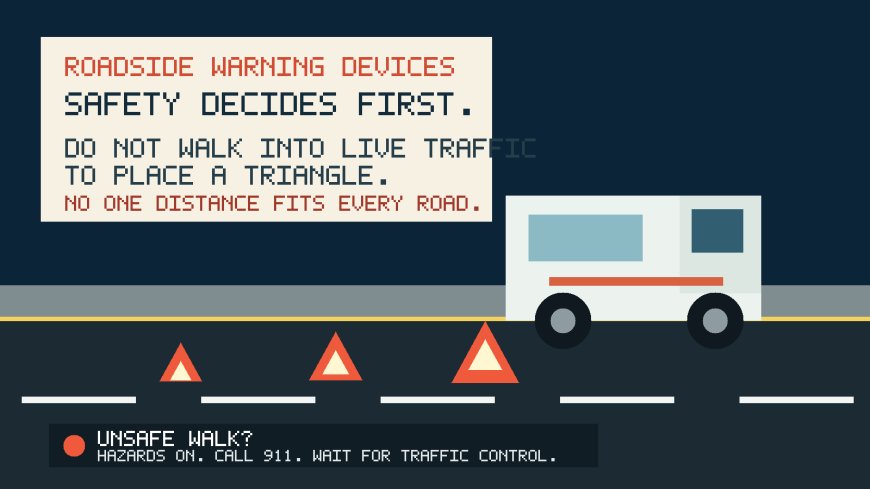
Turn on the hazard flashers. Then look at the scene from inside. A narrow shoulder, a traffic-side storage compartment, a concrete barrier, fast traffic, poor sight distance, ice, smoke, leaking fuel, fire or an RV that intrudes into a lane can make triangle placement too dangerous.
Do not walk into a travel lane, stand behind the RV, or work from the traffic side just to complete a diagram. Call 911 when the rig or its occupants are exposed to immediate traffic danger, and tell the dispatcher that warning devices cannot be placed safely. Wait for law enforcement, a highway patrol or another responder to establish traffic control.
California's current driver handbook tells motorists with a disabled freeway vehicle to pull to the right shoulder, use the right-side exit if they must get out, return from the traffic-free side and stay belted inside while waiting. It also recognizes that a cramped shoulder, a guardrail and the presence of a genuinely safe area away from the lanes can change whether remaining inside is best.[4] Those are useful scene-assessment questions anywhere, but they are not a substitute for local responder instructions.
If there is a fire, smoke, a propane alarm, a strong fuel odor, rising water, an unstable slope or another reason the RV itself is unsafe, move people away from that hazard without crossing moving traffic if possible and call 911. Warning devices come after human safety.
Do not memorize one universal distance
The familiar "10, 100 and 200 feet" shorthand is incomplete. Placement changes with the governing rule, road direction, the side from which traffic approaches, curves and hillcrests. Commercial and noncommercial operation may also be treated differently.
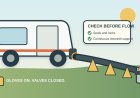
For a commercial motor vehicle covered by federal rules, 49 CFR 392.22 requires immediate hazard flashers and placement of required devices as soon as possible, no later than 10 minutes. On an ordinary two-way road, the rule describes one device about 10 feet from the traffic side of the stopped vehicle toward approaching traffic, one about 100 feet toward approaching traffic, and one about 100 feet in the opposite direction.[1]
That is not the pattern for every road. On a divided or one-way highway, the federal commercial rule puts the two distant devices 100 and 200 feet toward approaching traffic, with the close device on the traffic side within 10 feet of the rear. When a curve, hillcrest or another obstruction blocks the view within 500 feet, the device in that direction moves to a point 100 to 500 feet from the vehicle that gives approaching drivers ample warning.[1]
The practical lesson is to identify the traffic pattern before opening the triangle case. "Front" and "rear" alone are poor instructions. Mark the direction from which vehicles can actually approach.
Commercial and private RVs are not the same legal category
Federal Motor Carrier Safety Regulations apply to covered commercial motor vehicles, not automatically to every privately used motorhome or trailer because it is large. A commercial RV rental movement, entertainer coach, mobile business, for-hire passenger operation or other business use may need a fact-specific compliance answer. The vehicle's use, configuration, weight and operating circumstances matter. Owners should confirm status with the carrier, employer or the appropriate state and federal regulator rather than self-classifying from appearance.
For covered power units, 49 CFR 393.95 requires a compliant warning-device option: three bidirectional reflective triangles, or the specified fusee alternative. Extra warning lights may supplement the required devices but do not replace them.[2] Section 392.22 then controls when and how those devices are deployed.[1]
Private RV drivers still have state law to consider. California shows why an online commercial-truck diagram cannot be treated as the only answer. Its reflector statute reaches vehicles subject to the state's clearance-light rule, which includes vehicles 80 inches or more in overall width, plus truck tractors. For those covered vehicles, California specifies nighttime reflector placement and has separate instructions for a vehicle disabled off the roadway but within 10 feet of it.[3] Many motorhomes and towable RVs are at least 80 inches wide, but the owner should verify the exact vehicle and current law rather than assume coverage.
California's one-way or divided-highway pattern also uses the close, 100-foot and 200-foot arrangement toward traffic. On an ordinary roadway it uses close, approximately 100 feet rearward and approximately 100 feet forward; a curve or crest can move a device to between 100 and 500 feet. The statute contains exceptions and conditions, including darkness and some lawful urban parking situations.[3] Another state can define covered vehicles, lighting conditions, device types and distances differently. Check every state on the route before departure.
The owner's manual is a starting point, not interstate law
Manufacturer instructions vary by model and year. The 2025 Jayco Class A motorhome manual says to carry road flares or reflective warning signs and gives a three-device nighttime pattern: one on the traffic side, one 100 feet behind toward approaching traffic and one 100 feet in front. It adds that curves and hills may change safe placement, and elsewhere tells the person placing devices to stand off the road and out of traffic.[5]
The 2018 Mercedes-Benz Sprinter operator's manual takes a different approach. It identifies a warning-triangle and warning-lamp storage location behind the driver's seat base, while warning that described equipment can vary by country and that a particular vehicle may not have every listed item.[6] That matters to Class B and small Class C owners: a chassis manual may show where optional equipment belongs without supplying a complete U.S. roadside placement rule.
Read the coach manual, chassis manual and warning-device instructions for the exact model year. Then compare them with current law in the state where the RV is stopped. If they conflict, do not improvise a compromise distance beside moving traffic. Tell the dispatcher what equipment is available and ask for scene-specific direction.
A safer way to deploy triangles when the scene permits it
Use this process only after deciding that leaving the RV is reasonably safe.
- Put on a high-visibility vest before exiting if one is reachable from inside. A vest improves visibility; it does not create a protected work zone.
- Take all required devices on the first trip. Do not make repeated walks to the traffic side.
- Exit from the side away from traffic. Keep the RV between you and moving vehicles whenever the road layout allows.
- Face approaching traffic as you move along a safe shoulder or protected area. Do not walk backward while counting paces.
- Set each triangle upright and oriented as its instructions require. Put it on the lane or shoulder described by the governing rule only when that location can be reached safely.
- Return by the same protected route. Re-enter from the side away from traffic and remain belted unless the vehicle itself is unsafe or responders direct otherwise.
Do not use phone-based distance measuring while walking next to traffic. For a covered commercial operation, follow the rule's distances and timing. For a private RV, use the applicable state rule and manual. Pre-trip practice in a parking lot can show what the actual distances look like without turning a breakdown shoulder into a classroom.
Wind and wake turbulence can flatten lightweight devices. Choose stable, purpose-built triangles and inspect hinges, ballast and reflective faces before each trip. If a triangle will not stand, do not chase it toward traffic. Report the failed device when requesting help.
Be cautious with flares around an RV
"Road flare" can mean a flame-producing fusee, a liquid-burning flare or a battery-powered LED beacon. They are not interchangeable.
Federal commercial rules prohibit carrying flame-producing signals on specified hazardous-material vehicles, certain cargo tanks and commercial vehicles using compressed gas as motor fuel. They also bar lighting or placing a flame-producing warning signal near leaking flammable liquid or gas unless the distance prevents fire or explosion.[1][2] California has similar limits for covered commercial vehicles and leaks.[3]
A private RV with an onboard propane system is not automatically one of those federally described commercial vehicles. Still, an open flame is a poor default around an unknown fuel, propane or battery incident, dry roadside vegetation, spilled gasoline or a suspected leak. Reflective triangles and approved electronic warning lights avoid adding an ignition source. Do not place any device in spilled liquid, attach a burning fusee to the RV, or use a flare merely because it came in a roadside kit.
Electronic beacons can be useful supplements, especially in rain or darkness, but check local rules on color, flashing patterns and roadway use. Under the federal commercial equipment rule, an extra device does not replace the required option.[2]
Build a route-specific device card
Keep the card with the triangle case, not in a traffic-side bay that cannot be opened safely. Record:
- the RV's measured overall width and vehicle type;
- private or commercial operating status, with the basis confirmed when commercial use is possible;
- the current warning-device rule for each state on the route;
- the manufacturer and model-year manual page for roadside equipment;
- where triangles, vest and flashlight are stored;
- whether every device can be reached from the non-traffic side;
- a note that curves, crests and one-way or divided roads change the pattern; and
- a bold instruction: Do not deploy if the walk itself enters live traffic or feels unsafe. Call 911 and report the exposure.
Practice opening and weighting the triangles at home. Replace cracked cases, weak batteries and faded reflectors. Never test a flame-producing device near the RV.
The decision in one sentence
Use the placement pattern required for the specific vehicle, road and jurisdiction only when a person can reach every point without stepping into moving traffic. If that safety condition fails, hazards stay on, occupants stay in the safest available place, and responders handle traffic control.
Editorial note: This is a practical planning guide, not legal advice or a substitute for emergency-responder direction. Rules and owner manuals can change. Sources were checked October 5, 2026. No roadside deployment or product testing is claimed.
Sources
- Electronic Code of Federal Regulations: 49 CFR 392.22, Emergency signals; stopped commercial motor vehicles (federal commercial placement and flame-signal rules; accessed October 5, 2026)
- Electronic Code of Federal Regulations: 49 CFR 393.95, Emergency equipment on all power units (required commercial warning-device options and flame-device restrictions; accessed October 5, 2026)
- California Legislative Information: Vehicle Code § 25300 (state reflector placement, covered-vehicle conditions and flare restrictions; accessed October 5, 2026)
- California DMV: Driver's Handbook, "If Your Vehicle Becomes Disabled on the Freeway" (occupant and exit-side guidance; accessed October 5, 2026)
- Jayco: 2025 Class A Motorhome Owner's Manual (model-year manufacturer guidance on emergency stopping and warning indicators, pp. 20-21)
- Mercedes-Benz Vans: 2018 Sprinter Operator's Manual (warning-triangle and warning-lamp storage plus equipment-variation caveat, pp. 241-242)
What's Your Reaction?