

Mt. Hood reduced the Grasshopper Fire closure, but six campgrounds are still out
Mt. Hood reduced its Grasshopper Fire closure, but six campgrounds remain closed through 2027. See the RV fit limits before choosing a replacement.
By RVCamping.info Research Desk. This report was researched and edited with AI assistance; no named human review is claimed.
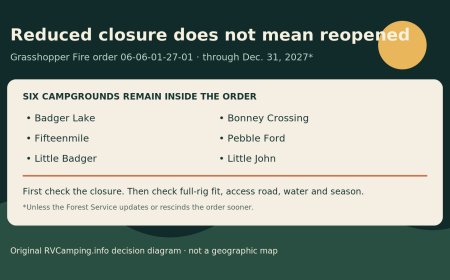
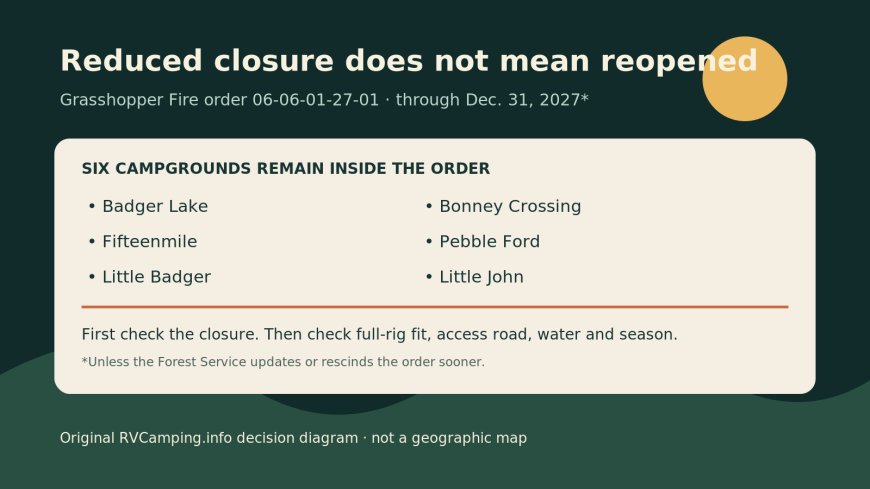
A smaller closure area can sound like an all-clear. At Mt. Hood National Forest, it is not. The Forest Service replaced its previous Grasshopper Fire order on November 6, 2026, but the new order still bars entry to six named campgrounds through December 31, 2027 unless the agency changes or rescinds it sooner.[1]
For an RV trip, the useful move is to remove those six campgrounds from the plan before looking for an alternative. Several are primitive, first-come sites with 16-foot vehicle limits, while Badger Lake's final approach prohibits trailers altogether. A search result or old campground description can therefore fail twice: the place may be inside the closure, and the rig may not fit even after it reopens.
The six campgrounds still named in the order
The November order lists Badger Lake, Fifteenmile, Little Badger, Little John, Bonney Crossing and Pebble Ford. It describes the change as a reduction from order 06-06-01-26-18, not a reopening of every recreation site east of Mount Hood.[1]
| Campground | What the current site page says about RV fit | Planning status |
|---|---|---|
| Badger Lake | The approach may require high clearance or four-wheel drive, and trailers are prohibited on Forest Road 4860-140. No potable water is listed.[2] | Exclude while the order applies. A trailer should remain excluded even after reopening unless the access rule changes. |
| Fifteenmile | Maximum vehicle length is 16 feet; no potable water; first come, first served.[3] | Exclude while closed. Later, treat 16 feet as the whole vehicle limit, not a campsite-pad estimate. |
| Little Badger | Maximum vehicle length is 16 feet; no potable water; first come, first served.[4] | Exclude while closed. It is a small-rig prospect after reopening, not a general RV fallback. |
| Bonney Crossing | Maximum vehicle length is 16 feet and the campground is first come, first served.[5] | Exclude while closed. Check a new operating season before relying on it. |
| Pebble Ford | Maximum vehicle length is 16 feet; no potable water; all sites are first come, first served.[6] | Exclude while closed. It does not solve a large-rig or guaranteed-arrival problem. |
| Little John | The page allows trailer parking and describes both winter recreation and a small summer campground; winter use normally requires an Oregon Sno-Park permit.[7] | Exclude the campground and Sno-Park while the fire order applies. Do not let the normal permit season override the closure. |
This is a closure table, not an availability table. A campground disappearing from the newest closure list does not prove that it is open, undamaged, in season or suitable for an RV. The Forest Service order controls entry to the described area; each recreation page and current road report still control the next layers of the decision.
What changed for a 2027 trip
The end date is the part most likely to be missed. The replaced order ran through the end of 2026. The November 6 replacement extends the reduced closure through December 31, 2027 unless updated or rescinded.[1] A saved 2026 screenshot, old trip plan or campground bookmark is no longer enough.
Start with order number 06-06-01-27-01. Check that number on the forest alert page shortly before departure. If the page shows a later order, use the later map and site list. If the order is unchanged, the six campgrounds above remain out even when a campground directory still displays hours, fees or normal-season language.
The mismatch is easy to see at Little John. Its recreation page explains the usual November-to-April Sno-Park permit season and says trailer parking is allowed.[7] Those details describe ordinary operation. They do not grant access through a fire closure.
Build the replacement in the right order
Do not begin by choosing the closest campground pin. Begin outside the closure.
1. Open the current Forest Service order and its map. Reject any campground, access road or trailhead inside the boundary.
2. Open the exact campground page. Check its current status and operating season instead of relying on the descriptive paragraph.
3. Test the entire rig against the stated vehicle limit and approach road. Include the tow vehicle or towed car if the page defines a combined limit.
4. Check water, toilets, hookups and reservation method. Badger Lake, Fifteenmile and Little Badger explicitly list no potable water.[2][3][4] Pebble Ford does too.[6]
5. Recheck the forest alerts and road page before leaving. A candidate outside this fire order can still have a seasonal gate, snow, another closure or an expired operating season.
There is no honest one-name substitute for all six campgrounds. A 15-foot camper van looking for a primitive first-come site has a different replacement problem from a travel trailer that cannot use Badger Lake's final spur. The closure boundary comes first; rig fit and services decide what remains.
Sources
- Mt. Hood National Forest: Grasshopper Fire closure order [1]
- Mt. Hood National Forest: Badger Lake Campground [2]
- Mt. Hood National Forest: Fifteenmile Campground [3]
- Mt. Hood National Forest: Little Badger Campground [4]
- Mt. Hood National Forest: Bonney Crossing Campground [5]
- Mt. Hood National Forest: Pebble Ford Campground and Day Use [6]
- Mt. Hood National Forest: Little John Sno-Park and Campground [7]
What's Your Reaction?