







Remote campsite weather alerts: build a three-layer plan before signal disappears
Test NOAA Weather Radio and Wireless Emergency Alerts at a remote RV campsite, then write a no-signal fallback with a shelter, check-in and early-exit trigger.

Remote campsite weather alerts: build a three-layer plan before signal disappears
By Romana
Category: RV Camping
A phone can show full bars at the fuel stop and become useless ten miles up a canyon. A weather-radio receiver can work at one campsite and hiss at the next. Neither failure should be discovered when the sky is already changing.
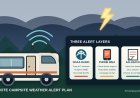
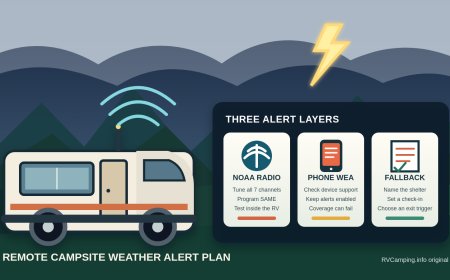
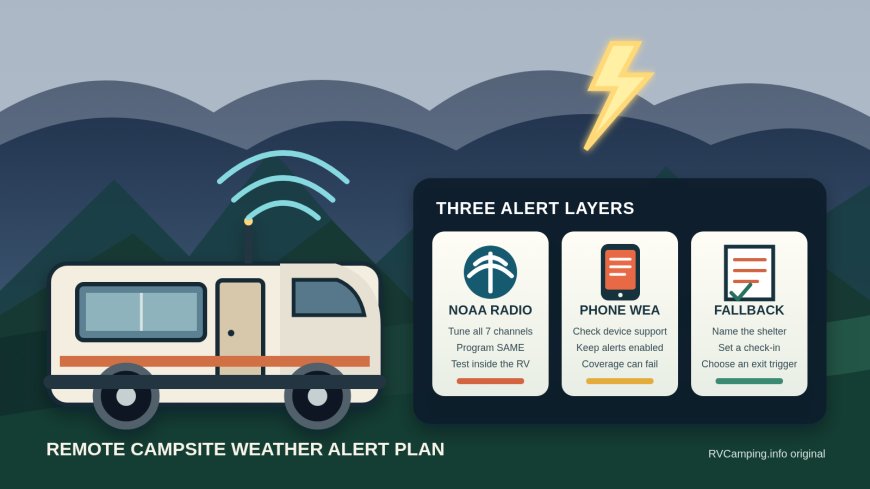
For a remote RV stay, treat Wireless Emergency Alerts (WEA) and NOAA Weather Radio as separate alert paths. Test both where you will sleep. Then write a no-signal fallback that tells the group when to leave, where to shelter and who will check for updates. The fallback does not manufacture a warning. It sets decisions while information is still available.
Decide whether the site is acceptable before committing
Run this screen at the last place with dependable service, not after leveling the RV:
- Check the current National Weather Service forecast, watches and warnings for the campsite's actual location.
- Identify the county or independent city containing the campsite. NOAA Weather Radio receivers that use Specific Area Message Encoding, or SAME, commonly filter alerts by county or independent city.[2]
- Confirm the campground's emergency instructions, shelter location, exit road and after-hours contact.
- Set up and test the weather radio at the exact site.
- Verify that each phone can receive WEA and that relevant alert categories have not been disabled.
- Choose a fallback update source and a check-in schedule before the group loses service.
Leave or choose another campsite if hazardous weather is plausible and the group cannot receive any live warning, cannot identify a suitable shelter or cannot use the only exit under the expected conditions. A reservation fee is not a reason to accept an alerting gap.
Layer one: make NOAA Weather Radio work at the campsite
NOAA Weather Radio All Hazards is a network of stations that carries official National Weather Service warnings, watches, forecasts and other hazard information continuously. It uses seven VHF frequencies from 162.400 to 162.550 MHz and requires a receiver or scanner that can tune them; an ordinary AM/FM-only radio is not enough.[1][2]
For RV travel, select a receiver with:
- all seven NOAA Weather Radio frequencies;
- an alert function, not merely a manual weather-band tuner;
- SAME programming for the campsite's county and any county crossed by the evacuation route;
- replaceable batteries or another independent power option;
- a visible alert display if anyone may not hear the alarm; and
- an external antenna jack when marginal reception is likely.
The NWS says the 1050 Hz alarm can activate equipped receivers even when their audio is off. SAME lets a compatible receiver respond to selected geographic codes instead of every alert carried by the transmitter. The NWS also recommends battery backup because storms often cause power outages, and notes that extending the whip antenna or using an external antenna can improve reception in some locations.[2]
Run a real reception test
Do not count the NOAA logo as proof of reception. At the campsite:
- Extend the antenna and power the unit from its normal overnight source.
- Tune through all seven channels and choose the clearest local broadcast.
- Listen long enough to hear a complete station identification and forecast cycle.
- Confirm the programmed SAME county code against the campsite location, not the billing address or the nearest town you recognize.
- Put the receiver where it will stay overnight, then close the RV door and repeat the listening test.
- Verify the alert volume, display and battery state.
- Test again after moving the RV or lowering an antenna. A few yards, the metal RV body and surrounding terrain can change reception.
If no channel is intelligible, change receiver position and antenna orientation without putting anyone on the roof in unsafe conditions. If reception remains unusable, mark the NOAA layer as failed. Static is not a warning system.
Layer two: verify Wireless Emergency Alerts, but do not mistake them for coverage
WEA messages come from authorized public alerting authorities and are broadcast from area cell towers to WEA-enabled phones in a targeted location. They do not require an app or a subscription. A traveler can receive one away from home because delivery is based on the phone's location, not its home area.[3]
That convenience has boundaries, and either electronic alert path can fail. FEMA says a phone may miss an alert because reception is inadequate, the phone is off or in airplane mode, it is not connected to a tower broadcasting the alert, the tower is out of service, or the device has opted out. A call in progress can also delay an alert on some phones.[3] The FCC adds that carrier participation, service areas and device support vary, so even a WEA-enabled phone may not receive an alert on an unsupported network or while roaming on a network that does not support WEA.[4]
Before entering the dead zone:
- install operating-system and carrier updates;
- ask the carrier whether the exact phone and plan support WEA in the trip area;
- open emergency-alert settings and record which categories are enabled;
- turn off airplane mode and leave the phone powered;
- keep at least one phone charged from an independent battery bank; and
- do not silence the entire group's phones in a way that prevents anyone from noticing an alert.
Do not send yourself a text and call that a WEA test. A successful text proves only that one message used the network at that moment. It does not prove that the phone is WEA-capable, that the serving tower will broadcast a future alert or that service will remain available overnight.
Layer three: write the no-signal fallback
A fallback is needed when the radio cannot receive a usable broadcast and phones cannot dependably connect to a WEA-participating network. It should fit on one page and answer six questions.
1. What is the information deadline?
Write the last place and time for a forecast and alert check. Examples are the ranger station before its posted closing time, the highway junction with dependable service or the campground office during staffed hours. If the latest check shows conditions outside the group's limits, do not continue to the remote site.
2. Who is the outside contact?
Choose one person who will remain in service. Give that person the campsite name, site number, coordinates, county, vehicle description, planned route, departure time and overdue time. Agree on exactly what the contact should do if the group misses a check-in. Do not leave that decision vague.
3. How will updates enter the campground?
Record the options that actually exist: a staffed ranger desk, campground host, landline, bulletin board, scheduled patrol or another camper leaving for service. Ask the operator which channel it uses for emergency notices and whether that channel functions after hours. A generic promise that staff will "let people know" is not a verified method.
4. Where is the shelter?
Write the operator-designated shelter or evacuation assembly point and walk the route before dark. Record whether it is unlocked overnight and accessible to every traveler. Do not label the RV, an awning, a picnic shelter or a restroom as safe for a particular hazard unless the responsible local authority says so.
5. What triggers an early exit?
Set the decision before losing updates. A practical rule is: if either electronic layer fails and the last official forecast or local instruction creates doubt about remaining through the next update window, leave while the route is open and visibility is adequate. This is a trip threshold, not a substitute for an official warning.
6. What happens if the group separates?
Put a paper copy in the tow vehicle or motorhome and another with the person most likely to be outside. Include the meeting point, shelter, outside contact and "do not wait past" time. Every adult should be able to act without the trip leader's phone.
Use a go, conditional or no-go decision
Record one outcome after testing at the site:
| Result | Decision |
|---|---|
| NOAA Weather Radio receives clearly; WEA settings are verified; shelter and exit are known | Go, with scheduled radio and forecast checks |
| Only one electronic layer works; staffed local notification and a clear shelter or early-exit plan are confirmed | Conditional go, if everyone accepts the written limits |
| Neither electronic layer works, or shelter/exit information is missing during a credible weather concern | No-go; move to a site with a working alert path or leave before conditions worsen |
"One bar" is not its own category. Neither is "the host probably knows." Name the working channel and the action tied to its failure.
Pack and departure checklist
- ☐ Campsite coordinates and county written down
- ☐ Current NWS forecast, watches and warnings checked before the last service point
- ☐ NOAA Weather Radio tuned at the campsite
- ☐ SAME area code verified for the campsite and exit route
- ☐ Fresh spare batteries packed separately
- ☐ Phone WEA settings checked on every device
- ☐ Carrier/device WEA support verified where practical
- ☐ Independent phone power packed
- ☐ Campground emergency channel and after-hours contact confirmed
- ☐ Shelter and exit route walked before dark
- ☐ Outside contact has the itinerary and overdue time
- ☐ Paper fallback copies placed in two locations
- ☐ Group agrees on the early-exit trigger
The point is not to collect gadgets. It is to know, before the signal fades, which alert path works and what the group will do when it does not.
Editorial note: Alert delivery, radio reception, wireless coverage, campground staffing and weather can change. Sources were retrieved September 25, 2026. This planning guide does not replace current NWS warnings, local emergency instructions or directions from public-safety officials, and it makes no claim of firsthand testing at a particular campsite.
Sources
- [1] NOAA/National Weather Service: NOAA Weather Radio All Hazards (retrieved September 25, 2026).
- [2] National Weather Service: NOAA Weather Radio receivers (retrieved September 25, 2026).
- [3] FEMA: Wireless Emergency Alerts (retrieved September 25, 2026).
- [4] Federal Communications Commission: Wireless Emergency Alerts consumer guide (official page excerpt retrieved September 25, 2026; direct automated access was denied).
What's Your Reaction?