








Cooked beans at an RV campsite: cool the batch, not your odds
A serve-and-save RV workflow for canned or home-cooked beans, covering clean opening, hot holding, shallow cooling, cold storage, reheating and discard decisions.

Cooked beans at an RV campsite: cool the batch, not your odds
By Romana
Category: Cooking
Beans are forgiving in a skillet and surprisingly awkward in a small RV refrigerator. A deep pot stays warm in the middle. A half-used can is easy to forget beside the stove. The serving spoon keeps making trips between the picnic table and the pot. None of those problems needs a complicated fix, but the decision to save food has to happen before cleanup.
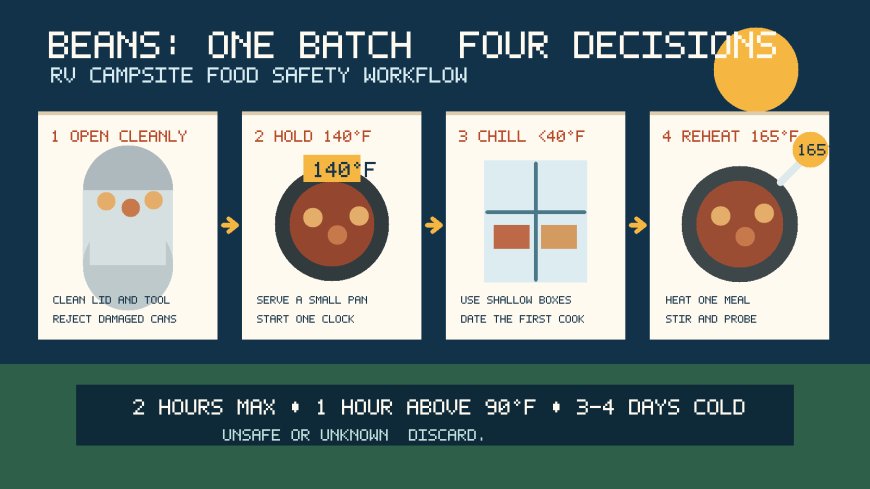
The short answer: Keep cooked beans at 140°F or hotter while serving, or move the portion you plan to save into shallow containers promptly. Refrigerate perishables within two hours, or within one hour when the outdoor temperature is above 90°F. Keep the refrigerator at 40°F or below, use refrigerated leftovers within three to four days, and reheat leftovers to 165°F. If the beans miss the time limit or their history is uncertain, discard them.[1][2][3]

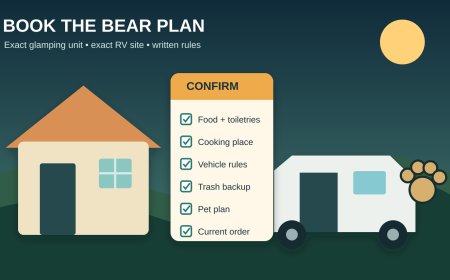
One batch, four decisions: open cleanly, control the serving portion, chill shallow, and reheat only what will be eaten. Original RVCamping.info illustration.
Canned and home-cooked beans meet at the same handoff
Shelf-stable canned beans are convenient because an unopened can does not use refrigerator space. Once the can is opened and its contents are heated or mixed into a campsite dish, the useful question changes: can the food stay under temperature control until it is eaten or chilled?
Start by checking the can. Do not use a can that is leaking, bulging, badly dented at a seam, or spurts liquid or foam when opened. Do not taste food from a suspect can.[5] For a sound can, FDA advises cleaning the lid before opening.[1] Use a clean opener and spoon, and move unused contents into a clean food-storage container rather than treating the open can as tomorrow's storage dish.
Home-cooked beans need one extra step at the front end: cook them fully according to the bean variety and recipe. This article begins after that cooking step. It covers canned beans that have been opened or heated and dried beans that have already been properly cooked. It is not a dry-bean preparation guide.
Split the pot before it becomes a buffet
The easiest RV workflow is a serve-and-save split. Before the first plate is filled, put the amount intended for tomorrow into one or more clean, shallow containers. Keep those containers away from the picnic table and begin the cooling handoff. Put only the current meal's amount in the serving pan.
That split solves several campsite problems at once. The saved beans avoid repeated contact with the serving spoon. They spend less time outside temperature control. The hot pan can be sized to the group instead of the original batch. Most important, nobody has to decide whether a pot that sat through conversation and dishwashing is still worth saving.
If people will eat in shifts, keep the serving pan at a measured 140°F or hotter. USDA consumer guidance uses 140°F as the hot-holding threshold, while FDA's retail Food Code uses 135°F for regulated food establishments.[2][4] For a household campsite rule, 140°F is the simpler conservative target. Check the center with a clean food thermometer; a low burner, insulated carrier or warm-looking steam does not prove the food is holding hot enough.
Do not keep topping off an old serving pan with fresh hot beans. Either replace it with a clean pan or let the first portion finish before adding more. Mixing batches also mixes their time histories, which makes the discard decision harder.
Start the clock when control stops
The two-hour limit is a deadline, not a recommended cooling duration. FDA says to refrigerate perishables within two hours of cooking, and within one hour when the outside temperature is above 90°F.[1] FoodSafety.gov gives the same rule and says food left beyond those limits should be thrown out.[3]
Write the time on painter's tape and stick it to the serving pan or container. Count time on the picnic table, RV counter and cleanup rack together. Moving the pan into shade does not restart the clock. Neither does putting on a lid. If the beans were held at 140°F or hotter, start the written clock when verified hot holding ends.
At a busy campsite, use three labels:
- HOT: still holding at 140°F or above.
- CHILL: reserved food already moving into shallow cold storage.
- OUT: food being served under the one- or two-hour clock.
This is an original RVCamping.info control method, not an FDA labeling requirement. Its job is to stop three similar-looking containers from acquiring three unknowable histories.
Give the refrigerator a shape it can cool
A full Dutch oven or saucepan is the wrong shape for rapid cooling. FDA tells consumers to divide large amounts of leftovers into shallow containers so they cool more quickly in the refrigerator.[1] USDA gives the same shallow-container advice and says most cooked leftovers should be used within three to four days.[2]
Set up the cold space before cooking:
- Confirm the RV refrigerator reads 40°F or below with an appliance thermometer. The control dial alone is not a measurement.[1]
- Fit the empty shallow containers on a shelf. Make sure the door closes and air can move around them.
- Portion beans in low layers. A wide container is more useful here than a tall deli tub.
- Put the containers into refrigeration promptly. Do not wait for a deep pot to reach room temperature on the counter.
- If the refrigerator is small or already crowded, reduce batch size or use a separate cooler that can actually maintain 40°F or below. Ice without a thermometer is a hope, not a reading.
- Once the food is cold, cover it securely and label the original cooking or opening date.
A clean ice-water bath can help pull heat from a saucepan before the deadline. Keep bath water below the rim and stir the beans with a clean utensil so the center releases heat. The bath is a cooling aid, not permission to extend the one- or two-hour limit.
For campers who want a measurable cooling check, FDA's Food Code gives food-service operators a two-stage benchmark: cool cooked time/temperature-control food from 135°F to 70°F within two hours, then to 41°F or below within six hours total.[4] That code is written for retail food establishments, not private RV kitchens. Still, it is a useful diagnostic for a large batch. If a shallow container is not dropping through the first stage, the layer is too deep, the refrigerator is overloaded, or the cooling method needs help. The simpler consumer rule still applies: refrigerate promptly within the outdoor time limit.
Keep the calendar attached to the first cook
Use refrigerated cooked beans within three to four days.[2][3] Day one follows the original cook or the day the can was opened and prepared; reheating does not create a fresh four-day window. Transferring the container from the rig's refrigerator to an adequately chilled cooler does not restart the calendar.
Freeze portions early when the route and meal schedule put them beyond that limit. Do not wait until the fourth day to decide whether a container spent part of the weekend warm. A refrigerator that lost power, a cooler that ran out of ice, or a container with no date deserves a temperature-and-time assessment, not optimism.
Keep wet cooler contents sealed from meltwater. Store beans above raw meat and poultry so leaking packages cannot contaminate them. Use a clean spoon each time. These details matter because reheating addresses temperature; it does not undo dirty utensils, raw-meat drips or contaminated water.
Reheat one meal, once
Pull out only the amount the group will eat. FDA lists 165°F for reheated leftovers, and USDA gives the same target.[1][2] Beans scorch at the bottom while remaining cooler in the middle, especially when thickened, so add a small amount of water if needed, lid the skillet, and sweep a spoon through the center, edges and base. Probe more than one spot with a clean thermometer.
In a microwave, use a microwave-safe container, vent the cover, pause to stir, allow the stated standing time, and check several places. A bubbling ring around a cool center is common evidence of uneven heating, not a finished reheat.
Serve immediately or return the portion to measured hot holding. Avoid warming the whole supply, serving half, cooling it again, and repeating the cycle the next day. Reheating a single meal keeps the untouched containers cold and leaves a simpler history.
When the right answer is the trash bag
Discard cooked beans when any of these is true:
- They sat without verified hot or cold control for more than two hours, or more than one hour above 90°F.[1][3]
- The time outside control is unknown.
- The refrigerator or cooler was above 40°F long enough that safety cannot be established.
- The container has passed the three-to-four-day refrigerated window.[2][3]
- Raw-meat liquid, dirty water or an unclean utensil contaminated the batch.
- The can was bulging, leaking, badly seam-dented, or released foam or liquid on opening.[5]
Do not taste beans to decide whether they are safe. Smell and appearance can identify obvious spoilage, but a normal smell cannot reconstruct a missing time log. Boiling an uncertain pot is not a reset button.
The bean card beside the stove
Tape this compact version inside a cabinet door:
CLEAN LID. SPLIT EARLY. HOLD 140°F. CHILL SHALLOW. STORE AT 40°F OR BELOW. REHEAT TO 165°F. DISCARD AFTER AN UNSAFE OR UNKNOWN CLOCK.[1][2][3]
That sequence is intentionally bean-specific. It begins with the can or cooked batch, separates tomorrow's portion before campsite service, and keeps the refrigerator load small. Soup and chili call for their own pot-cooling plan; rice, barley and other grains have different textures and portioning problems. Beans deserve a workflow built around the serving pan, shallow meal containers and a clock everyone can read.
Evidence note: FDA, USDA FSIS and FoodSafety.gov supply the temperature, timing, shallow-container, storage and reheating guidance. The serve-and-save split, three-label system and bean card are original RVCamping.info planning tools.
Sources
- Safe Food Handling — U.S. Food and Drug Administration
- Keep Food Safe! Food Safety Basics — USDA Food Safety and Inspection Service
- Game Day Food Safety Tips — FoodSafety.gov
- Food Code 2022 — U.S. Food and Drug Administration (retail food-service benchmark; not presented as a household requirement)
- Shelf-Stable Food Safety — USDA Food Safety and Inspection Service
What's Your Reaction?