









Hot dogs and fresh sausage at an RV campsite: know which package you opened
Separate fully cooked hot dogs from raw fresh sausage at camp, use the right thermometer target, prevent cross-contamination and handle leftovers by time and temperature.

Hot dogs and fresh sausage at an RV campsite: know which package you opened
By Romana
Category: Cooking
A hot dog and an uncooked brat can look remarkably similar once they hit a campground grill. They do not start with the same safety status. Most hot dogs are cooked, ready-to-eat sausages. Fresh sausage is raw and must reach a safe internal temperature. Treating both as "dogs" is how raw tongs end up on the bun table and an undercooked link gets mistaken for a reheated frank.
The short answer: Read the package before packing. Keep hot dogs and raw fresh sausage at 40°F or below. A package marked ready-to-eat or fully cooked can be reheated for serving; USDA says people at increased risk of foodborne illness should eat hot dogs only after reheating them until steaming hot. A fresh or otherwise not-ready-to-eat sausage needs full cooking: 160°F for sausage made with ground beef, pork, lamb or veal, and 165°F for sausage made with ground chicken or turkey.[1][2][4]
Give raw sausage its own sealed storage, plate and tongs. Put cooked links on a clean platter. Chill eligible leftovers before two hours elapse; when the air is hotter than 90°F, cut that window to one hour. Reheat leftovers to 165°F.[3][4]

The package label sets the lane. Original illustration by RVCamping.info.
Make the label decide, not the shape
USDA divides sausage into uncooked and ready-to-eat products. Fresh links, patties and bulk sausage are uncooked. Frankfurters and other cooked sausages are ready-to-eat categories, while some smoked-looking sausages are still not ready to eat.[2] Brown color, smoke flavor, a curved link and a familiar brand name do not settle the question.
Look for the exact package language. A raw or partly cooked product may say "uncooked," "ready to cook," "cook before eating" or "needs to be fully cooked," and it should carry safe-handling instructions.[2] A ready-to-eat package may say "fully cooked" or provide reheating directions. Follow the product directions when they are more specific than this general plan.
Do this check at home, where the print is easy to read. Mark the raw package with a strip of tape if several people will use the grill. If the original label is missing or nobody can establish whether a sausage is ready-to-eat, do not guess from appearance. Treat it as raw and cook it to the target for its meat or poultry ingredients. If those ingredients are also unknown, the practical choice is not to serve it.
Two lanes from the refrigerator to the bun
Both products are perishable, even though one is already cooked. For transport, FDA calls for enough ice or frozen packs in the cooler to maintain food at 40°F or colder.[4] Use an appliance thermometer inside the cooler; a handful of ice around one corner does not prove the food stayed cold.
Build two physical lanes:
| Lane | Before the grill | Tools | Finish line |
|---|---|---|---|
| Ready-to-eat hot dogs | Sealed package in verified cold holding | Clean tongs and plate reserved for cooked food | Heated as the label directs; steaming hot for a person at increased risk |
| Raw fresh sausage | Leakproof package below or apart from ready-to-eat food | Raw-only tongs and tray | 160°F for beef, pork, lamb or veal sausage; 165°F for chicken or turkey sausage |
FDA recommends securely wrapping raw meat and poultry so their juices cannot contaminate prepared food. It also warns against serving cooked food with a plate or utensil that held raw meat unless it has first been washed in hot, soapy water.[4] At a campsite, a second set of tongs is easier to verify than a hurried wash in a crowded basin. Color-code the handles or put tape on the raw set.
Pack buns, sliced onions, condiments and other ready-to-eat items above and away from raw sausage. The raw tray should travel inside a washable bin or leakproof bag. A drink cooler that opens every few minutes is a poor home for either product; FDA suggests separating beverages from perishables so warm air does not enter the food cooler each time someone grabs a drink.[4]
Run the grill without crossing the lanes
Set a clean landing platter on the serving side before lighting the grill. Keep the raw tray and raw tongs on the opposite side. If the same cook handles both lanes, hot dogs can go on first with the clean tools, or the cook can change utensils and wash hands before touching buns, condiments or cooked food.
Do not partly grill raw sausage at home and finish it hours later at camp. The safer, simpler options are to keep it raw and cold until one continuous cooking session, or cook it completely at home, cool it promptly and transport it as a cooked leftover. The second option still needs cold holding and a 165°F reheating target at camp.[3]
Puncturing a casing, splitting a link or waiting for clear juices is not a temperature check. USDA says visual indicators such as color and firmness cannot establish that food reached a safe internal temperature.[5] Check each raw sausage because different thicknesses and grill positions can finish at different times.[5]
For a thin link, insert the thermometer through the side so the sensing area reaches the center. USDA specifically gives this placement for sausage and other thin foods.[5] Lift the link to a clean plate or spatula first if that makes the side entry safer. Check more than one spot on an irregular or thick link, clean the probe between raw and ready-to-eat foods, and return an under-temperature link to the heat.
The targets are based on what is inside the raw sausage:
- Ground beef, pork, lamb or veal sausage: 160°F.[2]
- Ground chicken or turkey sausage: 165°F.[2]
- A mixed sausage containing poultry: use 165°F.
Hot dogs are different. USDA describes them as cooked or smoked sausages and says they are fully cooked.[1] Heating them at the campsite is reheating, not the kill step required for raw fresh sausage. Still, USDA advises people at increased risk of foodborne illness to reheat hot dogs until steaming hot because of listeriosis risk.[1] If one guest needs that protection, keep their portion identified and use clean tools after heating.
Put a clock on service
A grill batch can be safe when it leaves the grate and still become a bad leftover. Keep cooked hot dogs and sausages at 140°F or above if they will remain in hot holding. Otherwise, start a written service clock when they leave the grill or hot holder. Cold unopened packages should remain at 40°F or below.[3][4]
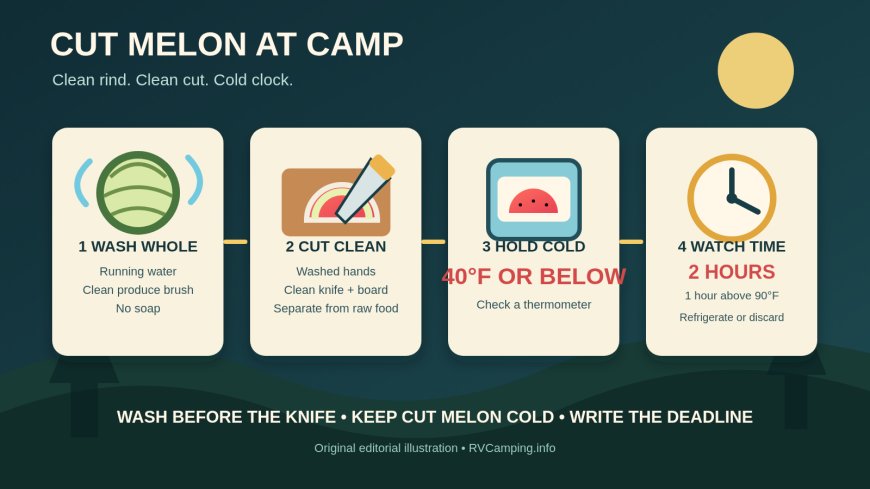
Federal consumer guidance allows perishable food no more than two hours outside temperature control. If the air temperature tops 90°F, only one hour is allowed.[3][4] The clock is cumulative. Moving a platter back into a lukewarm cooler does not reset it, and reheating does not rescue food that has already exceeded the discard limit.
Use small batches. Leave the reserve cold until the grill is ready, then cook only what the group is likely to eat. Mark a piece of tape:
- RAW SAUSAGE OUT OF COOLER: ____
- COOKED BATCH OFF GRILL: ____
- REFRIGERATE OR DISCARD BY: ____
This tape is an RVCamping.info planning tool, not a USDA or FDA form. Its value is that nobody has to reconstruct the timeline after sunset.
Keep only leftovers with a known history
A leftover is not simply a link that remains on the platter. It must have reached its required cooking temperature, stayed protected from raw tools and juices, and remained within the applicable two-hour or one-hour window. If any part of that history is unknown, discard it.
Move eligible leftovers into shallow, covered containers and refrigerate them promptly. USDA recommends shallow containers for faster cooling and says refrigerated leftovers can be kept for three to four days.[3] In an RV, "refrigerated" means the appliance or cooler actually holds 40°F or below. Do not overpack a small refrigerator so tightly that cold air cannot circulate, and do not count a powerless refrigerator as cold storage.
Separate leftovers by status. Cooked sausage and heated hot dogs can share a clean container if both have a known safe history. Raw sausages go back into their own leakproof container only if they remained safely cold and were never on a contaminated service tray. Do not mix a cooked link into the raw package to save space.
Reheat cooked leftovers to 165°F, measured with a food thermometer.[3] That number applies to leftovers, including fully cooked hot dogs once they are being handled as saved food. Reheat only the portion you plan to serve, keep it protected from raw food, and use a clean platter again.
Discard rather than refrigerate when a batch:
- exceeded two hours outside cold or hot holding, or one hour above 90°F;
- has no reliable start time;
- contacted raw sausage, raw juices or raw-only utensils after cooking;
- never reached the required internal temperature;
- sat in a cooler or RV refrigerator whose temperature history cannot be established; or
- was served on a platter that cannot be separated from guest handling and contamination.
Smell and taste cannot repair a missing timeline. The useful leftover question is: can you show that this link was cooked, protected and chilled in time?
The 60-second campsite briefing
Before anyone picks up the tongs, point out four things:
- Which package is ready-to-eat and which package is raw.
- Which tray and tongs belong to raw sausage.
- Whether the raw target is 160°F or 165°F.
- What time the cooked batch must be refrigerated or discarded.
That brief separation does more than a complicated grill routine. It keeps a fully cooked hot dog from being treated like raw meat, and it keeps a raw fresh sausage from being waved through as if browning were enough.
Evidence note: Product classifications, cooking temperatures, cold and hot holding temperatures, time limits, thermometer placement, leftover cooling and reheating guidance come from the cited USDA and FDA sources. The two-lane layout, color coding, tape log and 60-second briefing are RVCamping.info planning tools. This is U.S. consumer guidance. Commercial or permitted events can have additional state and local requirements.
Sources
- Hot Dogs and Food Safety | USDA FSIS (live content archived September 4, 2026)
- Sausages and Food Safety | USDA FSIS (live content archived September 4, 2026)
- Leftovers and Food Safety | USDA FSIS (live content archived September 12, 2026)
- Handling Food Safely While Eating Outdoors | FDA (accessed and archived September 22, 2026)
- Food Thermometers | USDA FSIS (live content archived September 12, 2026)
What's Your Reaction?