





Can Your Long RV Fit at the Visitor Center or Trailhead? Verify the Whole Parking Plan
A parking audit for long RVs and tow combinations that checks the exact lot, overflow, shuttle, circulation and turnaround before the road removes your options.

A parking audit for long RVs and tow combinations that checks the exact lot, overflow, shuttle, circulation and turnaround before the road removes your options.
Will your RV and tow combination fit at the visitor center or trailhead?
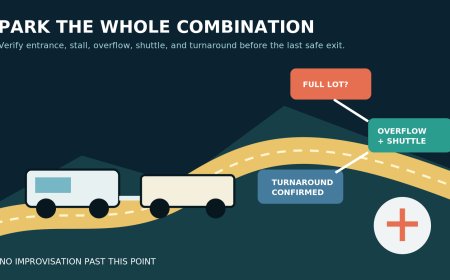
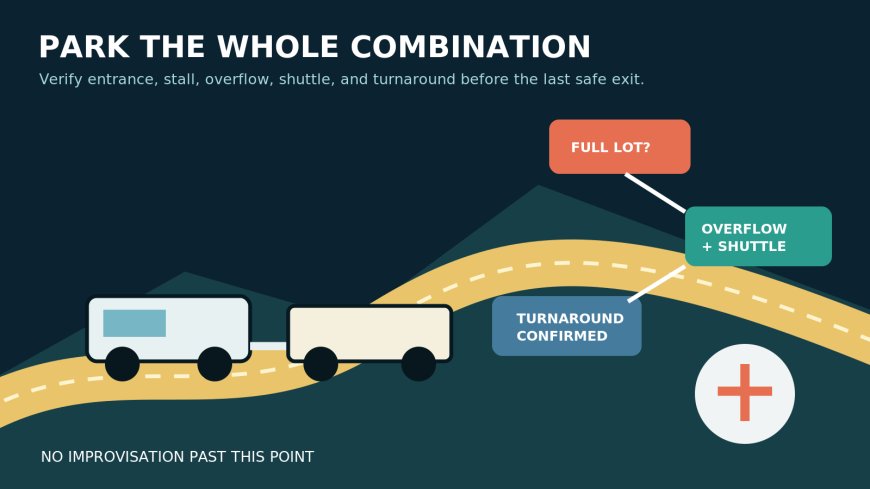
A pin labeled “parking” says almost nothing about a 55-foot truck-and-trailer combination. The lot may have two oversize stalls, a car-only overflow area, a one-way exit, or no place to turn around once the trailer enters. Verify the whole visit before leaving the campground: approach road, entrance, stall, exit, overflow and the last safe place to change plans.
Do not use a satellite image as permission. Pair the image with the park’s current parking page, alerts, shuttle schedule and a direct call when the exact combination is not addressed.
Start with the combination that will arrive
Write down the rig as it will be parked, not the trailer’s brochure length. Record total bumper-to-bumper length while hitched, width with mirrors, height to the tallest fixed item, and whether bicycles or a cargo rack extend the rear. Note the minimum space needed to open a slide only if you truly need it while stopped; sightseeing parking is not a campsite.
Also record the operational limits: can the driver back the combination accurately, can the trailer be detached legally, how long does unhitching take, and can every passenger use a shuttle? A place that accepts a 30-foot motorhome may not accept a 30-foot trailer plus its tow vehicle.
FHWA’s RV Friendly program illustrates why a stall length is only one piece. Its eligibility criteria for participating tourist attractions call for short-term spaces 12 feet wide and 65 feet long, a 50-foot swing radius, 12-foot-wide hard-surface access and 14 feet of overhead clearance.[5] Those figures are program criteria, not a promise that every signed park lot or attraction meets your rig’s needs. They are a useful prompt to ask about the path into and out of the space.
Check the exact lot, not the destination name
Large-vehicle rules can change from one adjacent lot to the next. At Grand Canyon’s South Rim Visitor Center, towed combinations and motorhomes can use the long drive-through stalls in Lot 1, while Lots 2, 3 and 4 have no RV or trailer spaces. NPS also says large vehicles should not occupy several ordinary stalls.[1] “Visitor center parking available” would be technically true and practically useless.
For each planned stop, capture six answers:
- Which named lot accepts an RV or a vehicle towing a trailer?
- Is the posted length limit for one vehicle or the full combination?
- Are spaces pull-through, back-in or parallel?
- Is there a legal overflow lot, and does it also accept the combination?
- Can the rig circulate to the exit if every oversize stall is occupied?
- Are parking and access rules different during shuttle hours, weekends, construction or winter?
Bryce Canyon’s additional lot is a good example of a rule tied to operations. It provides all-day oversize parking, while visitor-center parking is limited to one hour; when the shuttle is running, combinations and RVs above 23 feet cannot park in the amphitheater zone.[3] The workable plan is the named oversize lot plus the shuttle connection, not circling the closest lot.
Put overflow and shuttle in the primary plan
“Overflow available” needs a location and a vehicle rule. Sequoia and Kings Canyon directs RVs to spaces near Lodgepole Visitor Center and notes overflow beyond the market, past the campground entrance. At Kings Canyon Visitor Center, oversize spaces are by the gift shop and market, with overflow beyond the visitor center.[2] Save those landmarks before arrival; they are more useful than discovering an overflow sign after passing its turn.
For a shuttle, confirm the operating dates, hours, boarding stop, frequency and whether everyone’s mobility equipment can ride. Check the final return, not merely the first departure. Decide what happens if the lot is full or the shuttle has stopped: continue to a known turnaround, return to camp, or use an approved gateway lot. Never make “wait in the travel lane” the fallback.
At Grand Canyon, the visitor-center shuttle connects to other village areas and the Kaibab Rim route reaches South Kaibab Trailhead and Yaki Point.[1] This shows the useful pattern: park once in a verified large-vehicle space, then use the park’s transportation for the smaller destination. Recheck schedules near the travel date because route names, seasons and service hours change.
Audit the turnaround before the trailhead
Trailheads create the hardest failure: a driver reaches a full, tight lot and learns there is no loop, shoulder or reverse-safe exit. Crater Lake says the Cleetwood Cove trailhead has no designated large-vehicle spaces and a tight turning radius; it advises unhitching before approaching. The same official page identifies other pullouts with no easy turnaround and calls Steel Visitor Center a good turnaround point, although it has only two large-vehicle spaces and does not allow unhitching.[4]
That distinction matters. A turnaround is not automatically a parking or staging area. An oversize stall is not automatically a place to detach a trailer. A wide shoulder is not permission to leave the tow vehicle or trailer. Verify each action separately.
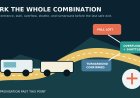
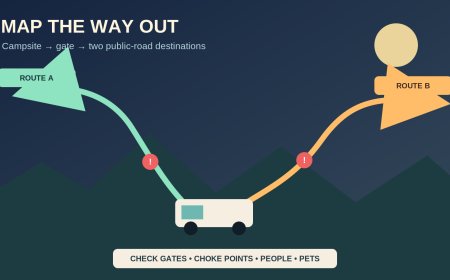
Mark a decision point on the route before the constrained road. At that point, the driver needs enough information to choose among entering, switching to overflow, unhitching at an authorized place, or aborting. If the official page gives a directional technique, save it. Sequoia and Kings Canyon, for example, advises longer RVs bound for Roaring River Falls or Zumwalt Meadow to continue north to Road’s End, turn around, and approach on the return.[2]
Use a three-layer parking worksheet
Build one line for every visitor center, trailhead and attraction.
Layer 1: legal fit. Record the accepted vehicle type, total-length wording, time or seasonal restrictions, parking duration and whether detached trailers are allowed.
Layer 2: physical movement. Note the approach road, gate clearance, turn into the lot, stall style, overhead hazards, circulation direction and confirmed turnaround. A map screenshot can support this layer, but it does not replace posted rules.
Layer 3: capacity fallback. List likely fill time if the park publishes one, the exact overflow lot, shuttle stop and hours, and the last safe alternative. Add the park phone number and the date the information was checked.
If any layer is blank, the stop is not verified. Move the combination only after the unanswered item is resolved, or park it at the campground and use a smaller vehicle.
Call with dimensions, not “Is it RV friendly?”
A useful call sounds like this: “We will arrive Tuesday at about 9 a.m. with a 56-foot total truck-and-trailer combination, 13 feet high. Which lot can legally hold us? Is it pull-through? If those spaces are full, where is the next legal lot or turnaround? May we detach there? Is the shuttle operating for our return time?”
Write down the employee’s answer, time and office number. Ask whether an alert, construction closure or event changes the published plan. When a ranger’s current instruction conflicts with an older page, follow current on-site controls and keep the discrepancy in the trip notes for the next check.
Set a no-improvisation rule
Do not straddle car stalls, block a bus loop, detach in an unapproved lot, reverse into traffic, or continue down a narrow road hoping a turnaround appears. These moves transfer a planning problem to other visitors and can trap the rig.
The best long-combination itinerary may leave the trailer at the campsite, use a towed car, or skip one trailhead. That is not wasted capability. It is the result of checking the complete movement chain before the road removes your options.
Sources
- Parking: South Rim Visitor Center and Village — National Park Service, Grand Canyon National Park; accessed 2026-10-04.
- Visiting With An Oversized Vehicle — National Park Service, Sequoia and Kings Canyon National Parks; accessed 2026-10-04.
- Additional Parking Lot — National Park Service, Bryce Canyon National Park; accessed 2026-10-04.
- Traveling in an RV or Towing — National Park Service, Crater Lake National Park; accessed 2026-10-04.
- Interim Approval for Addition of RV Friendly Symbol — Federal Highway Administration; accessed 2026-10-04.
What's Your Reaction?