



A park entry reservation is not an RV parking plan: verify both before you go
A timed-entry or vehicle reservation may admit a vehicle without guaranteeing an RV-sized route or parking space. Use this two-reservation, two-fit checklist.

A park entry reservation is not an RV parking plan: verify both before you go
A reservation can get your vehicle past a checkpoint and still leave the RV with nowhere legal to go. Acadia National Park supplies the cleanest example: a 2026 Cadillac Summit Road vehicle reservation provides a timed entry window, but it does not assign a parking space. RVs, trailers, and vehicles over 21 feet long, counting hitch attachments and bike racks, are prohibited on that road even when the driver holds a valid reservation.[3]
That is the planning gap. An access product answers whether a vehicle may cross a controlled point at a certain time. It does not necessarily answer whether the vehicle fits the road, may use the destination lot, or will find an open space. A campground booking answers where the party sleeps, subject to that campground's rules. It does not automatically solve daytime parking.
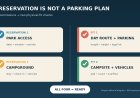
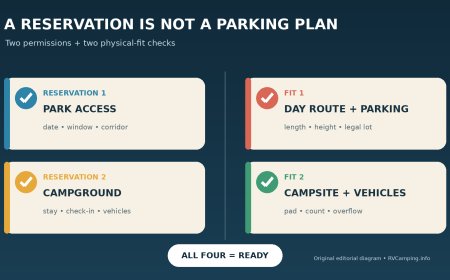
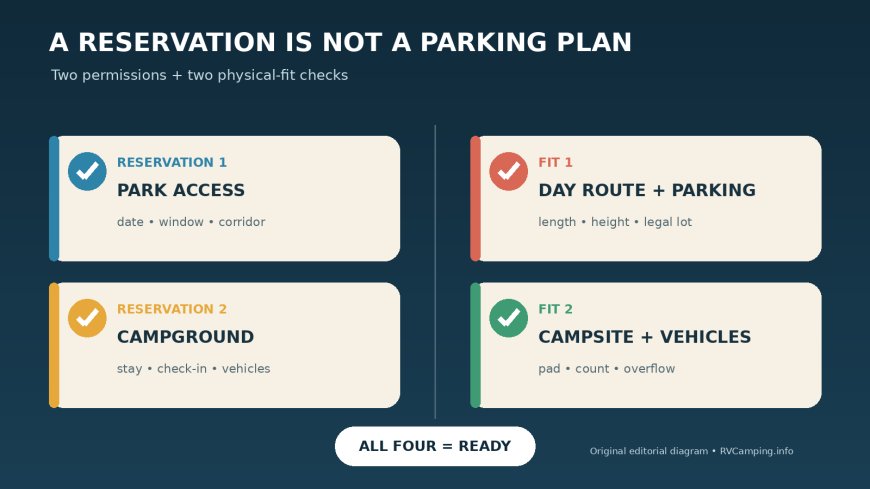
For an RV trip, verify four separate items: two reservations and two kinds of fit. Sometimes one document covers more than one item, but only the park's current language can establish that.
Use four boxes, not one confirmation folder
Build one row for each park day:
| Box | Question to answer | Evidence to save |
|---|---|---|
| Park access reservation | May this vehicle enter this controlled park, corridor, or road at the planned time? | Product name, date, entry window, covered area, vehicle and holder rules |
| Campground reservation | Where may the RV stay overnight? | Campground, dates, check-in time, vehicle count, confirmation |
| Day-route and parking fit | Can the full rig legally travel the route and use a legal destination space? | Length, height, trailer and RV restrictions, lot rules, shuttle or toad plan |
| Campsite fit | Can the camping unit and other vehicles occupy the site as required? | Campground limit, exact-site data, parking surface, overflow rule |
The first two boxes concern permission. The second two concern the equipment and space. A green check in one box never fills another by implication.
This is a narrower test than a general timed-entry checklist. If you still need to determine whether a campground confirmation substitutes for timed entry, start with RVCamping.info's campground-versus-timed-entry document check. Then return to the physical route and parking questions below. A valid gate document is the beginning of the RV movement plan, not the end.
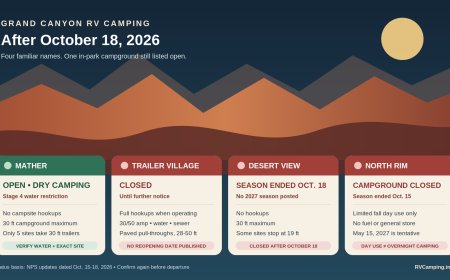
Acadia: a valid reservation can be unusable for the rig
Cadillac Summit Road requires vehicle reservations from May 20 through October 25 in 2026. Visitors also need a park entrance pass; the road reservation is a separate product. The reservation applies per vehicle and gives either a sunrise or daytime entry window.[3]
None of that makes the road available to an RV. The NPS states that recreational vehicles and trailers are prohibited. It also bars vehicles over 21 feet, measured with racks and hitch attachments, and says an over-limit vehicle will be denied entry even with a valid reservation.[3]
The same page removes another tempting assumption: the reservation does not assign a particular parking space. Only designated parking may be used, with parking at two summit locations.[3] In practical terms, the driver must pass three tests:
- hold the separate park entrance pass;
- hold the correct Cadillac road reservation for that vehicle and time; and
- arrive in a vehicle that meets the road limit, then use an available legal space.
A motorhome driver cannot repair a failed third test by showing the QR code again. Acadia's broader oversized-vehicle page also closes several roads and parking areas to RVs and trailers, including Sand Beach, Jordan Pond South, and Bubble Pond parking lots. It lists Park Loop Road height limits as low as 12 feet on one segment and 12 feet 2 inches on another.[4]
The workable plan may be to leave the RV at a confirmed legal location and tour in a compliant towed car. It may require a different destination. Do not invent a staging spot at the reservation checkpoint or assume an attraction lot will hold the motorhome because the park entrance admits it. Confirm where the RV may remain, whether overnight or day parking is allowed there, and how every traveler gets back.
Rocky Mountain: campground access and campground fit still differ
Rocky Mountain National Park uses two 2026 timed-entry products. One covers the Bear Lake Road Corridor plus the rest of the park from 5 a.m. to 6 p.m.; the other covers the park except Bear Lake Road from 9 a.m. to 2 p.m. Both admit a vehicle in a two-hour entry window.[1]
A qualifying campground confirmation can supply timed-entry access, but its scope is specific. The park's current campground page says overnight reservations at Aspenglen, Glacier Basin, or Timber Creek include timed entry beginning at 1 p.m. on the first camping day. Aspenglen and Glacier Basin include Bear Lake Road access; Timber Creek does not.[2] Longs Peak is tents only, and its camping fee does not include timed entry.[2]
Even after the access box passes, the camping unit must fit. Rocky Mountain publishes campground-level RV or trailer maximums of 30 feet at Aspenglen, 35 feet at Glacier Basin, 40 feet at Moraine Park, and 30 feet at Timber Creek. Longs Peak is tents only.[2] Those campground limits are a screening tool, not proof for an unexamined site or combination.
Parking inside the campground is its own constraint. The NPS counts a vehicle, trailer, RV, or towed unit as a vehicle, limits a site to two, and requires them to stay on the provided gravel or paved pad. Some sites hold only one vehicle. The overflow area is first come, first served and is not guaranteed.[2]
A trailer, tow vehicle, and second car can therefore produce three separate failures despite a valid camping confirmation: too many counted units, insufficient room on the pad, and no available overflow space. The solution is not to edge onto vegetation or the campground road. Reduce the vehicle count, confirm a lawful alternate location, or use a campsite that supports the combination.
Measure the traveling configuration
Record the rig in the form it will use for each outing. "Our motorhome is 20 feet" is incomplete when a bike rack makes the road measurement longer. "The trailer is 28 feet" does not describe the connected truck-and-trailer length or the number of units after unhitching.
Keep these measurements in the trip file:
- motorhome or trailer body length;
- bumper-to-bumper length with racks, cargo carriers and hitch attachments;
- connected length of tow vehicle and trailer;
- loaded height, including air conditioners and antennas in travel position;
- width at the widest fixed point;
- number of units while coupled and after setup;
- turning and tail-swing concerns that affect a tight lot.
Compare each number with the rule's wording. A road may regulate total vehicle length while a campground lists maximum RV or trailer length. Those are different measurements. If the official page does not define the measurement, ask the park and retain the answer with the date.
Decide where the RV goes during the park day
A campsite is not automatically a day-parking permit for every attraction, and an attraction reservation is not permission to leave a rig at the campground before check-in or after checkout. Put a location beside the RV for every part of the day:
| Time block | RV location | Other vehicle | Rule still to verify |
|---|---|---|---|
| Before check-in | Named legal lot or on the road | Coupled or separate | Early parking permission and space |
| During sightseeing | Campsite or named oversized lot | Toad, tow vehicle or shuttle | Destination access and re-entry |
| After checkout | Named legal day location | As planned | Checkout, parking deadline and overnight ban |
| At the attraction | Exact approved lot, if the RV travels | Same vehicle | Length, height, trailer and space limits |
Avoid placeholders such as "visitor center lot" or "somewhere near the gate." Save the lot name, eligible vehicle types, hours and fallback. If parking is not guaranteed, set a decision point before the rig enters a road with no easy turnaround.
The two-reservation, two-fit checklist
Use this checklist for each park day, then repeat it whenever the vehicle configuration changes.
Reservation 1: park or road access
- [ ] I recorded the exact product, controlled area, date and entry window.
- [ ] I know which vehicle and reservation holder must be present.
- [ ] I separated the entrance pass or fee from the access reservation.
- [ ] I saved the full confirmation for offline use.
- [ ] I know whether re-entry is allowed and what happens if we miss the window.
Reservation 2: campground
- [ ] The campground, stay dates and check-in and checkout times are correct.
- [ ] I found the park's current statement on whether this booking supplies timed entry.
- [ ] I recorded when included access starts and which roads it covers.
- [ ] I counted the RV, trailer, tow vehicle, toad and extra cars under the campground's definition.
Fit 1: daytime route and parking
- [ ] The traveling vehicle meets every route length, height, trailer and vehicle-type restriction.
- [ ] The destination accepts this vehicle type; a reservation alone is not my evidence.
- [ ] I identified a legal lot for the RV during sightseeing.
- [ ] I know whether parking is assigned, guaranteed, first come, or unavailable to oversized vehicles.
- [ ] I have a fallback before the last safe turnaround.
Fit 2: campsite and overnight parking
- [ ] The campground maximum accepts the RV or trailer.
- [ ] The selected site's usable pad accommodates the camping unit and permitted vehicles.
- [ ] All tires, hitch equipment and parked vehicles can remain on the required surface without entering the road.
- [ ] Any overflow lot accepts the unit overnight, and I know whether space is guaranteed.
- [ ] Slides, doors and access equipment can be used without borrowing neighboring space.
Finish the row with one sentence: "On this date, this vehicle may enter this area using this document, the RV will remain at this legal location, and the camping unit plus other vehicles fit the overnight rules." Every noun should be specific. If "this vehicle" or "this location" still means "we will figure it out there," the trip is not ready.
Editorial note: Reservation systems, controlled dates, road restrictions and parking rules change. The official NPS pages cited below were reviewed October 19, 2026. This article does not claim firsthand gate, road, campsite or parking inspection.
Sources
What's Your Reaction?