






Bonita Canyon Campground for RVs: Exact Limits and When to Stay Near Willcox
Bonita Canyon suits measured small rigs, but the entrance dip, under-29-foot boundary, driveway fit and 24-foot scenic-road rule make Willcox the better base for many RVs.

Bonita Canyon Campground for RVs: exact limits and when to stay near Willcox
By Romana for RVCamping.info | October 3, 2026
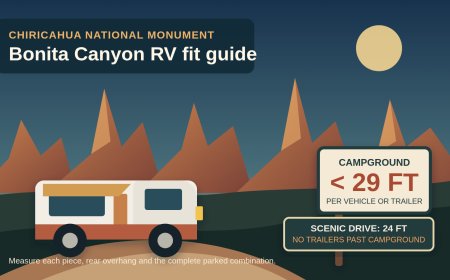
Bonita Canyon Campground works best for camper vans, truck campers, short motorhomes and carefully matched small trailers. It is not a general-purpose national park RV campground. The entrance has a sharp dip, every standard campsite is a back-in, there are no hookups or dump station, and the road beyond camp has a separate 24-foot limit with no trailers.
The conservative booking rule is simple: if any single vehicle or trailer is close to 29 feet, if the complete truck-and-trailer combination cannot fit one driveway, or if you need routine power, tank filling or dumping, use an RV park near Willcox and tour Chiricahua in a smaller vehicle.
The hard rig limits
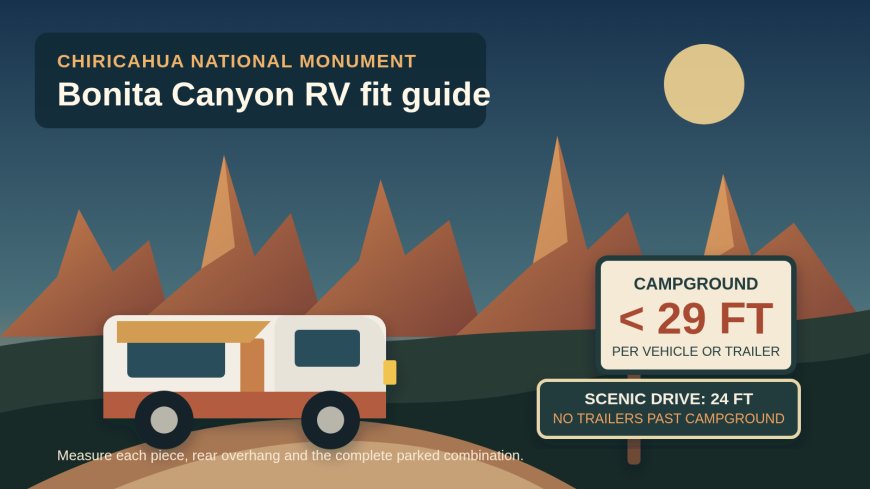
The official pages contain a boundary wording conflict worth noticing. NPS requires each vehicle or trailer to remain under 29 feet once attached racks are counted, while Recreation.gov describes 29 feet as the maximum per piece, with racks included there too.[1][2] A rig measuring exactly 29 feet sits on that conflict. Do not assume it will be accepted because a booking form allows it; call the park before reserving.
There are four separate fit tests:
- Each piece: the motorhome, tow vehicle or trailer must satisfy the 29-foot entrance limit on its own. Bike and storage racks count.[1][2]
- Rear overhang: the current handout says less than 9.5 feet in its diagram but warns in the body that overhang beyond 9 feet may scrape. Recreation.gov also uses both 9- and 9.5-foot warnings. Treat 9 feet as the conservative ceiling until the park confirms your measurement method.[2][6]
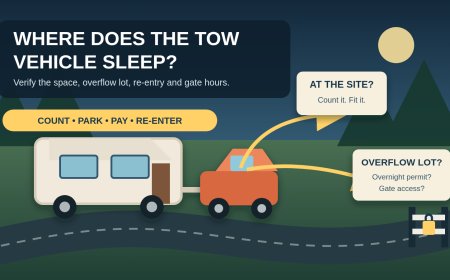
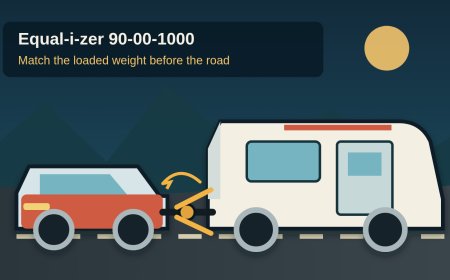
- Combined parking length: the truck and trailer together must fit inside the reserved driveway. They may not fit side by side, and a trailer counts as one of the site's two vehicles.[2]
- Upper scenic drive: past the campground, the limit drops to 24 feet and trailers are prohibited. Campground eligibility does not make a 25- to 29-foot motorhome eligible for Echo Canyon or Massai Point.[3][6]
NPS illustrates the parking test with a 35-foot combination made from a 20-foot tow vehicle and a 15-foot trailer. That outfit should use a driveway at least 35 feet long. The articulation at the hitch may help it cross the entrance dip, but the complete combination still needs to park within the site.[1]
The longest published driveways
The individual Recreation.gov records retrieved October 3, 2026 show only five standard sites with driveways longer than 30 feet. All are gravel back-ins.
| Site | Driveway | Listed max vehicle | Overhead clearance | Grade |
|---|---|---|---|---|
| 18 | 38 ft | 29 ft | 15 ft | Slight |
| 11 | 36 ft | 29 ft | 14 ft | N/A |
| 14 | 34 ft | 29 ft | 12 ft | N/A |
| 20 | 34 ft | 29 ft | 14 ft | Slight |
| 6 | 33 ft | 29 ft | 14 ft | Slight |
Those figures are screening tools, not promises. Site 14's 12-foot overhead field, for example, rules out many taller RVs even though its driveway is long. Site 12 illustrates why the exact record matters: it displays a 25-foot maximum vehicle, a 20-foot driveway, a 35-foot site length and a moderate grade. That combination needs clarification before booking. The campground overview itself warns that only a few sites accommodate RVs or trailers, that some are hard to back into, and that some are not level.[2]
Most other records are materially shorter. Published maximum vehicle fields include 26 feet at site 24; 24 feet at site 23; 22 feet at sites 1, 3, 4, 8 and 9; 21 feet at site 10; 20 feet at site 25; 18 feet at sites 5, 21 and 22; 16 feet at sites 2 and 15; and 15 feet at site 7. Site 26 is the group tent area, not RV inventory. Reopen the live site record because equipment labels and dimensions can change.
What camping here actually provides
Bonita Canyon is dry camping. There is no electric, water or sewer hookup and no black-water dump station. Drinking-water faucets are available, but hose connections and RV tank filling are prohibited. Campers can use two designated gray-water disposal points. The restroom has flush toilets and sinks but no showers.[2]
Generator hours are narrow: 8–10 a.m. and 4–6 p.m. Quiet hours run from 8 p.m. to 8 a.m.[2][6] That schedule is workable for battery charging but poor for anyone expecting generator-powered air conditioning through a hot afternoon or overnight.
A standard site allows up to eight people, two vehicles and two tents. A trailer counts as a vehicle, and nothing may park outside the reserved site. Excess or incompatible vehicles must be left outside the park; there is no overflow overnight parking.[2]
All sites require a reservation. The NPS handout says campers may reserve as far as six months ahead or on the day of arrival if space remains.[6] The campground often fills, especially around holidays and during March and April, so a larger-rig traveler should not arrive hoping that one of the five longer driveways will be open.[1]
Why the scenic drive changes the plan
The campground is not the end of the size restrictions. The road narrows and winds as it climbs. NPS sets a 29-foot limit from Faraway Ranch to the visitor center and campground, then a 24-foot limit with no trailers beyond the campground.[3]
That means a 26-foot Class C may fit an appropriate campsite yet still be unable to reach the main upper-road trailheads in that RV. Echo Canyon and Massai Point list no oversized spaces. Travelers with a towable can disconnect, leave the trailer as directed and use the tow vehicle, provided the vehicle fits the reserved site at night. A motorhome traveler without a towed car has fewer options.
Do not substitute a map-app shortcut. NPS says the paved road has one entrance and ends at Massai Point. Pinery Canyon Road and Apache Pass are winding, rocky dirt routes that can become impassable after rain or snow.[4]
When Willcox is the better operational base
An outside base near Willcox is the better choice when:
- any one vehicle or trailer exceeds the conservative under-29-foot limit;
- rear overhang is near 9 feet, or height and width leave little tree or dip clearance;
- the truck and trailer need more than the exact reserved driveway;
- the driver does not want a narrow gravel back-in or an uneven site;
- hookups, reliable air conditioning, showers, a dump station or an RV tank fill are part of the trip plan;
- a 25- to 29-foot motorhome needs a smaller vehicle for the scenic drive;
- the stay is long enough that repeated water and waste logistics outweigh sleeping inside the monument.
NPS itself points larger vehicles and travelers who dislike narrow back-ins toward private campgrounds. It says Willcox has multiple campgrounds, while private parks may offer pull-throughs, hookups, water and dump stations that Bonita Canyon cannot.[5]
The trade is a commute. Willcox is about 37 miles from the park and roughly a 45-minute drive, while Highway 186 is winding and hilly.[2][4] In exchange, Willcox has the nearest full supermarket plus several places to fuel. There is no food, ice, fuel or vehicle charging inside the park.[2][5]
For a large motorhome, the clean operational pattern is to leave the coach at a suitable Willcox-area site and make the park visit in a vehicle under 24 feet. That avoids the campground entrance dip, preserves access to the upper scenic road and keeps resupply from becoming a separate travel day. Confirm the outside park's current site length, hookup amperage, dump arrangement and cancellation terms directly before booking; “near Willcox” is a strategy, not a guarantee that every commercial site fits every rig.
Arrival plan for an in-park stay
Measure the RV body, every attached rack, rear overhang and the full towing combination before opening Recreation.gov. Then check the exact site's equipment types, driveway length, maximum vehicle field, overhead clearance, grade and notes. Save the record with the reservation.
Fuel or charge in Willcox or Sunizona before the final approach. NPS says gas, groceries, ice and charging are 30–40 miles from the monument, and roadside assistance can take a full day or more.[3][4] Arrive in daylight so the entrance dip, trees and back-in are easier to judge.
The NPS live-alert feed checked October 3, 2026 contained one active information notice about vehicle length and trailer restrictions and no road-closure alert.[7] That is only a dated snapshot. Recheck park alerts and the exact Recreation.gov record before departure.
Bottom line
Bonita Canyon is a good small-rig campground with strict geometry, not a 29-foot blanket approval. The entrance limit applies to each piece; the combined outfit must fit one driveway; overhang and overhead clearance matter; and the scenic road beyond camp has a lower 24-foot, no-trailer rule.
Choose the in-park campground when the measured rig fits a specific record and dry-camping limits suit the trip. Choose a Willcox-area base when fit is close, utilities matter, or a smaller day-use vehicle will make the park easier to operate.
Sources
- [1] National Park Service, Bonita Canyon Campground. Retrieved October 3, 2026.
- [2] Recreation.gov, Bonita Canyon Campground, Chiricahua National Monument, including linked individual campsite records. Retrieved October 3, 2026.
- [3] National Park Service, Safety: vehicle restrictions at Chiricahua. Retrieved October 3, 2026.
- [4] National Park Service, Directions and transportation. Retrieved October 3, 2026.
- [5] National Park Service, Eating, sleeping and camping outside the park. Retrieved October 3, 2026.
- [6] National Park Service, Bonita Canyon Campground information handout. Retrieved October 3, 2026.
- [7] National Park Service, Chiricahua National Monument live alerts feed. Snapshot retrieved October 3, 2026.
What's Your Reaction?