











Stuffing a turkey in an RV oven? Both must reach 165°F
A four-reading RV oven plan verifies 165°F in the turkey and stuffing, with a safer separate-casserole route and fast leftover cooling.

Stuffing a turkey in an RV oven? Both must reach 165°F
By Romana | October 19, 2026 | Cooking
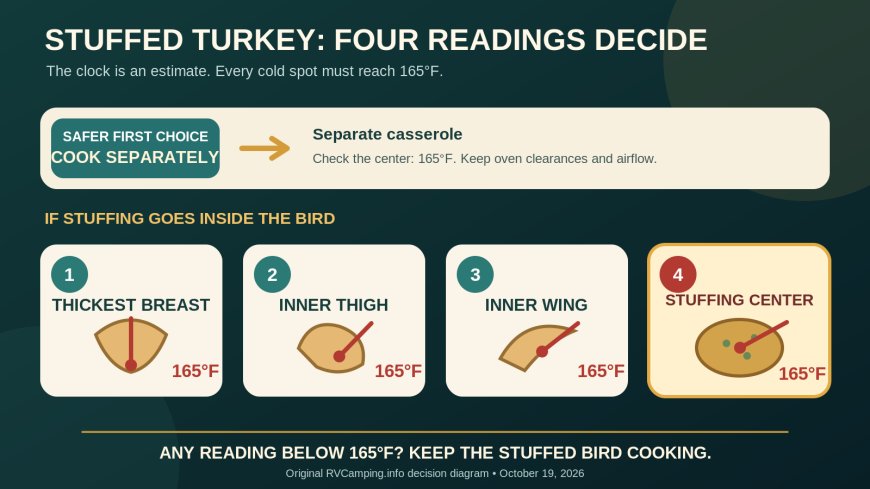
A browned turkey can be ready while the stuffing in its cavity is still below a safe temperature. That mismatch matters even more in a compact RV oven, where a crowded pan, close burner and uneven heat can turn a timetable into a poor guide. If you cook stuffing inside the bird, dinner is not done until the turkey passes three thermometer checks and the center of the stuffing passes a fourth. Every reading must be at least 165°F.[1][2]
Quick answer: USDA recommends cooking stuffing separately for optimal safety and more even doneness. If you stuff the turkey, mix the wet and dry ingredients just before filling, spoon the stuffing in loosely, put the bird straight into an oven set no lower than 325°F, and verify 165°F in the stuffing center, thickest breast, innermost thigh and innermost wing. If one point is low, the whole stuffed bird stays in the oven.[1][2]

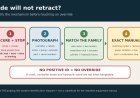
Four readings decide dinner: three in the turkey and one in the stuffing. Original RVCamping.info decision diagram.
The stuffed bird has two endpoints, not one
Stuffing absorbs raw poultry juices while the bird cooks. It also sits in the place heat reaches last. USDA warns that the meat may reach 165°F before every part of the stuffing does; bacteria can survive when the stuffing center remains below 165°F.[1]
That creates a hard rule: a passing breast reading does not clear the meal. Neither does a pop-up indicator. The turkey and stuffing are one cooking job with four required readings:
- the thickest part of the breast;
- the innermost part of the thigh;
- the innermost part of the wing; and
- the center of the stuffing.[2]
If the breast, thigh and wing read 165°F but the stuffing reads 158°F, keep cooking. Do not scoop out undercooked stuffing to finish it elsewhere while serving the bird. USDA's guidance is to continue cooking when the meat is done but the stuffing has not reached 165°F.[1]
Decide whether the RV oven can support the method
USDA notes that an oversized turkey or roasting pan can block heat circulation. Its roasting instructions call for an oven temperature of at least 325°F and a shallow pan, with the bird breast-side up on a rack.[2] In an RV, the physical fit is a safety decision, not a convenience check.
Test the setup while the oven is cold and the turkey is still wrapped:
- Put the empty rack and roasting pan in the exact positions you plan to use.
- Confirm that the door closes freely and the pan clears the burner, walls and other surfaces by the distances in the appliance manual.
- Leave the air paths required by the oven manufacturer. A pan that fills the cavity wall to wall is the wrong pan.
- Make sure you can reach the bird with an instant-read thermometer without dragging the hot pan across the aisle.
- Check that the oven can hold at least 325°F with an independent oven thermometer, if the appliance manual permits one.
A fit failure calls for a smaller bird, turkey parts or a different meal. Foil, a longer estimated time or a higher dial setting does not create missing clearance. Never use an outdoor grill, smoker, fryer or microwave for a stuffed whole turkey; USDA's stuffing guidance excludes those methods.[1]
Small propane ovens often have a strong hot spot near the burner. Use the rack position and pan type the manual specifies. If the manual allows rotation, rotate carefully and briefly. Do not treat frequent door opening as temperature control; every check drops oven heat and lengthens the cook.
If you stuff the bird, fill it and cook it now
Keep the dry bread mixture and chilled wet ingredients separate until the oven and turkey are ready. If the recipe contains raw meat, poultry or shellfish, cook those ingredients before they go into the stuffing. Mix the stuffing, spoon it into the cavity loosely and move the stuffed bird directly to the oven. USDA gives an approximate limit of 3/4 cup of stuffing per pound for a whole bird and says the mixture should be moist rather than dry.[1]
Do not mix raw stuffing in the morning and hold it in the RV refrigerator until afternoon. USDA says not to refrigerate uncooked mixed stuffing. The useful make-ahead work is limited: prepare dry ingredients separately, cook vegetables or other wet ingredients, chill the wet portion, and combine only at filling time.[1]
Set the oven no lower than 325°F. Published roasting times are planning estimates, not release times. Stuffing adds cooking time, and an RV oven's cycling and crowded geometry make clock-only decisions especially weak.[2]
Put the probe where the cold spots are
Start checking near the end of the expected cooking window, then let the thermometer settle at each location. Clean and sanitize the probe between insertions according to its instructions.
For the breast, enter from the side into the thickest meat and stop short of bone and the cavity. For the thigh, probe the innermost portion where the thigh meets the body without touching bone. Check the innermost wing area as a separate point. USDA requires all three whole-bird locations to reach 165°F.[2]
For the stuffing, insert the probe deep enough to reach the middle of the cavity's stuffing mass. Avoid reading against the metal rack, pan, bone or the cavity wall. Check more than one nearby path if the center is hard to judge. The lowest valid center reading controls.
An oven-safe leave-in probe can track one location, but it cannot certify all four. Use an instant-read thermometer to map the remaining points. If any result is under 165°F, close the door, keep cooking and check again. Write the four final temperatures on a scrap of paper or in a phone note; in a cramped galley, memory gets unreliable fast.
USDA advises letting the finished bird stand for 20 minutes, then removing the stuffing and carving. That rest comes after every endpoint passes, not as a way to make up for a low stuffing reading.[2]
Separate stuffing is the safer RV plan
USDA's preferred approach is to cook stuffing in a separate casserole because it improves safety and even doneness.[1][2] It also removes the slowest, hardest-to-measure cold spot from the turkey.
Limited oven space still needs a plan. Use one of these routes:
- Choose a small casserole that fits without blocking the air clearances required around the turkey pan.
- Cook the stuffing earlier, move it into shallow containers within two hours, refrigerate it at 40°F or below, then reheat it to 165°F before serving.[1][3]
- If neither route works within the appliance instructions and available cold space, skip stuffing. Bread, vegetables and broth do not need to become a food-safety bottleneck.
Do not balance a casserole on the roasting pan, place it directly over a burner or add a makeshift rack. If a second electric appliance is part of the plan, confirm its cooking instructions and the RV's circuit capacity before meal day. Tripping the pedestal breaker halfway through the turkey cook is not an acceptable schedule.
Separate stuffing still needs its own 165°F center reading. A crisp top says nothing about the middle.
Clear refrigerator space before the oven turns on
A small refrigerator can hold the meal before dinner and still fail at leftovers. Before cooking, reserve space for several shallow containers, including a separate container for stuffing. USDA says cooked poultry and stuffing must be refrigerated within two hours; the general limit drops to one hour when the temperature is above 90°F.[1][3]
After the 20-minute rest, remove all stuffing from the cavity. Carve the turkey into smaller pieces; slice breast meat, while legs and wings may stay whole. Divide the meat and stuffing among shallow containers so they cool quickly. USDA says hot food may go directly into the refrigerator, provided the refrigerator can hold 40°F or below.[3]
Do not slide the intact warm bird into a compact refrigerator. Do not pack all the stuffing into one deep bowl. If the planned containers will not fit without crowding the refrigerator, save a smaller quantity or change the menu before cooking. An unmonitored cooler or chilly outdoor air is not a verified refrigerator.
Use refrigerated leftovers within 3 to 4 days. Reheat turkey and stuffing to 165°F.[1][3]
The RV stuffed-turkey decision card
Before filling: The bird, pan and required clearances fit; the oven can run at 325°F or higher; the wet and dry stuffing components are still separate; a working food thermometer is ready.
Before serving: Record at least 165°F in breast, inner thigh, inner wing and stuffing center. One low reading means continued cooking.
Before relaxing: Remove the stuffing, carve the bird, portion both into shallow containers and refrigerate within two hours, or one hour above 90°F.
This page owns the cook-and-verify decision. The October 18 guide answers a different question: whether an RV refrigerator can support a whole turkey through thawing and the later leftover load. Use that cold-space plan before buying the bird; use this four-reading plan once deciding whether to put stuffing inside it.
Evidence note: USDA supplies the preparation, oven, endpoint and leftover limits. The four-reading decision card, RV oven fit check and capacity fallback choices are original RVCamping.info planning tools.
Sources
- USDA FSIS: Stuffing and Food Safety — stuffing preparation, 165°F center endpoint, separate-casserole preference and refrigeration guidance (archived September 23, 2026; live page checked October 19, 2026).
- USDA FSIS: Turkey Basics — Safe Cooking — 325°F oven floor, pan fit, three turkey probe locations and stuffed-bird endpoint (archived September 23, 2026; live page checked October 19, 2026).
- USDA FSIS: Leftovers and Food Safety — time limits, shallow-container cooling, 40°F cold holding and leftover storage guidance (archived September 23, 2026; live page checked October 19, 2026).
What's Your Reaction?