







Farm-stand milk or cheese at camp? Read the pasteurization label first
An RV dairy purchase card checks pasteurization, label identity, cooler temperature and higher-risk campers before serving.

Farm-stand milk or cheese at camp? Read the pasteurization label first
By Romana | October 20, 2026 | Cooking
A roadside cooler and a handwritten farm sign can make a local dairy stop feel like part of the trip. The safety decision still comes down to the package. CDC recommends pasteurized milk and dairy products and says careful label reading is part of that choice.[2]
Quick answer: Before raw milk, yogurt, ice cream or cheese enters the RV refrigerator, find a clear pasteurization statement and the product's refrigeration instructions. Choose pasteurized dairy, keep perishable products at 40°F or colder, and do not use smell or a tidy farm setting as proof of safety. For campers who are pregnant, 65 or older, immunocompromised, or younger than 5, CDC identifies a higher risk of serious illness from germs in raw milk.[2]

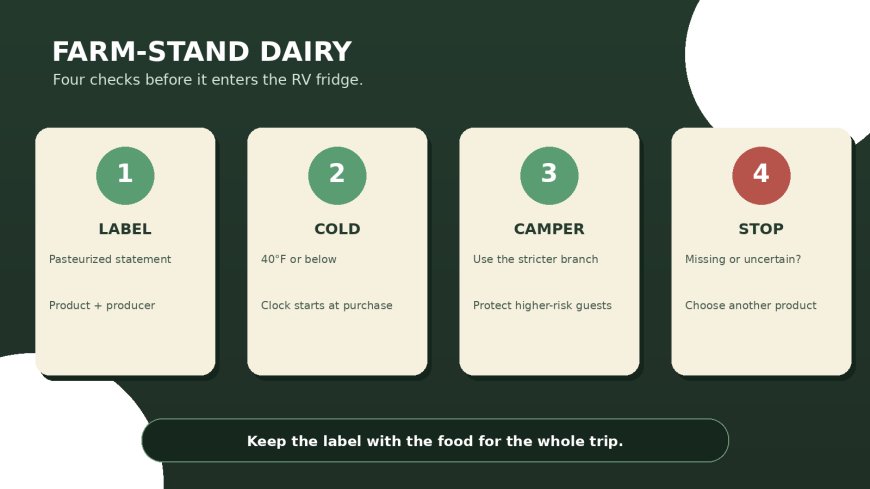
The purchase decision happens before the cooler lid opens. Original RVCamping.info label-check diagram.
This is not a verdict on a farm or a lesson in state dairy law. It is a purchase-and-storage check for RV travelers who may cross state lines, lose the original package or have limited refrigerator space.
"Local" and "raw" answer different questions
Local tells you something about where a food came from. It does not say whether the milk was pasteurized. Organic, grass-fed, small-batch and artisan are also separate claims.
FDA says raw milk may carry disease-causing organisms and explains that pasteurization uses controlled heat to kill harmful bacteria. FDA also says pasteurized and unpasteurized milk do not have a meaningful nutritional difference.[1]
CDC's raw-milk warning covers several kinds of germs. The list includes Salmonella, Listeria and E. coli, along with Campylobacter, Brucella and Cryptosporidium. Good practices at a farm can reduce contamination, but CDC says they cannot guarantee that raw milk is free of harmful germs.[2]
Do not try to settle this at the campsite by tasting a sample. The useful evidence is the label, the seller's required product information and an intact cold chain.
Run the package check before buying
Take a photo of the entire label while standing at the counter. Capture the product name, producer, pasteurization statement, lot or date code, storage directions and seller contact information. If the product is later recalled, those details matter more than remembering that it came from "the farm stand near the highway."
Use three questions:
- Does the package clearly say the milk is pasteurized? If the wording is absent or ambiguous, do not assume.
- Does it require refrigeration? Most fresh dairy products do. Follow the exact package directions.
- Can your RV maintain the required temperature for the full trip? FDA advises checking label storage directions and discarding food that was not properly refrigerated.[4]
Keep the product in its original container. Pouring milk into an unmarked jug or wrapping cheese without its label removes the information another traveler needs to make a safe decision.
If the seller cannot provide a durable label, write down the details and keep them with the product. For a group refrigerator, add the buyer's name and purchase date without covering the original information.
Cheese needs more than a hard-versus-soft guess
Milk form and cheese texture are not the same decision. A firm cheese can still be made from raw milk, while many soft cheeses are made from pasteurized milk. Read the statement on the exact package.
Campers at higher risk of invasive listeriosis need a stricter cheese branch. CDC advises them to avoid cheese made with unpasteurized milk. Its lower-risk list includes several cheeses when made with pasteurized milk, while queso fresco-type cheese receives special caution: CDC advises avoiding it unheated for high-risk people even when the milk was pasteurized, or heating it to 165°F or until steaming.[3]
That last detail matters at a potluck. "Made with pasteurized milk" addresses the starting milk; it does not promise that a fresh cheese could not be contaminated later. A person in a high-risk group should use CDC's food-specific guidance rather than treating the pasteurized statement as a universal green light.[3]
Do not invent a campsite rescue step for an unlabeled cheese. Melting it until it looks soft is not a verified substitute for knowing what the product is or following an agency's specified heating advice.
Protect the cold chain on the drive back
A farm stop often happens mid-route, when the RV refrigerator is already full and the day is warm. Decide where the dairy will go before paying.
CDC advises holding perishable food at 40°F or below and limiting room-temperature exposure to two hours, or one hour when conditions exceed 90°F.[2] The clock includes checkout, conversation, loading, sightseeing and the drive. It does not begin when you reach the campsite.
Use this travel setup:
- Put a refrigerator thermometer in the RV refrigerator or an appliance thermometer in the food cooler.
- Pre-chill the cooler and use enough ice or frozen packs to maintain 40°F or below.
- Place dairy in a clean, waterproof bin above any raw meat packages.
- Keep the label facing up and dry.
- Use a separate beverage cooler if frequent drink stops would keep exposing the dairy cooler to warm air.
- Record the purchase time if the product cannot go immediately into verified cold storage.
A cold package is not proof that it stayed cold earlier. If the seller's display temperature, package condition or time history is uncertain, choose another product.
Match the strictest eater, not the average camper
CDC identifies children younger than 5, adults 65 and older, pregnant people and people with weakened immune systems as more vulnerable to severe illness from raw-milk germs.[2]
For a shared campsite meal, plan around the person who needs the safer branch:
- buy pasteurized milk, yogurt and ice cream;
- select cheese using CDC's product-specific guidance;
- keep the original label available at serving time;
- prevent the serving utensil from moving between labeled and uncertain products;
- do not pressure someone to "try a bite" because other campers ate it without symptoms.
FDA notes that illness from raw milk can be severe or life-threatening for some people and tells a pregnant person who believes they consumed contaminated raw milk or raw-milk cheese to contact a healthcare provider.[1]
Pasteurization does not fix the whole cooler
Choosing pasteurized dairy removes one avoidable hazard, but the food still needs refrigeration. FDA says pasteurized milk can spoil and should remain cold.[1] A leaking raw-meat package can contaminate a sealed cheese wrapper on the outside. A communal knife can transfer contamination between foods.
Keep dairy in a clean bin, wash hands before portioning, and give each shared cheese its own utensil. Put out a small serving portion and leave the reserve supply under temperature control. Do not return food from a visibly contaminated serving board to the original package.
If the refrigerator loses cooling, use measured time and temperature rather than appearance. FDA says perishable refrigerated foods such as milk should be discarded after four hours above 40°F during an outage scenario.[4] That outage rule is different from the shorter outdoor serving limit; use the rule that fits the actual exposure.
The five-line dairy card
Save this with the shopping list:
- LABEL: "Made with pasteurized milk" is visible on the exact product.
- IDENTITY: Product, producer, lot/date and seller details are retained.
- COLD: Verified storage is 40°F or below from purchase onward.
- CAMPER: The choice fits the highest-risk person who may eat it.
- STOP: Missing label, uncertain temperature history, damaged package or recall match means do not serve.
A local-food stop can still be part of the trip. Keep the romance at the farm stand and make the storage decision like an RVer: read the package, preserve the label, confirm the cold space and choose the safer product for the people at your table.
Evidence note: FDA and CDC supply the raw-milk hazard, pasteurization, high-risk group, product-choice and refrigeration guidance. The label photo, group-fridge marking, cooler placement and five-line card are original RVCamping.info travel controls.
Sources
- FDA: Raw Milk Questions & Answers — raw-milk hazards, pasteurization, nutrition, refrigeration and what to do after a suspected exposure (retrieved October 20, 2026).
- CDC: Raw Milk — named pathogens, higher-risk groups, label choice, 40°F cold holding and outdoor time limits (content dated January 31, 2025; retrieved October 20, 2026).
- CDC: Preventing Listeria Infection — dairy and cheese choices for people at higher risk, including queso fresco-type cheese guidance (retrieved October 20, 2026).
- FDA: Are You Storing Food Safely? — label storage directions and time-temperature handling during refrigeration loss (retrieved October 20, 2026).
What's Your Reaction?