

Gas One GS-3400P review for RV camping: two fuels, one outdoor-only stove
Research-based Gas One GS-3400P review covering dual-fuel runtime, tested cooking performance and the outdoor-only RV safety boundary.
The Gas One GS-3400P is a useful backup cooker for RV travelers who want one compact burner that accepts either an 8-ounce butane canister or a 16.4-ounce propane cylinder. It weighs about 3.3 pounds, packs into a small case and has enough control for coffee, eggs, rice and one-pan meals.[1][3]
Its best feature is fuel choice, not raw heat. Gas One markets the stove at 8,000 BTU, while the instruction manual gives fuel-specific maximum inputs of 7,650 BTU per hour on butane and 8,367 BTU per hour on propane.[1][3] Independent tests agree that it is easy to use and good at simmering, but they do not agree on the exact boil time.[4][5]
This is a research-based review. RVCamping.info did not buy, operate or physically test this stove. Product identity, instructions and performance claims were checked against current manufacturer, Amazon and independent test records.
Affiliate disclosure: As an Amazon Associate, RVCamping.info earns from qualifying purchases. If you check the Gas One GS-3400P on Amazon, we may earn a commission at no extra cost to you.
Buy it for an outdoor galley, not the RV kitchen
The reviewed stove is model GS-3400P, UPC 859176000181, Amazon ASIN B01HQRD8EO.[1][2] Amazon's current record matches those identifiers and includes the propane converter/regulator with the stove.[2] Gas One lists the body at 13.5 by 11.2 by 4.4 inches and 3.3 pounds.[1]
That size works well on a picnic table or a stable outdoor prep table beside an RV. It does not make the stove safe on an interior counter. The manual says "FOR OUTDOOR USE AS A CAMPSTOVE" and warns never to use it inside a camper, tent, car or home because combustion can produce carbon monoxide.[3] An open RV window or a running roof fan does not change that instruction.[3]
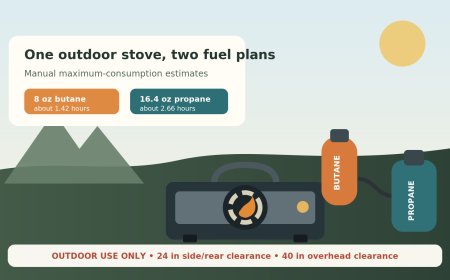
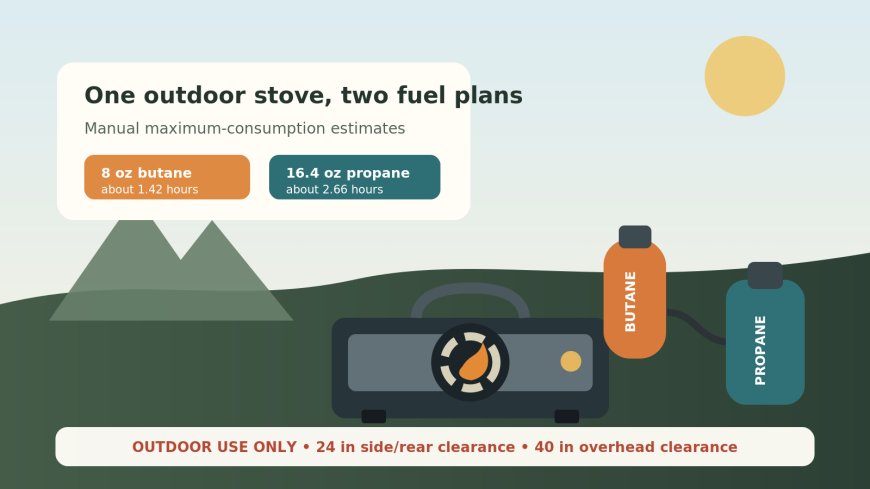
The same manual calls for a noncombustible surface and minimum clearances of 24 inches at the rear, 24 inches at each side and 40 inches overhead.[3] Those measurements rule out many tempting setups under a fabric awning, inside a screen room or on a narrow table pushed against the RV wall. Before buying, find an outdoor spot that fits the stove, pan and clearances without blocking the campsite walkway.
Cookware fit also matters. Gas One's safety guidance says an oversized pan must not extend over the butane-canister compartment.[3] This is a single small burner, not a substitute for a two-burner range or a broad griddle. A modest saucepan or skillet is its natural workload.
The fuel choice is useful, with a cold-weather catch
Butane is tidy because the canister locks into the stove body. Propane adds a hose and bottle beside the stove, but a 16.4-ounce cylinder carries more fuel. The manual lists maximum gas consumption at 160 grams per hour on butane and 175 grams per hour on propane.[3]
Those ratings translate into a simple upper-bound planning card:
- An 8-ounce butane canister contains about 227 grams, or roughly
227 ÷ 160 = 1.42 hoursat the manual's maximum consumption rate. - A 16.4-ounce propane cylinder contains about 465 grams, or roughly
465 ÷ 175 = 2.66 hoursat maximum consumption. - Real cooking time can be longer because simmering uses less than the maximum rate. Wind, temperature, cookware and repeated ignition also change results.
The usual advice that propane is the cold-weather choice needs a qualification for this exact stove. Independent reviewers note that butane loses performance in cold conditions and report using the propane attachment as the better cool-weather option.[4][5] The GS-3400P manual, however, says not to operate the stove below 32°F, without granting a propane exception.[3] For this product, the manual controls. Switching fuels does not turn it into a subfreezing stove.
Fuel storage has its own boundary. The manual says to remove the canister or cylinder after use, let the stove cool and store cylinders outdoors.[3] It also warns against keeping butane where temperatures can exceed 100°F.[3] That matters in an RV storage bay or tow vehicle that can heat up in direct sun. Follow the cylinder label and local fire rules rather than treating the carrying case as a fuel locker.
Expect small-meal speed, not a boiling powerhouse
The GS-3400P has enough output for ordinary campsite meals, but wind changes the experience.[4][5] CleverHiker reports an 8-minute, 29-second boil for one liter of water in a 64°F windless test and measured 0.6 ounce of propane consumed.[4] OutdoorGearLab reports a faster 5-minute, 15-second one-liter boil in its comparison data, while still scoring the stove poorly for boil speed and wind resistance.[5]
That disagreement is useful. It shows why a single boil number is a planning aid rather than a promise. Different starting-water temperatures, elevations, pots and test methods can move the result by minutes. Both tests point to the same buying conclusion: the stove handles small meals and simmering better than large-volume boiling in exposed weather.[4][5]
CleverHiker's measured 0.6 ounce of propane per one-liter boil implies about 26 theoretical one-liter boils from a full 16-ounce cylinder in the same controlled conditions (16 ÷ 0.6 = 26.7).[4] Do not pack exactly to that figure. A practical trip plan needs reserve fuel for wind, reheating, ignition attempts and meals that simmer after the water boils.
For two people, a more realistic question is whether one burner can carry the menu. Coffee followed by oatmeal is easy because the pot can be reused. Pasta plus a separate sauce means cooking in sequence. A large family breakfast will feel slow even if the burner itself performs as specified. The dual-fuel design helps with supply flexibility, but it does not add a second cooking zone.
The setup routine decides whether the convenience lasts
The butane side has a pressure-sensing ejection and gas shutoff system. Gas One describes those as safeguards for irregular canister pressure, not permission to ignore heat, fuel or cookware limits.[1][3] If the safety device trips, the manual says to turn the control off, move the lever to unlock and let the canister cool before resetting it.[3]
For propane, connect the regulator hose to the stove before attaching the cylinder. After cooking, turn the stove off, disconnect the cylinder first and then remove the hose from the stove.[3] Inspect the hose, seals and fittings before every setup. Stop if there is visible damage, a worn seal, a gas smell or a connection that will not seat correctly.
A windscreen deserves caution. Reviewers criticize the stove's wind performance, and one tester used the carrying case as a shield.[5] The manufacturer clearances and ventilation requirements still apply. Do not wrap a tight screen around the stove, trap heat beside the butane compartment or place the plastic case where it can heat, melt or fall toward the flame. Moving to a naturally sheltered table is safer than improvising an enclosure.
The piezo igniter is convenient, but carry a backup ignition method permitted by the manual and know how to shut the fuel off. Keep the stove attended until the flame is out and the fuel is disconnected. The safest RV role is an outdoor meal station used by an awake adult, not an interior emergency cooker or unattended simmering appliance.
Who should buy it
The GS-3400P is a good fit for one or two travelers who cook outside, value a compact case and want the option to buy either common butane cans or one-pound propane cylinders. It is particularly appealing as a backup to an RV range when the campsite has a safe outdoor cooking area.
Skip it if the only available cooking location is inside the RV, under a low awning or within the manual's clearance zone. Choose a larger two-burner stove if meals normally use multiple pans, and choose a higher-output design if large pots or quick group cooking are the main job. Cold-weather campers also need a model whose own instructions allow the expected temperature range.
The decision comes down to a clean trade: the GS-3400P gives up speed and wind resistance for low weight, simple controls and two fuel paths. Verify model GS-3400P and ASIN B01HQRD8EO, then measure the outdoor setup rather than the cabinet where the case will ride.
Sources
What's Your Reaction?