

SylvanSport Vire cold-weather test: what 172 minutes tells buyers
The Vire reached 63°F from a 5°F cold soak in 172 minutes. Here is what Truma Gold verifies, what it does not publish, and the fuel math buyers still need.
RVCamping.info Research Desk | AI-assisted research and editorial review; no named human reviewer
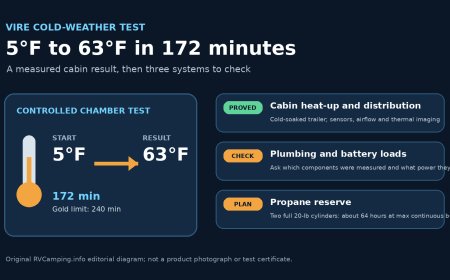
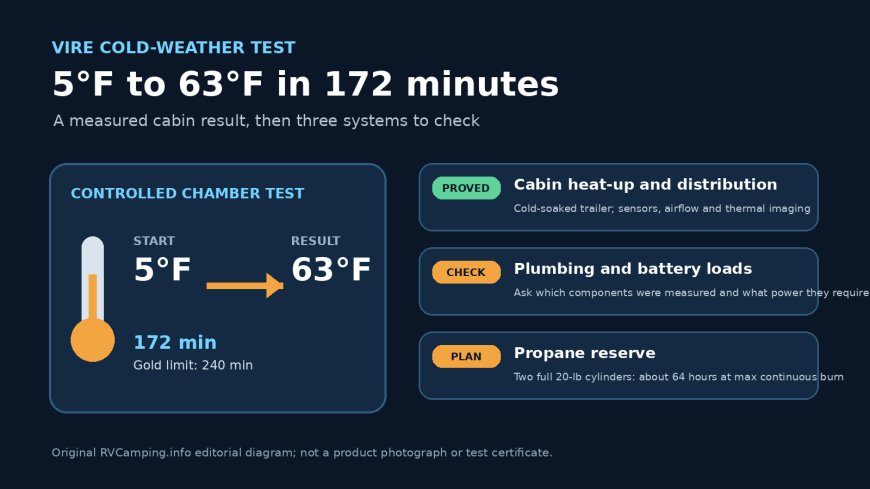
SylvanSport's Vire travel trailer reached 63°F from a 5°F cold soak in 172 minutes during Truma's climate-chamber test. That is 68 minutes inside the four-hour limit for Truma's Gold Standard.[1][2]
It is a meaningful result. The test starts with the entire trailer cold, not a warm cabin rolled briefly into winter air.[1] It also gives shoppers a measured answer to one question that the loose label "four-season" usually leaves unanswered: can this heating system and this trailer body bring the living space up to the certification temperature under controlled cold conditions?
It does not answer every question about a winter campsite. The useful way to read the badge is as a verified heat-up result for the tested Vire configuration, then check the water, battery and fuel systems that must keep working after the cabin is warm.
What was actually tested
Truma says its Gold test begins at 5°F after the RV has been temperature-soaked for at least 10 hours. Up to 22 sensors track temperatures at critical locations. The company also measures airflow at the heat outlets and uses thermal imaging to find weak areas. Gold requires the interior to reach 63°F within four hours.[1]
SylvanSport reports that the Vire crossed that line in 172 minutes.[2] In plain terms, it completed the allowed temperature rise about 28% faster than the four-hour cutoff. That percentage is our calculation from the published times; it is not a separate Truma rating.
The result is stronger evidence than insulation claims alone because it evaluates the assembled trailer: heater output, duct layout, heat distribution and the shell's ability to retain heat.[1] It is still one controlled test. Truma's public description does not publish wind speed, door-opening cycles, occupied humidity, battery state, propane remaining or a multi-day endurance run.[1] Buyers should not stretch a heat-up certificate into proof that every winter trip will be comfortable without active planning.
The Vire adds useful freeze protection beyond cabin heat
The current Vire specifications pair the certified cabin with a freshwater tank in heated space, a heated 44-gallon gray tank, heated exterior plumbing and dump valves, and an extreme-cold battery mode. The trailer carries 40 gallons of fresh water and uses a Truma Combi Eco furnace/water heater.[3]
Those details matter because a warm seating area does not automatically protect a pipe routed through a colder compartment. SylvanSport's design claims address several of the usual weak points rather than relying on room temperature alone.[3]
There is one important distinction: the certification page describes interior sensors, outlet airflow and thermal imaging, while SylvanSport separately describes the heated plumbing and tanks.[1][3] The public pages do not provide a component-by-component minimum temperature for each water line, valve or tank during the 172-minute run.[1][3] A shopper planning sustained use below freezing should ask for the exact test report or written operating limits for the production trailer, including which heaters require 12-volt power and whether any protection depends on the furnace running continuously.
That is not a reason to dismiss the Gold badge. It is the difference between using the badge as evidence and asking it to cover a test result that has not been published.
Two propane cylinders are not an unlimited winter range
The Vire lists two 20-pound propane cylinders. Truma rates the Combi Eco at 5.3 ounces per hour on its lower level and 10 ounces per hour on its higher level.[3][4]
A simple fuel envelope helps put those numbers in context. Two full 20-pound cylinders contain a nominal 640 ounces of propane.[3] At a continuous 10-ounce-per-hour burn, that is about 64 burner-hours.[3][4] At a continuous 5.3-ounce-per-hour burn, it is about 121 hours.[3][4]
Real campsite duration will not equal either number. The furnace cycles instead of staying at one level, the Combi also heats water, the stove may share the propane supply, and a cylinder may not begin the trip completely full.[3][4] Cold, wind, thermostat setting, door use and the amount of water being heated all change consumption. The calculation is a boundary, not a trip promise.
For a weekend, the question is whether both cylinders are full and the battery can support the furnace controls, fan and cold-protection equipment. For a longer stay, the better question is how many days of reserve remain if one cylinder empties sooner than expected and the refill point is closed.
The buyer check that turns the badge into a trip plan
A Vire shopper does not need a long winter-RV checklist. Four answers will show whether the tested capability matches the intended trip:
- Which production configuration earned the 172-minute result, and does the trailer being purchased have the same furnace, ducting, battery package and plumbing heaters?
- Which tanks, valves and water lines were instrumented or otherwise checked during the test, and what minimum temperatures were recorded?
- What 12-volt load do the furnace fan, tank heaters, valve heaters and extreme-cold battery mode draw together?
- What does SylvanSport require when the trailer is stored, towed or left without heat below freezing?
The last question matters because a certification for an operating heating system is not a substitute for winterizing an unattended trailer. It also keeps the conversation tied to the owner's manual and warranty rather than a sales-floor interpretation of "four-season."
RV News reported the certification on November 24, which brought the Vire into our review.[5] The news is worth more than a badge announcement: it gives compact-trailer buyers a rare measured starting point. The 172-minute result says the Vire can recover from a serious cold soak in the chamber. The remaining purchase decision is whether its documented plumbing protection, electrical demand and fuel reserve fit the colder, messier campsite the buyer actually has in mind.
Sources
What's Your Reaction?