








Towing an RV with an EV? Audit the charging stop before you commit
Audit an EV charging stop for an attached RV: connector, cable reach, trailer-capable stall, turning path, charge reserve and a usable backup.

Towing an RV with an EV? Audit the charging stop before you commit
By Romana
Category: RV Camping
A charger can be compatible with the tow vehicle and still be unusable with the trailer attached. The plug may fit, yet the only open stall requires a tight reverse turn. A curb may put the cable on the wrong side of the truck. The charging spaces may sit at the end of a grocery-store row with no legal place to wait or unhitch.
Treat every planned charge as two checks: an energy stop and a rig-movement stop. The first asks whether the charger works with the vehicle. The second asks whether the entire combination can enter, connect and leave without blocking traffic or inventing a maneuver on arrival.

Start with a one-line rig card
Write the combination's measured travel length, overall width and highest point on one line. Add the charge-port location, the native DC connector, any approved adapter, and the vehicle's charging limits. Keep the trailer height on the card even though a charger has no fuel canopy; parking structures, covered approaches, trees and signs can still control access.
Record two more facts that maps rarely know: which side needs room for the cable, and whether this trip can safely use a controlled unhitch. An unhitch is not a casual fallback. It needs permission to occupy the space, a level location away from traffic, the normal chocking and coupling procedure for the exact equipment, and enough time to reconnect and inspect. If any part is missing, mark the trip "stay connected only."
This card prevents a common planning error: confirming a connector while forgetting the 45 feet of trailer behind it.
Reject the wrong electrical stop first
Check the charging-network app or the tow vehicle's route planner for the exact site, not just the town. Confirm:
- the connector is native to the vehicle or works with the specific approved adapter carried in the truck;
- the station is public during the planned arrival window;
- DC fast charging is available when the route depends on a short travel-day stop;
- the listed port count leaves some resilience if one stall is occupied or unavailable; and
- payment and app access are ready before the combination enters a confined lot.
The federal Alternative Fuels Data Center station format separates hours, connector types, port counts and charging-unit power.[2]
It defines operating hours and connector types as separate station fields.[2]
Those are different fields because one does not prove another. A connector match, for example, does not prove that the site is open or that a usable port is live.
The Joint Office of Energy and Transportation recommends that federally covered charging data include connector type, power, station access hours and real-time port status.[1]
The same protocol treats trailer accessibility as a separate data point because a live, electrically compatible port may still be unusable by an attached rig.[1]
Use live information on travel day, but do not mistake it for a geometric survey of the lot.
Run the fit audit from entrance to exit
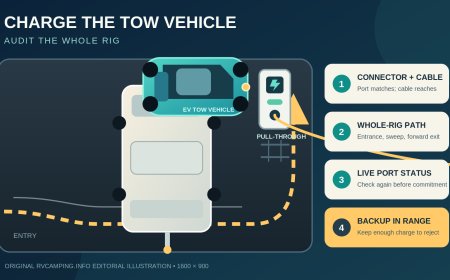
Open a recent satellite image and the network's site photo, when available. Trace one continuous path with the full combination. Start on the public road rather than at the charger icon.
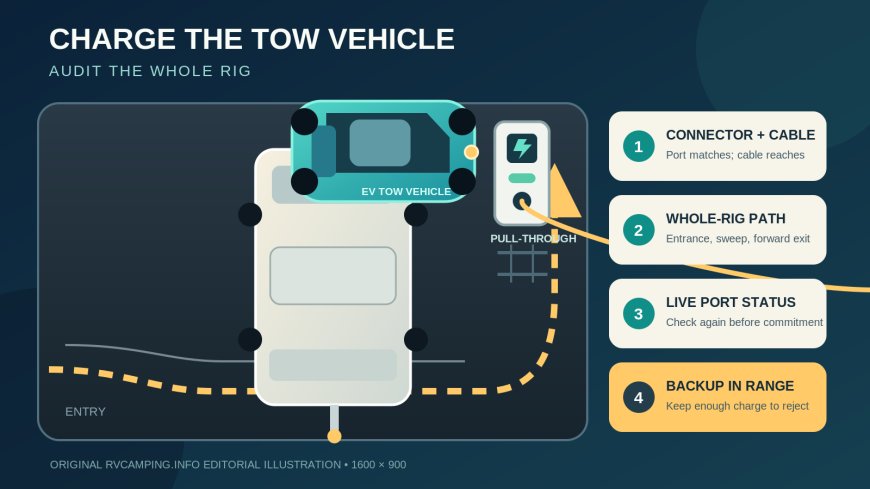
- Entrance: Is the driveway wide enough for the trailer to follow without crossing a curb, bollard or opposing queue? Check medians and right-turn-only approaches.
- Approach: Can the combination reach the charging row without entering a parking garage, drive-through lane or signed vehicle restriction?
- Stall: Does the tow vehicle's charge port land within cable reach while the trailer remains in a legal position?
- Sweep: Is there room for the trailer's inside path and tail swing? A blank patch on a map may contain carts, parked cars, snow piles or delivery activity.
- Departure: Can the rig leave forward? If departure depends on an empty neighboring stall, the stop does not have a dependable exit.
Do not measure clearance from a photo by comparing the RV with a painted line. Image scale, camera angle and old imagery can mislead. Use the image to find questions, then confirm the difficult ones with the charging operator or property host. Ask about trailer access, entrance restrictions, overhead limits, construction and the best arrival direction.
Give every candidate a fit grade
A short grade keeps a route planner from treating all charger pins as equal.
A: connected pull-through
The combination enters, charges and exits without reversing or blocking another port. This is the first choice. The Joint Office's charging-data protocol even defines trailer accessibility as whether a port can serve a vehicle with the trailer attached, such as at a pull-through stall.[1]
B: connected edge stall
The charger is on the edge of a lot and the trailer can remain in a marked, permitted area without crossing an aisle, sidewalk, accessible route or another charging stall. Confirm cable reach and departure before accepting this grade.
C: controlled unhitch
The property permits trailer parking, the driver has a safe place and normal equipment to unhitch, and the tow vehicle can charge without leaving the trailer exposed to traffic. This is a planned operation, not something to improvise beside occupied chargers.
D: reject
The route needs a blind back, depends on vacant neighboring spaces, blocks a port or traffic lane, has uncertain overhead clearance, or requires unapproved trailer storage. Move the route to another charger.
A network name alone does not settle the grade. Rivian says many of its Adventure Network sites can handle trailers, but explicitly warns that not every site can.[3] Grade the location and usable port, not the logo.
Build the energy plan around towing data
Plan the first charging leg from the tow vehicle's actual consumption with this loaded trailer. Do not substitute the solo EPA range or another owner's percentage loss. Wind, speed, temperature, grade, tire pressure, trailer profile and payload can all change the result.
Use the vehicle's trailer profile or towing-aware range estimate when it has one. After the first leg, compare planned arrival charge with the actual arrival figure and revise later legs. A fixed 10% or 20% reserve rule is not universal. Set a trip-specific floor that leaves enough energy to reach the chosen backup under the conditions you expect, then increase it when weather or terrain adds uncertainty.
The stop audit and the energy calculation meet at one decision: pass the primary early enough to reach the backup. A driver who arrives nearly empty has lost the ability to reject a blocked or unsafe lot.
Pair each primary with a real backup
A backup should be a second audited stop, not another pin in the same crowded shopping center. Record:
- route distance from the decision point, not from the failed charger;
- connector and adapter requirement;
- hours and current operating status;
- fit grade for the whole rig;
- the minimum departure charge needed to reach it; and
- a phone number or app channel for current help.
Prefer a backup on the same side of a divided highway when a long combination would otherwise need a difficult U-turn. If both sites share one electrical service area, access road or parking lot, they may share the same failure.
The best decision point is often miles before the planned stop. Check live port status while parked at the previous break, then compare the vehicle's predicted arrival charge with the backup threshold. Do not do this work while moving.
Use a two-minute arrival check
Pause where the combination is legal and out of traffic. Compare the real lot with the saved plan.
- Is the intended entrance open?
- Has construction, snow storage or a delivery truck changed the turn?
- Is the planned trailer-capable port available?
- Can the cable reach without crossing a traffic path or being pulled tight?
- Is the forward exit still open?
If the answer fails, leave while the rig still has a clean path. Do not stop across charging stalls to walk the site, send a passenger into moving traffic, stretch a cable beyond its intended reach, or uncouple in an active aisle.
The charging-stop fit checklist
Save this beside the route plan:
- [ ] measured combination length, width and height recorded;
- [ ] charge-port side and position recorded;
- [ ] connector or approved adapter confirmed;
- [ ] public access, hours, power and port status checked;
- [ ] entrance and approach traced for the whole combination;
- [ ] cable reaches at the planned trailer-capable stall;
- [ ] turning sweep and tail swing remain clear;
- [ ] forward exit does not depend on an empty adjacent space;
- [ ] unhitching excluded or planned in a permitted safe area;
- [ ] arrival-charge floor based on this loaded trip;
- [ ] backup stop independently audited; and
- [ ] live status and lot conditions checked before commitment.
The useful unit is not "a charger." It is a compatible port, in an accessible lot, with a movement path the attached RV can complete and enough remaining charge to say no.
Evidence note: federal charging-data sources support the checks for connectors, access, power, port status and trailer-access fields. Rivian supplies a current manufacturer example showing that trailer fit varies by charging location. RVCamping.info developed the rig card, A-through-D fit grade, entrance-to-exit trace, backup threshold and arrival checklist.
Sources
- Standardized Protocol for Real-Time APIs — Joint Office of Energy and Transportation — recommended charging-station fields for access, connector, status and trailer accessibility.
- Data Included in the Alternative Fuel Stations Download — Alternative Fuels Data Center — station fields for hours, connectors, port counts and power.
- Are Rivian Adventure Network sites able to handle vehicles pulling a trailer? — Rivian — manufacturer statement that trailer accommodation varies by site.
What's Your Reaction?