





Propane on board: build an RV tunnel restriction route card before departure
Build a facility-specific route card for RV propane tunnel restrictions, inspection stops and verified alternate routes before departure.

Propane on board: build an RV tunnel restriction route card before departure
By Romana
A tunnel restriction is a routing problem, not a reason to make a blanket rule for every RV trip. The useful question is not, "Are RVs with propane allowed in tunnels?" It is, "What does the authority responsible for this specific crossing require of this specific rig today?"
That distinction matters. Around Baltimore, an ordinary RV cylinder can push a vehicle into a prohibited category and send the driver around the tunnels. At Virginia's Hampton Roads tunnels, motor homes with propane tanks must stop for a check. Farther east, the Chesapeake Bay Bridge-Tunnel publishes its own quantity limits and inspection terms. These rules are route-specific. This article is a workflow, not a nationwide tunnel table.
The fix is a one-page route card prepared before departure. It records the crossing, the agency, what is aboard, the action at the approach and a verified fallback. Hand it to the driver or keep it with the day's paper directions. A navigation app can still handle traffic, but it should not get the last word on propane.
Three official pages, three different instructions
Baltimore: route around when the cylinder crosses the threshold
The Maryland Transportation Authority bars vehicles carrying bottled propane in approved U.S. DOT containers above 10 pounds from two crossings: Fort McHenry on I-95 and Baltimore Harbor on I-895. Its notice says the restriction applies whether the bottles are empty or full and to personal as well as business use. It directs those vehicles to the western section of I-695.[1]
For many RVers, that settles the route before the engine starts. Turning the service valve off does not change the cylinder's size, and an empty cylinder does not create an exception under the notice. Put the western I-695 routing into the trip plan and check current conditions before committing to the beltway.
This is also why a route card should describe the actual cylinder, not merely say "propane aboard." Write down the number of cylinders and the marked capacity of each. Do the same for a permanently mounted tank. If the official wording does not clearly cover that configuration, call the authority rather than interpreting the rule from memory.
Hampton Roads: plan for the inspection stop
The Virginia Department of Transportation gives motor-home drivers a different instruction for the tunnels it operates in Hampton Roads: before going through, a motor home must stop to have its propane tanks checked. The same page sends readers to VDOT's hazardous-materials information and lists 800-367-7623 as the contact number.[2]
That is not the same rule as Baltimore's prohibition. The route-card entry should say where the inspection is expected, which approach lane or station to use if the authority confirms one, and what the driver must do before reaching it. Do not write "propane okay" and leave it at that. The stop is part of the route.
VDOT's public wording on this page does not say that every possible RV propane configuration will pass. A fifth-wheel with removable cylinders, a motor home with an ASME tank and a propane-fueled vehicle are not interchangeable descriptions. Give the agency the configuration, quantities and vehicle dimensions when you call.
Chesapeake Bay Bridge-Tunnel: its own limits and inspection authority
The Chesapeake Bay Bridge-Tunnel is governed by a separate district and publishes more detailed compressed-gas limits. For a noncommercial vehicle, its page permits up to two removable containers; each may hold no more than 45 pounds of LP-Gas, corresponding to 105 pounds water capacity. As another option, the page permits one removable container rated for no more than 60 pounds of LP-Gas. It separately addresses permanently mounted containers used as motor fuel. The tanks must meet U.S. Department of Transportation standards and are subject to inspection.[3]
The district's tunnel rules also require flames used to heat vehicles or loads to be extinguished before the vehicle enters the bridge-tunnel or its approaches. Its employees may inspect cargo or shipping papers to determine compliance.[3]
Those details belong on a CBBT-specific card, not in a homemade rule for all Virginia tunnels. The facility's general hazardous-material table and its noncommercial compressed-gas section use different units and cover different contexts. If the cylinder label, tank type or use does not map cleanly to the posted noncommercial language, call the district and record the answer. Do not convert cylinder ratings on the shoulder.
Make one card for each tunnel or bridge-tunnel
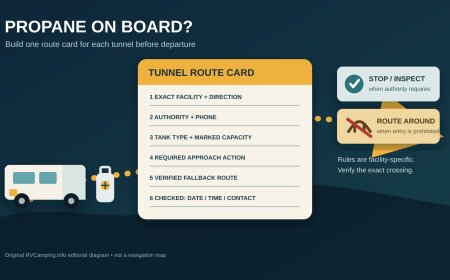
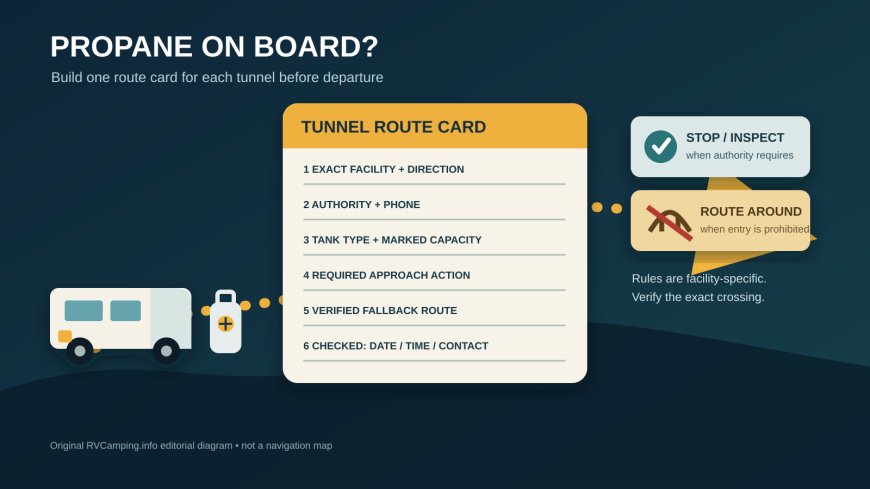
Use one card per facility. If the outbound and return routes use different crossings, make two cards. A useful card has seven fields:
- Exact facility and direction. Record the tunnel name, highway number and travel direction. "Baltimore tunnel" is not precise enough.
- Operating authority. Write the agency name, official page URL and a phone number taken from that agency's current site.
- RV description. Note motor home, travel trailer, fifth-wheel, truck camper or towable, plus total height, width and length. A propane answer does not clear the rig's dimensions.
- Propane inventory. List every removable cylinder and permanent tank separately. Copy the capacity from the plate or collar; note whether the container is connected, disconnected, full, partly full or empty.
- Required approach action. Examples include "use alternate route," "stop for inspection" or "confirm procedure with authority." Only write "valve off" when the authority for that facility tells you it is required; do not substitute shutoff for a prohibition.
- Fallback route. Record a route that avoids the restricted facility and verify that route for height, weight, width, tolls and current closures.
- Verification line. Add the date and time checked, page revision date if shown, phone number called, and the name or unit of the person who confirmed an ambiguous case.
A card is a briefing sheet, not a permit and not a substitute for signs or an officer's direction. If roadside signs conflict with the card, follow the signs and instructions at the facility.
A call sheet that gets a usable answer
Call when the posted rule does not squarely address the rig, when the route page appears old, when construction changes the normal approach or when the fallback has its own tunnel. Keep the conversation short and factual.
Read this information to the operator:
- "I am driving a [motor home / pickup towing a travel trailer] on [highway and direction]."
- "The vehicle is [height], [width], [overall length] and [weight, if relevant]."
- "I carry [number] removable propane cylinders marked [capacity] each, plus [description of permanent tank, if any]."
- "The containers are [connected/disconnected] and [full/partly full/empty]."
- "Is this configuration allowed at [exact facility] today?"
- "Must I shut every valve, extinguish appliances or pilot lights, stop at an inspection point, display anything or use a particular lane?"
- "If it is not allowed, which official alternate avoids the restricted facility?"
- "Are there current closures, construction restrictions or dimension limits that change that answer?"
Then read the answer back: "My card will say [action]. Is that correct?" Record the time, number called and the office or staff name offered. If the operator cannot answer, ask for the facility's police, operations or hazardous-materials unit. Do not ask a campground desk or a general travel forum to make the final call.
The departure-day sequence
Start with the planned line on the map and scan it for named tunnels, bridge-tunnels and signed hazardous-material routes. Open the operator's page for each facility. Search within the page for "propane," "LPG," "compressed gas," "hazardous materials," "RV" and "motor home."
Next, compare the published terms with the labels on the rig. Capacity language is easy to garble, especially when one page uses LP-Gas weight and another mentions water capacity. Copy what the label says; do not guess at a conversion. Photograph the labels so the person calling has the same information as the person driving.
Build the fallback before departure. A detour can introduce a lower bridge, a weight restriction, another tunnel or a road unsuitable for the combined length. Run the alternate through the same height-and-restriction check as the preferred route. Download or print both routes in case reception disappears near the decision point.
On departure day, close appliance flames and pilot lights whenever the facility requires it, complete any required tank or valve steps, and put the inspection stop into the driver's briefing. Recheck the authority's traffic or incident page. The passenger should handle calls and page checks while the vehicle is moving.
A filled example, with the right amount of caution
A Baltimore card for a motor home carrying a cylinder larger than the posted 10-pound threshold would name the Fort McHenry Tunnel, mark it "do not enter under MDTA propane notice," and route via the western section of I-695.[1] It would not say "turn propane off and proceed." The shutoff does not erase the prohibition described by MDTA.
A Hampton Roads card would identify the exact VDOT tunnel and say "stop for propane-tank check," with VDOT's contact number and the confirmed approach instructions.[2] A CBBT card would instead list each container's marked capacity, the applicable noncommercial limit, the inspection possibility and the rule to extinguish heating flames before the approaches.[3]
That is the point of the card: the action changes with the facility. Verify the crossing, describe the rig and write down the instruction that applies there. A four-minute call made at the kitchen table is much easier than sorting out propane beside a tunnel entrance.
Sources
- Maryland Transportation Authority, "Reminder: I-95 & I-895 Tunnel Restrictions" — official prohibition, empty/full treatment and western I-695 direction; retrieved October 19, 2026.
- Virginia Department of Transportation, "Hampton Roads bridges and tunnels" — official motor-home propane inspection instruction and VDOT contact; retrieved October 19, 2026.
- Chesapeake Bay Bridge-Tunnel District, "Hazmat and Compressed Gas Regulations" — official noncommercial compressed-gas limits, inspection authority and flame-extinguishing rule; retrieved October 19, 2026.
What's Your Reaction?